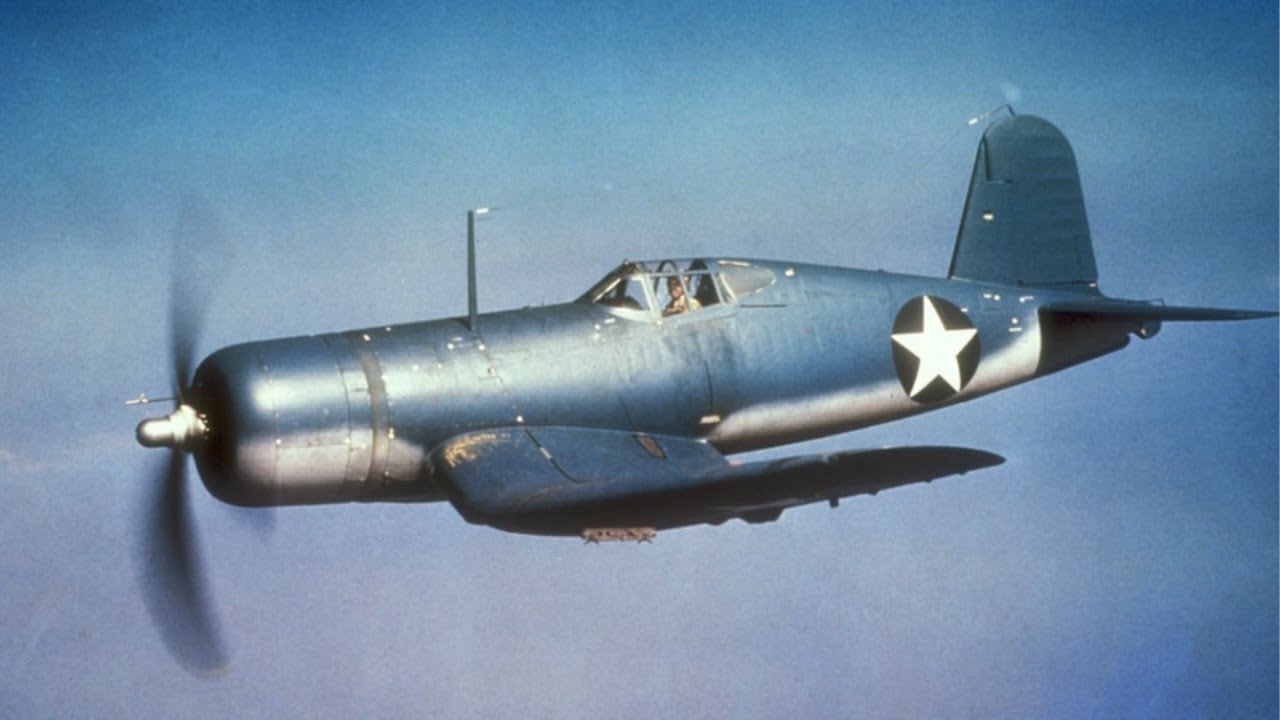
February 14th, 1943, 18,000 ft above Bugenville, Solomon Islands, Japanese naval aviation faced its first encounter with a fighter that would systematically dismantle their air superiority in the Pacific. The dark blue American fighter, its distinctive inverted gull wings unmistakable even at distance, executed a vertical climb that defied everything Japanese pilots understood about aerial combat.
It rose past 20,000 ft, then 22,000, still climbing with power to spare, while the Mitsubishi Zero, pride of the Imperial Japanese Navy, struggled at its operational ceiling. This was the VA F4U Corsair, soon to be known as whistling death for the distinctive sound its wingroot oil coolers made in a dive. Within 18 months, this single aircraft type would psychologically shatter the Imperial Japanese Naval Air Services Elite Pilot Corps through crushing demonstrations of technical superiority that demolished every tactical doctrine
Japanese pilots had perfected since 1937. What occurred that Valentine’s Day was not just another fighter engagement. It marked the beginning of systematic technological dominance that would transform Japan’s most experienced pilots from hunters to hunted, from confident warriors to men who would deliberately avoid combat when they spotted those distinctive inverted gull wings.
To understand the psychological devastation the Corsair inflicted, one must first comprehend the supreme confidence of Japanese naval aviators in early 1943. These were survivors of the most selective aviation training program in the world. The Yokaran Naval Aviator Preparatory Course accepted fewer than 2% of applicants.
Those selected endured 3 years of training that killed more candidates than the Americans lost in some battles. By 1943, the average Japanese carrier pilot had over 800 hours of flight time. Many veterans of the China campaign had over 2,000 hours. They had revolutionized naval warfare at Pearl Harbor, stunned the British at Salon, and dominated the skies from Burma to the Gilberts.
In 1942, the Mitsubishi A6M0 achieved a 12:1 kill ratio against Allied fighters. Japanese pilots had developed energy tactics that maximize their aircraft’s strengths, unmatched maneuverability, exceptional range, and excellent visibility. The Zero could turn inside any Allied fighter, could fly further than any opponent, and in experienced hands seemed unbeatable.
The Japanese Navy’s fighter doctrine, refined through six years of combat in China, emphasized individual skill and aggressive tactics. Their pilots were taught that spiritual superiority, the warrior’s bushido spirit, would overcome material disadvantages. This philosophy had proven correct against Chinese pilots, against British hurricanes, against American P40s and F4F Wildcats.
Each victory reinforced their belief that skill and spirit trumped technology and armor. The Corsair’s arrival in the Solomon Islands initially seemed like just another American attempt to match the Zero through brute force. Marine Fighting Squadron 124, VMF-124, brought the first 12 F4U1 Corsair to Guadal Canal on February 12th, 1943.
Japanese reconnaissance immediately noted the new aircraft’s distinctive appearance. the inverted gull wings, the massive four-bladed propeller, the long nose that extended far forward of the cockpit. The first combat encounter came on February 14th, Valentine’s Day, when Corsair’s escorted PB4Y1 Liberators on a strike against Cahili airfield on Bugenville.
The engagement, later called the St. Valentine’s Day Massacre, proved disastrous for the Americans initially. Nine allied aircraft lost versus one zero destroyed. However, the engagement revealed something crucial to Japanese pilots. These new fighters possessed performance characteristics that fundamentally changed air combat dynamics.
The Corsaires didn’t engage in traditional turning fights. Instead, they climbed above the zeros, something no American fighter had previously managed, and executed high-speed diving attacks. They used their massive speed advantage to escape before Japanese pilots could respond, then zoom climbed back to altitude, completely immune to pursuit.
The technical specifications that Japanese intelligence gradually assembled on the F4U1, Corsair revealed an overwhelming disparity in capability. The Pratt and Whitney R280 double Wasp engine produced 2,000 horsepower on takeoff with water injection boosting it to 2,250 horsepower in combat. The Zer’s Nakajima Sakaya A21 engine managed 1,130 horsepower at takeoff.
This wasn’t just a power advantage. It represented a different category of aircraft entirely. Maximum speed revealed the disparity starkly. The Corsair could reach 417 mph at 19,900 ft. The Zero Model 52, Japan’s latest variant in 1943, managed 351 mph at best. In a dive, the difference became terrifying.
Corsair’s routinely exceeded 500 mph while maintaining control. Zeros experienced control surface flutter at 360 mph and structural failure above 410.The climbing data was equally sobering. The Corsair could reach 20,000 ft in 7.7 minutes with a climb rate of 2,890 ft per minute standard or 3,210 ft per minute with war emergency power.
The Zero required 11 minutes to reach the same altitude. Above 25,000 ft, where the Corsair remained powerful and responsive, the Zero became sluggish, barely controllable. The American Fighter Service ceiling of 36,900 ft might as well have been outer space to Japanese pilots whose aircraft struggled above 33,000 ft.
The armament difference proved psychologically devastating. The Corsair carried six Browning M250 caliber machine guns, each firing 850 rounds per minute with a muzzle velocity of 2,840 ft pers. The total weight of fire was 69 lb of metal per second. The Zer’s two 7.7 mm machine guns and two 20 mm cannons delivered 13 lb per second and the cannons carried only 60 rounds per gun, enough for 7 seconds of firing.
Japanese pilots discovered that Corsair’s were nearly indestructible compared to their unarmored zeros. The F4U carried 155 lbs of armor plate around the cockpit, self-sealing fuel tanks and armored oil coolers. cannon shells that would destroy a zero merely damaged corsairs which often returned to base with hundreds of holes.
This survivability transformed combat dynamics. American pilots could be aggressive, even reckless, knowing their aircraft forgave errors. Japanese pilots had one chance. One mistake meant death. Their aircraft built for maximum performance through minimum weight offered no protection. The Zero achieved its legendary maneuverability by being the lightest possible fighter.
No armor, no self-sealing tanks, structure cut to the minimum. But the Corsair proved that American industrial capability had overcome the weight penalty. They built engines powerful enough to carry armor and still outperform unprotected fighters. They created fighters that could survive mistakes, equipment failures, and lucky shots.
luxuries Japanese pilots would never have. Rabol, Japan’s fortress in the Southwest Pacific, became the stage for the Corsair’s systematic demolition of Japanese naval aviation. Here, at Japan’s most powerful base outside the home islands, the cream of Japanese fighter units concentrated to stop the American advance.
By October 1943, when Major Gregory Papy Boington’s VMF214 Black Sheep Squadron arrived with their F4 U1A Corsaires, the psychological balance had already shifted. Japanese pilots no longer spoke of victory, but of survival. On December 17th, 1943, Boyington led 31 Corsaires as cover for a bombing raid on Rabal.
The Japanese launched 40 zeros to intercept their best pilots in their newest aircraft. The Corsair climbed to 25,000 ft, altitude where zeros struggled to maneuver. When the Japanese climbed to engage, the Americans dove through their formation at speeds approaching 450 mph, fired quick bursts, and Zoom climbed back to altitude.
The Zeros, unable to follow, unable to escape, unable to force close combat, lost 11 aircraft for two Corsaires damaged. The psychological terror the Corsair inflicted went beyond performance statistics. The aircraft’s distinctive sound became a weapon itself. The oil cooler intakes in the wing routts created an unforgettable whistling shriek during high-speed dives.
Japanese pilots reported hearing this sound in their sleep, developing involuntary reactions when any similar noise occurred. The Corsair’s appearance amplified this terror. The inverted gull wings created a predatory silhouette unlike any other aircraft. The massive propeller, 13’4 in in diameter, the largest ever fitted to a fighter, created a brutal, purposeful appearance.
The dark blue paint scheme made it nearly invisible against the sea when diving from above. American pilots deliberately enhanced this psychological warfare. They would make terror dives without firing just to create the whistling sound over Japanese airfields. Boyington’s black sheep squadron painted shark mouths on their corsairs, enhancing the predatory image.
By mid 1943, Japan faced a terrible equation. The Corsair and other advanced American fighters were killing experienced pilots faster than Japan could train replacements. Pre-war, Japanese naval aviators received 500 to 700 hours of flight training before combat assignment. By 1943, fuel shortages and training aircraft losses had reduced this to 150 hours.
By 1945, new pilots arrived with as little as 40 to 60 hours. Barely able to handle their aircraft, let alone fight corsairs. The psychological impact on veteran pilots was devastating. They were paired with noviceses who had no chance against corsairs, forced to watch them die while trying to protect them. The traditional mentor system collapsed under the weight of constant losses.
Veterans who faced Corsair’s in 1943 predicted with horrible accuracy what would happen when American carrier aviation fully deployed the new generation of fighters. At the Battle of the Philippine Sea inJune 1944, F6F Hellcats sharing the Corsair’s engine and similar performance demonstrated this prediction’s accuracy in what Americans called the Great Mariana’s Turkey Shoot.
Approximately 400 to 450 Japanese aircraft were destroyed versus 130 American planes lost. Many Japanese pilots never even saw their killers shot down by fighters they couldn’t climb to engage or escape from in dives. The personal experiences of pilots who faced corsairs reveal the depth of psychological transformation from confidence to terror.
VMF124’s first left tenant, Kenneth Walsh, who became the first Corsair ace on May 13th, 1943, described typical engagements where Japanese pilots seemed helpless against the Corsair’s performance advantages. Walsh achieved 21 victories in Corsair’s over 6 months, later stating that the Corsair made aerial combat unfair due to its overwhelming advantages in speed, climb, dive, armor, and firepower.
He noted that fighting zeros became mechanical. Climb above them, dive through their formation at speeds they couldn’t match, fire a burst, zoom, climb to safety, repeat. Lieutenant Robert Hansen’s extraordinary record, 20 Japanese aircraft destroyed in just 17 days between January 14th and 30th, 1944, demonstrated the Corsair’s dominance.
Flying with VMF215, Hansen exploited the Corsair’s advantages so effectively that Japanese formations would scatter upon identifying Corsair’s approaching. As 1943 progressed into 1944, improved variants of the Corsair widened the performance gap further. The F4U1A introduced a bubble canopy for better visibility, water injection for combat power increases, and improved armor.
The F4U1D could carry 4,000 lb of bombs, more than many Japanese bombers, while still outperforming any Japanese fighter. Japanese attempts to counter the Corsair revealed their technological desperation. The Zero Model 52 added armor and self-sealing tanks, but became so heavy it lost the maneuverability advantage without gaining survivability.
The new Kawanishi N1K George fighter showed promise but suffered from unreliable engines and complex hydraulics that failed constantly. The deployment of F4U2 Knight fighter variants in 1944 added a new dimension of terror. Equipped with APS4 airborne radar, these 36 specially modified Corsair hunted Japanese aircraft in darkness, previously Japan’s only sanctuary.
The psychological impact of being hunted in darkness by an invisible predator shattered the last vestigages of Japanese pilot confidence. The ultimate psychological defeat came with the adoption of kamicazi tactics in late 1944. This transformation from warriors seeking victory to pilots seeking only meaningful death represented complete acknowledgement of technological defeat.
Vice Admiral Takajiro Onishi, father of the kamicazi program, privately admitted the true reason for suicide attacks. Conventional combat against Corsair’s and Hellcats had become impossible. By late 1944, the exchange ratio had reached 15:1 in favor of American fighters. Rather than die meaninglessly in hopeless combat, Japanese pilots would attempt to die with purpose against ships.
American pilots flying Corsair’s accumulated victories at rates that would have seemed impossible in 1942. Major Gregory Papy Boington scored 22 of his 26 victories in Corsair’s in just 84 days. These scores weren’t achieved through superior skill alone, but through overwhelming technical advantage. The Japanese recognized this reality.
Their best pilots understood that American aces were created by their aircraft, not just their skill. The machine had become more important than the man, a complete reversal of Japanese fighter doctrine. The Corsair represented American industrial might in its most concentrated form. VA aircraft produced 12,571 Corsaires during the war, more than Japan’s total fighter production from 1942 to 1945.
Each Corsair contained 13,000 lb of aluminum, 1,000 lb of steel, 18 mi of electrical wire, and 2,000 individual instruments and controls. The Pratt and Whitney R28000 engine alone told the story of American industrial supremacy. with 2,800 cubic in of displacement, 18 cylinders in two rows, supercharging, and precision engineering tolerances Japan couldn’t achieve, it represented technology beyond Japanese capability to copy even if captured.
While Japan scraped the bottom of its manpower barrel, sending teenagers with minimal training to face Corsaires, America mass-roduced pilots with industrial efficiency. The US Navy trained 60,000 pilots during the war, each receiving 600 hours of flight training, including 200 hours in advanced fighters. American pilots arrived in the Pacific having fired more ammunition in training than most Japanese pilots fired in combat.
They studied gun camera footage, analyzed combat reports, and underwent continuous tactical evolution. Japanese pilot training, meanwhile, collapsed into futility. New pilots arrived with less than 100 hours total flight time. Having neverfired their guns in training, never practiced high altitude combat, never experienced high-speed dives.
The Corsair’s transformation into a fighter bomber in 1944 added another dimension of terror. Carrying bombs, rockets, and napalm, corsairs could destroy airfields, shipping, and infrastructure with impunity. This multi-roll capability meant corsaires could appear anywhere, anytime, in any role, adding strategic uncertainty to tactical terror.
Saburro Sakai, Japan’s most famous surviving ace with 64 victories, provided clear assessment of facing Corsaires in his postwar writings. He described recognizing that the war was lost upon encountering the Corsair, not because of one aircraft, but because America could build such aircraft by thousands, while Japan struggled to maintain existing designs.
Sakai noted that survival against Corsaires required avoiding engagement entirely. When Japanese pilots saw the bent wings, they would dive for the deck, flee to clouds, anything to avoid combat. This wasn’t cowardice, but recognition of reality. Fighting a Corsair in a zero had become suicide. By early 1945, the numbers told a story of complete annihilation.
Corsair’s claimed 2,140 aerial victories against 189 losses in air combat, an 11.3 to1 ratio. But these statistics understated the psychological devastation. Many Japanese aircraft fled without engaging. Others were destroyed on the ground by marauding Corsaires. Countless pilots refused to take off when Corsair were reported.
The final insult came from production statistics. In 1945 alone, America produced 7,829 fighters of all types. Japan managed 1,14, most inferior to designs from 1942. The Corsair production line alone outproduced Japan’s entire aviation industry. The Corsair’s dominance shattered fundamental aspects of Japanese military culture.
The concept of Yamato Damashi, the unique Japanese spirit that would overcome material disadvantages, proved hollow against overwhelming technological superiority. The traditional emphasis on individual warrior skill became meaningless when skill couldn’t overcome performance disparities. The most experienced Japanese ace in the most perfectly maintained zero had no chance against an average American pilot in a Corsair.
This reality destroyed the philosophical foundation of Japanese military training. The battle of Okinawa in April to June 1945 provided the Corsair’s final demonstration of superiority. Marine and Navy Corsaires flew from escort carriers and captured airfields, establishing complete air supremacy over the last major Japanese base outside the home islands.
The statistics from Okinawa reveal the scale of dominance. Corsaires flew over 15,000 combat sorties, claimed over 500 aerial victories, and delivered thousands of tons of ordinance. Japanese pilots, many with less than 30 hours of flight training, faced systematic destruction. The few survivors described engagements lasting seconds, never even pointing their guns at the Corsaires that destroyed them.
As Japan prepared for invasion of the home islands, the reality of facing thousands of Corsair created strategic paralysis. Japanese planners calculated that the Americans could deploy over 5,000 Corsaires from carriers and captured airfields. Against this, Japan could muster perhaps 2,000 flyable aircraft of all types, most obsolete, flown by pilots with minimal training.
Admiral Sumu Toyota, commander-in-chief of the combined fleet, later acknowledged that conventional air combat had become impossible. The only remaining strategy was to hide aircraft for suicide attacks. The Corsair had made traditional fighter combat obsolete for Japanese aviation. When atomic bombs ended the war in August 1945, they spared Japanese aviation from final annihilation.
Plans existed for Operation Olympic, the invasion of Kyushu, where over 2,000 Corsaires would have operated from 48 carriers and dozen captured airfields. Japanese pilots who survived expressed relief at avoiding this final confrontation. It would have been extermination, not combat. In the immediate postwar period, American occupation forces brought Japanese military leaders to see American aircraft factories.
The VA plant in Connecticut, still producing Corsair’s revealed the true scale of American industrial capacity. Single factories produced more aircraft engines than all of Japan. Individual American states had more aluminum production than the entire Japanese Empire. Former Japanese naval officers observing these production lines finally understood the impossibility of their wartime position.
They had challenged an industrial superpower with pre-industrial capacity, sending pilots trained for individual combat against mass-produced machines of overwhelming superiority. The final statistics of Corsair operations in the Pacific War tell a story of complete domination. Combat statistics. Total Corsair’s produced 12,571. Total aerial victories 2,140.
Air-to-air losses 189.Kill ratio 11.3 to1. Missions flown over 64,000. Bombs dropped 15,621 tons. Performance supremacy speed advantage over zero 66 mph. Climb rate advantage 1,000 plus feet per minute. Diving speed advantage 140 plus mph. Altitude ceiling advantage 3,900 ft. Firepower advantage 530% more weight of fire.
Production comparison Corsair’s produced monthly peak 418. Japanese fighters monthly all types 250. American pilot training hours 600. Japanese pilot training hours 1945 40 to 60. Japanese aviation engineers studied captured corsair intensively after the war using them as templates for understanding how far behind Japanese technology had fallen.
Every system hydraulics electronics metallurgy production techniques showed advancement Japan had not imagined possible. The Corsair’s influence appeared in every postwar Japanese aircraft design. The lessons learned from studying the plane that had terrorized their predecessors shaped Japan’s aerospace development for decades.
American Corsair pilots expressed complex emotions about their overwhelming superiority. Many felt combat became execution rather than warfare, particularly in 1945 when facing teenage Japanese pilots in obsolete aircraft. The Corsair turned air combat into an industrial process. American pilots weren’t knights jousting in the sky.
They were technicians operating superior machinery. The Japanese remained committed to their warrior tradition to the end, but faced the reality of swords against machine guns. The Corsair’s dominance contributed to fundamental changes in Japanese society postwar. The complete failure of spiritual strength against American technology helped discredit militaristic ideology and prompted embrace of technological modernization.
The F4U Corsair proved daily personally to thousands of Japanese that their entire world view was wrong. Spirit could not overcome technology. Will could not defeat industry. Courage meant nothing against overwhelming mechanical superiority. The story of Japanese pilots facing the F4U Corsair is ultimately one of technological determinism written in blood and fire.
It demonstrates that in industrial warfare, production lines defeat warrior codes. Engineering triumphs over courage. The Corsair didn’t just shoot down Japanese aircraft. It demolished an entire military philosophy. Every Japanese pilot who faced the Corsair and lived carried the same message. We cannot match this. We cannot stop this.
The accumulation of these individual defeats created collective understanding that transcended military failure to become civilizational revelation. The German PWS had arrived in America expecting to find weakness and discovered overwhelming industrial might. Similarly, Japanese pilots had entered the war confident in their superiority and training only to discover they faced not just a superior aircraft, but the concentrated expression of a superior civilization’s industrial power.
The F4U Corsair stands as monument to the principle that in modern warfare, technological superiority multiplied by industrial capacity equals victory. For Japanese naval aviation, the Corsair was judged, jury, and executioner. It judged their technology inadequate, their tactics obsolete, and their philosophy wrong.
The psychological journey from supremacy to terror, from confidence to desperation, from tactical innovation to kamicazi attacks was measured in Corsair encounters. Each meeting with the bent-wing fighter stripped away illusions until only naked truth remained. Japan had challenged an industrial superpower with warrior spirit and lost absolutely.
Today, restored corsairs fly at air shows worldwide, their distinctive whistle still evoking memories among those who remember the sound as death’s calling card. But for those who faced them in combat, the Corsair remains something more. a teacher of harsh truths, destroyer of illusions, and proof that in modern war, the nation with the best factories defeats the nation with the bravest warriors.
The Japanese pilots were terrified of the F4U Corsair, not because they were cowards, but because they were rational men who understood they faced not just a superior aircraft, but overwhelming civilizational advantage. Their terror was wisdom, the terrible wisdom that comes from recognizing everything you believed was wrong, and that your death would serve only to prove your enemy’s superiority.
In the end, the Corsair did what no amount of propaganda could achieve. It made Japanese pilots afraid to fly. And in that fear lay the seed of Japan’s transformation from militaristic empire to peaceful economic power. A transformation purchased with the blood of pilots who learned too late that in modern war, courage alone means nothing when your enemy owns the sky.
