February 14th, 1943. Solomon Islands. The pencil trembled slightly as a Japanese naval aviator recorded in his flight log words that would have earned him severe punishment if discovered by his superiors at Rabbal. The new American fighter is not what we were told. It is not inferior. It is something beyond our understanding.
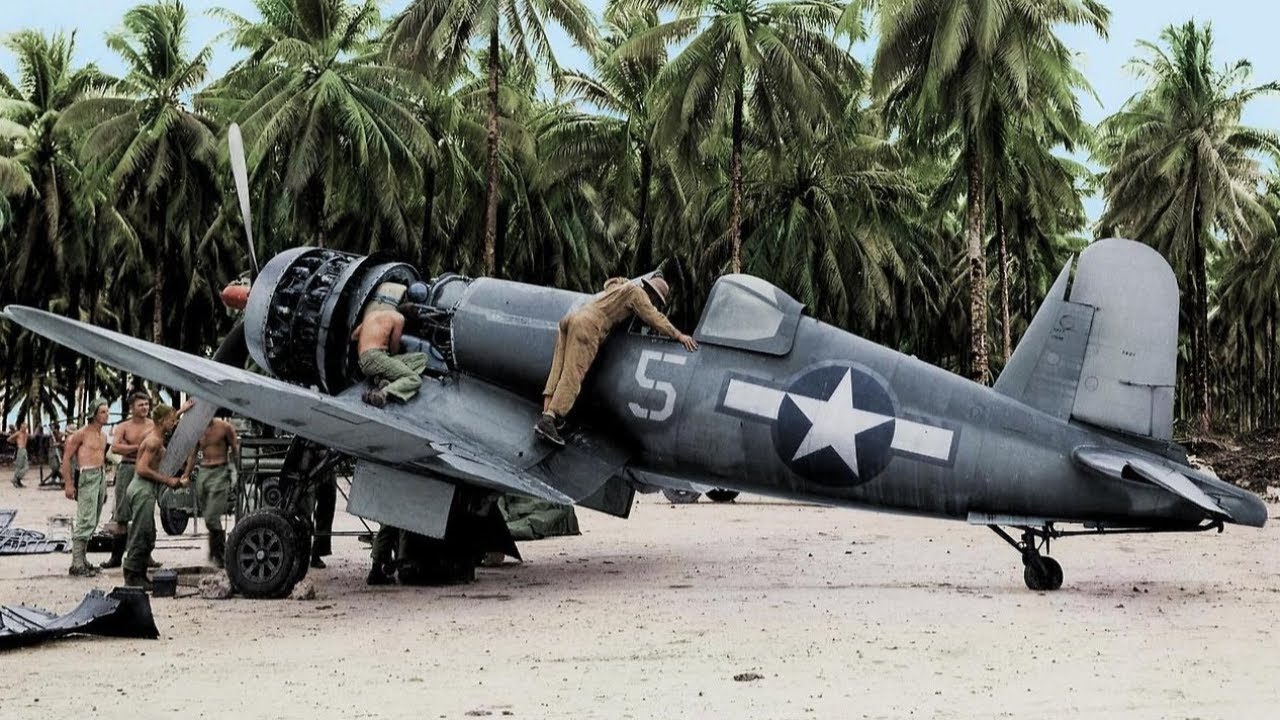
Through the smoke of battle over Guadal Canal, Japanese pilots had just encountered the F4U Corsair in combat for the first time. In what Americans would call the St. Valentine’s Day massacre, 12 Corsaires from VMF-124 engaged Japanese forces with mixed results. Two Corsaires were lost along with several other Allied aircraft, while Japanese losses were also significant.
Despite the tactical setback for the allies, the engagement marked the introduction of an aircraft that would fundamentally alter the Pacific Air War. The F4U Corsair had arrived in the Pacific, and with it came the systematic destruction of Japanese naval aviation’s most fundamental beliefs about aerial warfare, technical superiority, and the invincibility of the Mitsubishi 6M0 fighter.
What the Japanese pilots didn’t know was that they had just witnessed the opening act of a transformation that would see Japan’s elite naval aviators, men who had conquered the Pacific skies from Pearl Harbor to Singapore, reduced to desperate one-way missions in obsolete aircraft. The mathematics of aerial combat were being rewritten not in pilot skill or warrior spirit, but in horsepower, armor thickness, and production numbers that would soon reveal the fatal miscalculation at the heart of Japan’s war strategy. To understand the
psychological demolition that the Corsair would inflict on Japanese naval aviation, one must first comprehend the supreme confidence that existed in early 1943. For two years, the Imperial Japanese Navy’s zero fighters had ruled Pacific skies with near impunity. The statistics were intoxicating. At Pearl Harbor, nine zeros had been lost while destroying 188 American aircraft.
Over the Philippines, zero pilots claimed 550 Allied aircraft destroyed in the first week for the loss of fewer than 40 zeros. During the Indian Ocean raid, Commander Mitsuo Fuchida recorded that Zeros shot down 45 British aircraft while losing just four of their own. The kill ratios spoke of divine superiority, often 10 to1 or better in Japan’s favor.
Warrant Officer Hiroyoshi Nishawa, who would become Japan’s leading ace with 87 confirmed victories, wrote to his younger brother in February 1943. The Zero is the perfect weapon, harmonizing with the pilot’s spirit like a samurai’s sword. The Americans build flying trucks, heavy, clumsy, without soul.
They cannot match our unity of man and machine. This wasn’t mere propaganda. The Zero’s performance statistics in 1941 to 1942 genuinely surpassed anything the Allies could field. With a range of 1,929 mi, it could escort bombers distances that seemed impossible to American planners. Its turn radius of 612 ft at 200 mph was nearly half that of the F4F Wildcat.
It could climb to 15,000 ft in 5 minutes and 30 seconds, a full minute faster than its American opponents. Lieutenant Koname Harada, a Pearl Harbor veteran with 19 victories who would survive the war, recalled in a 1976 interview. We felt invincible in our zeros. The aircraft responded to thought, not just control input. We could dance in the air while the Americans lumbered.
Their pilots were brave but flew cattle compared to our thorbreds. Yet by late 1942, cracks in this superiority were appearing, though Japanese naval command refused to acknowledge them. The Battle of Midway had cost not just four carriers, but 110 of Japan’s most experienced naval aviators. These men, many with over 1,000 hours of flight time and combat experience in China, could not be replaced.
More disturbing were the technical reports filtering back from the front. Commander Minoru Gender, the tactical planner of Pearl Harbor, who would later help establish Japan’s postwar air self-defense force, noted in a classified report that American fighters were becoming increasingly difficult to shoot down. The new F6F Hellcat, encountered in small numbers, seemed to absorb tremendous punishment.
Pilots reported hitting American aircraft with dozens of 7.7 mm rounds without effect. The Guadal Canal campaign had demonstrated another troubling reality. American numerical superiority was growing. where once Japanese pilots might face equal or inferior numbers, by early 1943 they routinely encountered American formations of 20, 30, even 50 aircraft.
The mathematics of Bushido could not overcome the arithmetic of industrial production. The first confirmed encounter between zeros and F4U Corsair occurred on February 14th, 1943. 12 F4U1s from VMF124 having arrived at Guadal Canal just 2 days earlier escorted PB4Y Liberators on a bombing mission.
The engagement saw losses on both sides. Two Corsairs, four P40s, four P38s and two Liberators werelost while Japanese forces lost three zeros and additional bombers. Though tactically inconclusive, the engagement introduced a fighter that would soon dominate Pacific skies. The technical reality behind the Corsair was shocking to Japanese analysts.
The F4 U1’s Pratt and Whitney R28000 double wasp engine produced 2,000 horsepower, more than double the Zer’s 950 horsepower Nakajima Sakai 12 engine in the A6M2 or the 1,130 horsepower Sakai 21 in the later A6M5. This translated into performance figures that rendered traditional zero tactics obsolete.
a maximum speed of 417 mph versus the Zero’s 331 mph, a 6M2 or 351 mph, a 6 M5, a climb rate to 20,000 ft in 7.5 minutes compared to the Zeros 12 minutes, and the ability to maintain control in dives exceeding 450 mph, while Zeros experienced control surface freeze above 350 mph. The engagement of April 7th, 1943 during Operation WGO demonstrated the shifting balance of power.
Admiral Isuroku Yamamoto had launched this operation, his last major offensive, sending 224 aircraft, including 110 against Allied positions. At Guadal Canal, they met 76 Allied fighters, including Corsaires from Marine Squadrons. The results were devastating for Japan. 39 aircraft lost versus 12 Allied fighters destroyed.
Major Gregory Papy Boyington, who would later command VMF 214, the Black Sheep Squadron, and score 28 victories, participated in these early Corsair operations. He would later write in his autobiography, Bar Black Sheep, about the emerging tactics. The Zero was a dream to fly and fight in if you stayed slow. But we didn’t stay slow.
We came in high and fast, shot and kept going. The Corsaires used what would become known as the boom and zoom tactic, diving from altitude, firing during the high-speed pass, then using excess energy to climb away before the Zeros could bring their superior maneuverability to bear. In May 1943, Japanese technical teams examined captured Allied aircraft and reports from the field.
What they discovered horrified them. The Corsair’s construction represented industrial capabilities Japan could not match. Its armor plating, 155 lb, protecting the pilot, oil tank, and oil cooler, weighed more than some entire Japanese trainer aircraft. The bulletproof glass windscreen was 38 mm thick, capable of stopping the 07.
7 mm machine gun rounds at point blank range. The self-sealing fuel tanks containing layers of rubber that expanded when punctured prevented the fire deaths that claimed so many zero pilots. Most devastating was the armorament. Six Browning M250 caliber machine guns, each firing rounds with eight times the kinetic energy of the Zero’s 7.7 mm guns.
With 2,350 rounds total, the Corsair carried enough ammunition for 30 seconds of continuous fire, triple the Zero’s capacity. The ANM2 armor-piercing incendiary rounds could penetrate 21 mm of armor at 500 yd, while the Zero’s total armor protection was essentially zero. By June 1943, intelligence reports reaching Japanese naval headquarters painted a picture of American production that defied comprehension.
The United States would produce 12,571 Corsair by wars end. Vault building 4,952F 4U1 variants and additional later models. Goodyear producing 3,941 FG variants and Brewster manufacturing 735 F3A variants. Japan would manufacture 10,449 zeros throughout the entire war. Mitsubishi building 3,879 and Nakajima 6,570.
But raw numbers told only part of the story. American production included continuous improvement. The F4U1A introduced a raised cockpit for better visibility. The F4U1C mounted 4 20 mm cannons. The F4U1D could carry 4,000 lb of ordinance. The F4U4, introduced in late 1944, featured a 2,450 horsepower engine and 446 mph top speed.
Meanwhile, the A6M5, Japan’s most produced Zero variant, represented only marginal improvements over the 1940 original. The technical superiority of the Corsair exposed a fatal flaw in Japanese naval aviation doctrine, the inability to replace experienced pilots. The pre-war Japanese naval aviation training program was extraordinarily rigorous with a 95% wash out rate producing pilots of exceptional skill.
But this system could only generate 100 pilots per year. By contrast, the United States Navy’s expanded training program was producing 25,500 pilots monthly by 1943. These pilots received 600 hours of flight training before combat deployment, including 200 hours in advanced fighters. Japanese replacement pilots in 1943 averaged 100 to 150 hours total flight time.
By 1945, some kamicazi pilots would have as little as 40 hours. The mathematics were inexurable. Each experienced zero pilot lost meant replacement by someone with one sixth the training. Each Corsair pilot shot down was replaced by someone with equal or superior training. The qualitative gap widened with each engagement.
Rabul, Japan’s fortress in the South Pacific became the graveyard of Japanese naval aviation. Between October 1943 and February 1944, continuous battles with Corsair equippedsquadrons produced loss rates that destroyed Japan’s remaining cadre of experienced pilots. The statistics from this period tell a story of systematic annihilation.
On November 11th, 1943, carrier air groups including Corsair’s struck Rabol’s harbor and airfields. Of 270 Japanese aircraft available, 35 were destroyed and 40 damaged. By December 17th, 1943, when Allied forces mounted another major raid with 31 Marine Corsair, 22 Navy Hellcats, and 23 RNZ AFP40s, Japanese forces could mount only minimal opposition.
The few interceptors that rose were quickly destroyed. By January 1944, Japanese pilots were refusing to engage corsairs unless they held overwhelming numerical superiority. A complete reversal from 1941 when single zeros would attack entire enemy squadrons. While F4U Corsair did not participate in the Battle of the Philippine Sea on June 19th, 1944, carrier operations were still primarily conducted by F6F Hellcats.
The battle demonstrated the complete reversal of aerial supremacy that new American fighters had achieved. The results were catastrophic for Japan. 445 Japanese aircraft destroyed versus 30 American aircraft lost in combat. The kill ratio had reversed from 10:1 in Japan’s favor in 1941 to nearly 15 to1 in America’s favor.
The few Corsaires that were present served with land-based marine squadrons providing distant cover, but the battle’s outcome reflected the same technological and training advantages that made the Corsair dominant. Japanese naval aviation never recovered from this defeat. By late 1944, surviving Japanese pilots faced complete psychological collapse.
They had entered the war as members of the world’s premier naval aviation force. They now flew knowing they were inferior in every measurable way. Saburo Sakai, Japan’s leading surviving ace with 64 victories, wrote in his memoir Samurai, about this period. We had lost our edge in equipment, in numbers, in pilot quality, in everything.
The appearance of the new American fighters meant death for our younger pilots. They had neither the skill to fight nor the aircraft to escape. The introduction of the F4 U4 Corsair in October 1944 with its 2,450 horsepower engine, 2760 horsepower with water injection and 446 mph top speed removed any remaining illusions.
This variant could outperform the Zero in every flight regime. The psychological journey from elite fighter pilots to suicide attackers represented the ultimate admission of defeat. Vice Admiral Takijiro Onishi, who organized the first kamicazi units in October 1944, explained the brutal logic in a staff meeting.
If we continue conventional attacks, we will lose 100% of our aircraft for negligible enemy losses. If we employ special attacks, we will still lose 100% of our aircraft, but may inflict meaningful damage. The first organized kamicazi attack on October 25th, 1944 during the Battle of Lady Gulf saw 50 Zero fighters carrying 250 kg bombs attack American escort carriers.
Corsair pilots from Marine squadrons now found themselves intercepting suicide attacks, a complete reversal from traditional air combat. Lieutenant Yukio Seki, who led the first official kamicazi mission, wrote before his death, “Japan’s future is bleak if it is forced to kill one of its best pilots.” “I am not going on this mission for the emperor or for the empire.
I am going because I was ordered to.” By 1945, captured documents and postwar analysis revealed the full scope of the technological gap. F4 U4 Corsair 1945 versus A6M50 model 521 1943. Maximum speed 446 mph versus 351 mph. Service ceiling 41,500 ft versus 36,250 ft. Rate of climb 3,870 ft per minute versus 2,625 ft per minute.
Power 2,450 horsepower 2760 horsepower WP versus 1,130 horsepower. Empty weight 9,25 lb versus 4,136 lb. Armament weight of fire 6.7 lb/s versus 2.3 lb/s. Armor protection 155 versus 0. Fuel tank protection selfsealing versus none. The industrial statistics that emerged after the war revealed the impossibility of Japan’s position.
1944 production comparison United States 100,752 total aircraft 16,731 fighters. Japan 28,180 total aircraft 5,474 fighters. GDP comparison 1944 United States 1,499 billion 1990 international dollars Japan 189 billion1,990 international. The United States possessed eight times Japan’s economic output and was outproducing Japan in fighter aircraft by more than 3 to one while maintaining superior quality in each aircraft produced.
The loss statistics tell only part of the story. By war’s end, Japan had lost approximately 25,000 naval aviators. The United States lost 8,950 naval aviators in the Pacific. But the composition of these losses revealed the true tragedy. Japan lost 90% of its pre-war trained pilots by mid 1944. The United States never lost more than 15% of its experienced pilot cadre at any point.
By 1945, Japanese pilot training had collapsed entirely. New pilots received 30 to 100 hours of flight time before combat compared to 600 hours for their Americancounterparts. Many kamicazi pilots had never fired their weapons before their final mission. The dominance of the Corsair forced fundamental changes in Japanese tactical doctrine.
By 1944, standing orders prohibited engaging corsairs unless holding 3:1 numerical superiority. Even then, pilots were instructed to make one pass and disengage if unsuccessful. The Corsair rules distributed to Japanese pilots in late 1944 acknowledged complete inferiority. Never attempt to outclimb a Corsair. Never attempt to dive away from a Corsair.
Never engage in head-on attacks. Their armorament is superior. Never fly straight and level for more than 20 seconds. If bounced by Corsaires, conduct a split S and attempt to escape at minimum altitude. Attack only when holding overwhelming advantage and surprise. By early 1945, the situation had moved beyond crisis to complete collapse.
Japanese pilots flew aircraft that hadn’t been properly maintained in months, burning 87 octane fuel instead of the required 91 octane or 100 octane for optimal performance. with ammunition loads reduced to save weight. American Corsair squadrons operating from fleet carriers after December 28th, 1944, when they were finally approved for carrier operations, enjoyed overwhelming advantages in every aspect of operations.
They had radar direction, rescue services, excellent maintenance, and regular rotation home after completing tours. The complete statistical record of Corsair versus Zero combat tells a story of total American dominance. Overall Corsair combat record. Total aerial victories 2,140. Combat losses 189. Kill ratio 11.3 to1. Corsair versus zero.
Specifically confirmed zero kills 1562. Corsair’s lost to zeros 124. Kill ratio 12.6 to1. Comparative pilot survival. American pilots shot down who survived 64%. Japanese pilots shot down who survived 8%. The Corsair represented American industrial philosophy. Solve problems through overwhelming material superiority. The zero represented Japanese philosophy.
Achieve maximum capability through minimum resources. When these philosophies met in combat, material abundance proved decisively superior. Jiro Horikoshi, the Zer’s designer, reflected after the war. I created a fighter for a nation that lacked resources. The Americans created a fighter for a nation with unlimited resources.
My design was an elegant solution to poverty. Theirs was a powerful expression of abundance. In war, abundance wins. During the American occupation, Japanese military personnel gained access to detailed information about American aircraft production. The numbers stunned them. Chance Vort alone had produced nearly as many Corsaires as Mitsubishi had produced zeros.
The cost per aircraft, $50,000 to $75,000 for a Corsair versus approximately $25,000 for a Zero, reflected not waste, but quality. Americans spent more because they could afford to protect their pilots. The Corsair’s dominance taught Japanese aviation fundamental lessons that shaped postwar development. Technology trumps tradition.
No amount of pilot skill could overcome inferior equipment. Quantity has its own quality. Mass production of good aircraft beats limited production of excellent aircraft. Survivability matters. Dead pilots cannot gain experience. Industrial capacity determines capability. The nation with the best factories wins.
Innovation pace matters more than initial advantage. Static superiority becomes inevitable inferiority. These lessons became founding principles of post-war Japanese industry, contributing to the economic miracle that followed. The story of Japanese pilots facing the F4U Corsair is ultimately about the collision between tradition and modernity.
The Zero represented the pinnacle of weight-saving design. Every component minimized, every gram counted. The Corsair represented industrial abundance, power, protection, and firepower without compromise. When these philosophies met over the Pacific, the outcome was predetermined. No amount of pilot skill, warrior tradition, or spiritual dedication could overcome the mathematical reality of twice the horsepower, six times the firepower, and armor protection versus none.
The Japanese pilots who never expected F4U Corsair to route their Zero squadrons experienced one of the most complete psychological reversals in military history. They entered the war believing in their superiority, technological, spiritual, and tactical. They discovered instead that they were flying obsolete aircraft, following outdated tactics, and facing an enemy with unlimited industrial capacity.
The F4U Corsair didn’t just shoot down zeros. It shot down an entire world view. It proved that industrial capacity trumped warrior spirit, that technology defeated tradition, and that protecting pilots was more important than saving weight. These lessons, learned at terrible cost over Pacific waters, would help transform Japan from a militaristic empire into one of the world’s most successful peaceful democracies andindustrial powers.
The bent-wing fighter that Japanese pilots called Whistling Death became paradoxically an instrument of Japan’s rebirth. By demonstrating the absolute superiority of industrial democracy over militaristic tradition, the Corsair helped set Japan on a path toward becoming one of America’s strongest allies and most successful economic partners.
The pilots who survived their encounters with the Corsair carried forward hard one wisdom. In the modern world, the nation with the best technology and most efficient production wins, whether in war or in peace.
