At 2300 hours on November 14, 1942, the radar operators aboard USS Washington tracked nine Japanese warships moving through the darkness 18,000 yd away. The enemy force was invisible to the naked eye in the pitch black waters north of Guadal Canal. But on Washington’s SG radar screens, every ship appeared as a distinct green blip.
Their positions updated every sweep of the antenna. The Japanese fleet, still relying on search lights and binoculars, had no idea an American battleship was watching their every move. For 16 months, the crew of Washington had trained with this revolutionary technology. The SG surface search radar could detect ships at ranges that seemed impossible to adm.
The Mark III fire control radar could track targets and calculate firing solutions in complete darkness. Together, these systems gave Washington the ability to fight blind, to kill what she could not see. But in November 1942, nobody in the Pacific Fleet truly believed a battleship could win a modern naval battle.
That assumption was about to cost American lives. The admirals called battleships screening vessels, floating anti-aircraft platforms, expensive escorts reduced to protecting carriers like oversized destroyers. Official doctrine stated that battleships were obsolete, relegated to throwing up flack while carriers did the real fighting.
Since Pearl Harbor, the fast battleships had been kept on a tight leash, forbidden to seek surface engagements, restricted to defensive roles. Washington had crossed the Atlantic, served with the British home fleet, transferred to the Pacific, and in all that time had never once fired her main battery at an enemy warship. Tonight, that would change.
Tonight, one ship and one admiral would prove that battleships properly employed with the right technology could still dominate a naval battlefield. But first, the 3700 Americans aboard Washington would have to survive what was about to become the most violent surface action of the Pacific War.
The battleship was not the problem. Washington was a masterpiece of American engineering. The second ship of the North Carolina class laid down at Philadelphia Navyyard on June 14, 1938. She displaced 35,000 tons standard 44,800 tons fully loaded. Her main battery consisted of 96in Mark 6 guns in three triple turrets capable of hurling 2700 lb armor-piercing shells over 20 m.
Her belt armor was 16 in thick. Her turret faces 18 in. Four General Electric turbines generated 121,000 shaft horsepower, driving her through the water at 28 knots. She could fight, she could run, she could absorb punishment. But in the twisted logic of 1942 naval doctrine, she was considered too valuable to risk in the very role she was designed for, shipto- ship combat.
Three nights earlier, the cost of that doctrine had been paid in blood. Rear Admiral Daniel Callahan had led Task Force 67 into these same waters to intercept a Japanese bombardment force. His ships included the heavy cruisers San Francisco and Portland, the light cruiser Helina, the anti-aircraft cruisers Juno and Atlanta, and eight destroyers.
It should have been a powerful force, but Callahan had no battleships. The Navy had exactly two operational battleships in the entire South Pacific theater, Washington and South Dakota, and they were being held back with the Carrier Enterprise, the only functional American carrier left in the Pacific.
Doctrine said carriers were too precious to risk. Battleships existed to protect carriers, so Callahan went in without them. The result was catastrophe. In a confused night action that historians would later call the first naval battle of Guadal Canal, Kalahan’s force stumbled into Vice Admiral Hiroaki Abee’s bombardment group in the darkness.
The Japanese had two battleships, Hay and Kirishima, the heavy cruiser Kinugasa, two light cruisers, and 14 destroyers. What followed was not a battle, but a barroom brawl with naval guns. Ships fired at point blank range, unable to distinguish friend from foe. American ships shot at each other. Japanese search lights turned the night into a nightmare of glare and shadow.
When the smoke cleared, Callahan was dead on San Francisco’s bridge, killed by a direct hit from a 14-in shell. Rear Admiral Norman Scott was dead aboard Atlanta, killed by American shells fired in confusion. The destroyers Barton, Cushing, Lafy, and Monson were sinking or sunk. Atlanta was dying. Juno would be torpedoed and lost with nearly all hands while withdrawing.
706 Americans were dead. The Japanese had lost only the destroyers Akatsuki and Udachi. Though the battleship Hay was crippled and would be sunk by air attack the next day. Admiral Chester Nimmitz sitting in his headquarters at Pearl Harbor read the afteraction reports with growing alarm. The Marines on Guadal Canal were barely holding.
Henderson Field, the airirstrip that made Guadal Canal worth dying for, was under nightly bombardment from Japanese cruisers and destroyers. Nowintelligence reported another even larger Japanese force heading south. Admiral Noutake Condo was coming with the battleship Kirishima. four heavy cruisers, two light cruisers, and nine destroyers.
Their mission was to pound Henderson Field into rubble, then cover the landing of 11,000 fresh Japanese troops. If they succeeded, Guadal Canal would fall. The Marines would be slaughtered. The first American offensive of the Pacific War would end in disaster. Nimmits faced an impossible choice. Doctrine said, “Never risk battleships without carrier support.
” But Enterprise was damaged and operating with a patched flight deck from the Battle of Santa Cruz 3 weeks earlier. Her air group was depleted. If Nimttz held the battleships back to screen the carrier, Henderson Field would be destroyed, Guadal Canal would fall, and months of blood and sacrifice would be wasted.
If he sent the battleships forward alone, they might all be sunk, leaving Enterprise defenseless. Every principle he had been taught at the Naval War College said this was wrong. Every war game he had ever participated in, said battleships operating alone at night were doomed. But the Marines were out of time. Nimttz made the hardest decision of his career.
He ordered Admiral William Holsey to release the battleships. Send them in alone. Let them fight ship to ship. Doctrine be damned. The man chosen to lead this desperate mission was Rear Admiral Willis Augustus Lee Jr. At 54 years old, Lee was an unlikely warrior. Born in Natalie, Kentucky, a tiny town in Owen County, he had graduated from the Naval Academy in 1908.
Short, stocky, and perpetually disheveled. Lee looked more like a rural school teacher than an admiral. His uniforms never fit right. He wore thick glasses. He spoke with a Kentucky draw that made other officers underestimate him. But behind that unimpressive exterior was one of the finest tactical minds in the United States Navy.
Lee was a marksman without peer. At the 1920 Olympics in Antworp, he had won five gold medals, two silver medals, and one bronze medal in shooting events. He could put 10 shots through the same hole at 1,000 yards. He understood ballistics the way musicians understand rhythm instinctively, perfectly. trajectories, windage, bullet drop, lead angles.
They were not calculations to him, but intuitions. When he looked at a target, he knew where to aim. When he transitioned from rifles to naval guns, that intuition came with him. A 16-in naval rifle was just a very large rifle to Willis Lee. The principles were the same. You calculated the principles. Target’s position.
You led it based on its speed and direction. You adjusted for wind and motion and you fired. The only difference was scale. But Lee understood something even more important than gunnery. He understood technology. Specifically, he understood radar in a way that most admirals in 1942 did not. While his contemporaries treated radar as an interesting novelty, a gadget that might supplement visual spotting, Lee recognized it as a revolution in naval warfare.
A ship with radar could see through darkness, through smoke, through rain. It could track targets at ranges that made visual engagement impossible. It could calculate firing solutions with mathematical precision. Most importantly, it could allow one ship to dominate a battlefield where the enemy was fighting blind. For 6 months, Lee had been drilling his crews relentlessly on radar directed gunnery.
He redesigned Washington’s fire control procedures from the ground up. In the standard Navy system, the radar operator reported contacts to a talker who relayed them to the gunnery officer who ordered the gun directors who aimed the guns. Lee eliminated the middlemen. He had the radar operators wired directly to the gunnery officer and gun directors.
The radar plot officer could designate targets in real time. The fire control radar could track the fall of shot and correct aim between salvos. It was a system that had never been tested in combat. Lee had developed it through hundreds of hours of drilling, refining, perfecting. Now he would find out if it worked when it mattered.
Lee’s task force was designated task force 64. It consisted of his flagship Washington, the battleship South Dakota, and four destroyers, Walk, Benham, Preston, and Gwyn. On paper, it looked impressive. Two of America’s newest battleships with destroyer escort. In reality, it was a scratch team that had never worked together.
South Dakota had just arrived from the states after repairs from the Plains 26 to the Plains Aerodin Battle of Santa Cruz where she had been hit by a Japanese bomb. Her crew was green, many of them fresh from training. The four destroyers had been pulled from different task groups. They had never operated with the battleships.
There had been no time for exercises, no opportunity to develop common procedures. Lee had exactly one day to weld this collection of ships into afighting force. The problems went deeper than just unfamiliarity. Washington and South Dakota had incompatible radio systems. Their talk between ships sets operated on different frequencies.
Their recognition signals were different. Lee discovered this only after they were already at sea. He had to juryrig a communication plan on the fly using signal lights and predetermined maneuvers because the ships literally could not talk to each other reliably. The destroyers had their own problems.
They were armed with 5-in guns and torpedoes, weapons designed for close-range knife fights. Against Japanese cruisers, and battleships, they would be outgunned and outranged. Their only advantage was their torpedoes. But to use them, they would have to close to under 10,000 yards, well within range of Japanese guns. As the sun set on November 14, Lee took his small force around the western tip of Guadal Canal.
The four destroyers led in column formation, Walker in the lead, then Benham, Preston, and Gwyn, followed by the two battleships with Washington leading South Dakota. The column stretched for over two mi, six ships heading into waters that had already claimed dozens of American vessels. The sailors had taken to calling it Iron Bottom Sound because so many ships rested on the seafloor.
As they rounded Savo Island, every man aboard could see the oil slicks and debris from Callahan’s battle three nights before. Bodies still floated in the water. The wreckage of American destroyers broke the surface at low tide. Lee knew what he was heading into. Intelligence had provided detailed provided omi detailed information about Condo’s force.
The Japanese admiral was bringing the battleship Kirishima, a veteran of Pearl Harbor and dozens of battles since. She was technically a battle cruiser built during World War I and modernized in the 1930s. But her eight 14-in guns could throw 2800 lb shells 19 mi. With her were the heavy cruisers Atarago and Takao, each armed with 10 8-in guns.
The light cruisers Send Sai and Nagara and nine destroyers. 14 ships total, each one trained in night fighting. Each one armed with the Type 93 torpedo, what the Americans called the Long Lance, the deadliest torpedo in the world. It could run 12 mi at 49 knots with a,000lb warhead.
One hit could break a cruiser in half. two or three could sink a battleship. The Japanese had been training for night surface combat for 20 years. They had developed tactics, equipment, and doctrine specifically for fighting in darkness. Their lookouts were selected for superior night vision and trained to superhuman levels of skill.
They could spot ship silhouettes at ranges that seemed impossible to American sailors. Their star shells and search lights could turn night into day. Their torpedo tactics were refined to perfection. They had proven their superiority in night combat again and again at Java Sea, at Tsavo Island, at Cape Esperance. American sailors had learned to fear the night.
The darkness belonged to the Japanese. But Lee had something the Japanese did not expect. He had radar, and more importantly, he knew how to use it. As Task Force 64 moved through the sound, Washington’s radar operators tracked every contact. They could see the mountains of Guadal Canal and Tsavo Island.
They could track friendly aircraft returning to Henderson Field. Most importantly, they could see the Japanese coming from 20 m away, far beyond visual range. At 225 152, radar detected the first enemy ships, a group of destroyers sweeping ahead of the main force, range 18,000 yd and closing. Lee faced a critical decision.
He could open fire at maximum range, using his radar advantage to hit the Japanese before they knew he was there. But that would reveal his position, alert Condo to the trap, and possibly allow the Japanese admiral to abort his bombardment mission and escape. or he could wait. Let the Japanese commit to their attack run.
Let them get close enough that they could not escape, then spring the ambush. It was a terrible risk. The closer the Japanese got, the more likely they would spot the American force. If they saw Lee’s ships first, if they launched their torpedoes first, Task Force 64 would be annihilated. But Lee understood something crucial.
The Japanese were not looking for a surface engagement. They were expecting aircraft from Henderson Field, PT boats, submarines, anything but American battleships. Holsey had kept the bro battleship movement so secret that even many American commanders did not know they were coming. Lee bet everything on Japanese overconfidence. He ordered his ships to hold fire and maintain course.
The range closed 16,000 yd 14,000 12,000 on Washington’s bridge. Men could hear their hearts beating. The radar operators called out ranges in hushed voices. 10,000 yards. At this range, Japanese lookouts should have spotted the massive silhouettes of two battleships. But the Japanese were looking toward Guadal Canal, expecting to see theflashes of their bombardment.
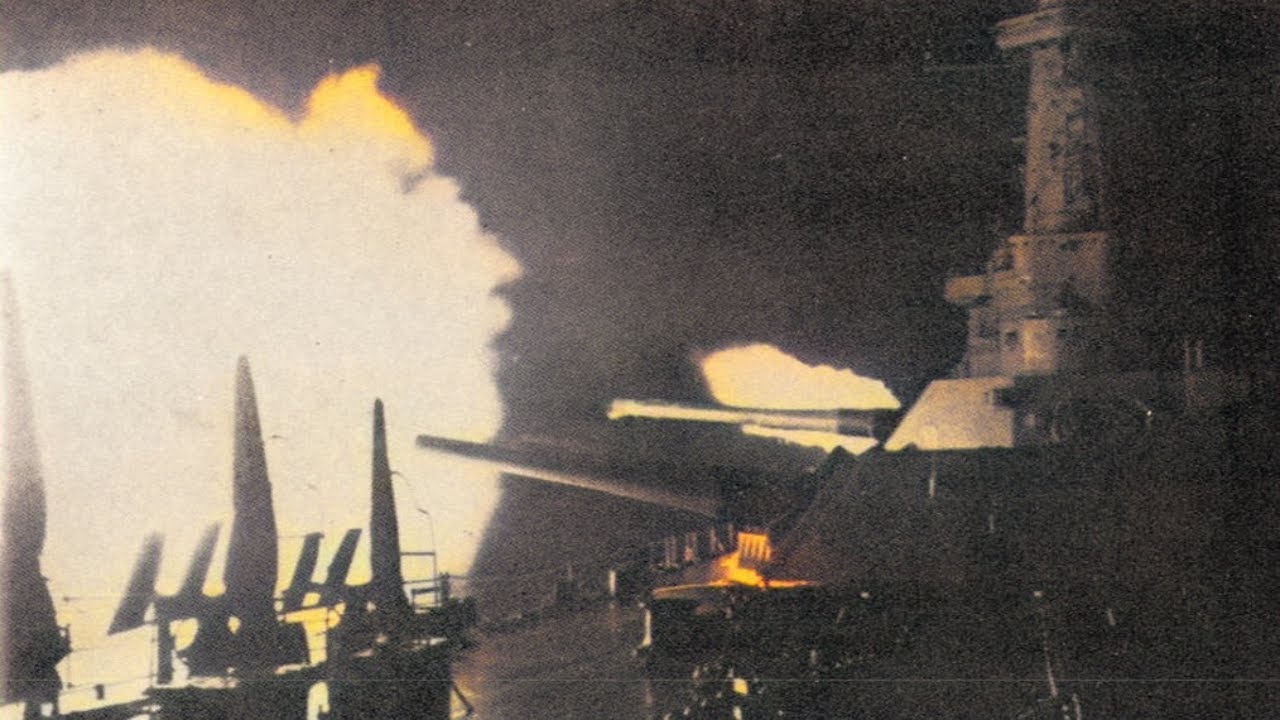
They were not looking behind them. 8,000 yd. Lee could wait no longer. At 2300 hours exactly, he gave the order to open fire. Washington’s first salvo erupted into the night. Nine 16in shells, 24,300 lb of steel and explosive arked through the darkness toward the light cruiser Sendai. The shells were radar directed, aimed at a target the gun crews could not see, adjusted by a fire control computer that calculated the precise lead and elevation.
The salvo took 23 seconds to reach the target. It missed, but not by much. Giant columns of water erupted around Sai, close enough to drench her decks. Her captain, realizing he was under fire from heavy guns, immediately ordered evasive action and smoke. But Lee was not focused on Sendai. She was a distraction, a secondary target.
Washington’s radar had identified a much more important target, the destroyer Iron Army, leading the Japanese van. She was closest to the American destroyers, most dangerous to Lee’s screen. The second salvo shifted to her. This time, Washington’s guns did not miss. At least one 16-in shell, possibly two, slammed into Iron Army.
At that range, against a destroyer’s thin armor, the effect was catastrophic. The shell punched through her hull-like paper, detonated in her engine room, and blew her machinery spaces apart. Iron Army went dead in the water, burning furiously. Her crew desperately fighting floods and fires. The night exploded into chaos.
South Dakota opened fire seconds after Washington, her guns tracking different targets. The American destroyers charged forward, trying to get into torpedo range. Japanese star shells burst overhead, bathing the sound in greenish white light. Search lights snapped on, probing the darkness. Every ship was firing at something, but in the confusion, it was impossible to tell who was shooting at whom.
Tracers crisscrossed the water in every direction. The thunder of heavy guns mixed with the rapid crack of destroyer weapons. It was Callahan’s battle all over again. Except this time, the Americans had radar. Then disaster struck. At 237, South Dakota suffered a massive electrical failure. Her chief engineer trying to correct a minor problem with her electrical board accidentally threw the main circuit breakers.
Every electrical system on the ship died instantly. Lights went out. Radar screens went black. Gun directors lost power. Ammunition hoists stopped. In seconds, one of America’s most powerful battleships was reduced to a floating target. Emergency diesel generators kicked in, but they could only power essential systems.
The main battery could still fire in local control, but without radar, without directors, the gunners were shooting blind. The Japanese pounced on the crippled battleship. Search lights from Kiroshima and the cruisers locked onto South Dakota, illuminating her like a stage performer. Every Japanese ship that could bring guns to bear opened fire.
14-in shells from Kiroshima slammed into South Dakota’s superructure. 8-in shells from a Targetago and Takao ripped through her upper works. In 90 seconds, South Dakota took 27 hits. Her radio antennas were shot away. Her radar was destroyed. Her secondary battery was knocked out. 38 sailors and one marine was killed.
59 more were wounded, including Captain Thomas Gatch, who was hit by shrapnel, but remained on the bridge. The American destroyers were fairing even worse. They had charged into the Japanese formation trying to launch torpedoes, but they were outnumbered and outgunned. Preston was the first to die. Caught in a crossfire between Japanese cruisers and destroyers. She was hit repeatedly.
Shells ripped through her thin hull, starting uncontrollable fires. Her captain ordered abandoned ship, but before most of the crew could get off, her magazines detonated. Preston disappeared in a ball of fire, taking 117 men with her. Walk went next, leading the American destroyer column. She had pressed closest to the Japanese line.
She managed to launch several torpedoes, but before she could turn away, Japanese return fire found her. Shells smashed into her bridge, killing her captain. More shells hit her engine room. Then a long lance torpedo slammed into her hull. Amid ships, Walkie broke in half and sank in minutes. Of her crew of 250 men, only 75 survived.
Benham was hit by a torpedo that blew her bow completely off. Somehow, she remained afloat, her watertight bulkheads holding, but she could no longer fight or maneuver. Gwyn, the last destroyer still operational, was burning from multiple shell hits, but still had power and steerage. Her captain made the bitter decision to withdraw, picking up survivors as she retreated.
In less than 15 minutes, Lee’s destroyer screen had been annihilated. By 23:15, Lee’s task force had effectively ceased to exist. Four destroyers were sunk or crippled. South Dakota was blind, deaf, and on fire, limping away from the battle. Of the six ships that had entered IronBottom Sound, only Washington remained operational.
She was alone facing 14 Japanese ships including a battleship, four cruisers, and multiple destroyers. Every war college scenario, every tactical manual, every piece of conventional wisdom said Lee should withdraw immediately. He was outnumbered 14 to1. He had no support. No one would blame him for saving his ship and crew. But Willis Lee looked at his radar screen and saw something the Japanese could not see.
In their excitement at pounding South Dakota, in the adrenaline rush of destroying American destroyers, the Japanese had lost their formation. Their ships were scattered, some pursuing South Dakota, some finishing off destroyers, some milling about in confusion, and none of them had noticed Washington. She had been hidden behind the burning wrecks of Preston and Walk, her radar signature masked by the surrounding carnage.
Lee had an opportunity, but it would require doing something that violated every principle of battleship combat. He would have to charge alone into the middle of an enemy fleet. Lee gave the order that would define his place in naval history. Complete silence on all radio circuits. No lights.
No communication with other ships. Maximum speed ahead. Course 030. Washington accelerated to 26 knots and headed straight for the Japanese battle line. Her radar operators tracked every enemy ship, calling out ranges and bearings in whispers. 15,000 yds to Kiroshima, 12,000 to Itago, 10,000 to Takao. The Japanese still had not seen her.
Their search lights were focused on South Dakota, now burning on the southern horizon. Their lookouts were watching their victims die. No one was looking for another battleship. At 8,400 yds, practically pointblank range for battleship guns, Lee gave the order to open fire on Kirroima. Washington’s entire main battery, nine 16-in guns, erupted in a perfectly coordinated salvo.
At that range, with radar fire control with a stationary target illuminated by her own search lights, Washington’s gunners could not miss. The first salvo straddled Kirishima. The second was a direct hit. Then another and another. In 7 minutes, Washington fired 756in shells. At least nine, possibly as many as 20, slammed into Kiroshima.
The effect was devastating. Washington’s shells, weighing 2,700 lb each, traveling at 2,300 ft pers, hit with the force of freight trains. They punched through Kiroshima’s armor like tissue paper. One shell destroyed her forward turret, killing everyone inside instantly. Another detonated in her engine room, shattering turbines and boilers.
A third hit below the water line, opening a hole that flooded three compartments. Her steering gear was smashed, jamming her rudder hard to port. She began circling helplessly, unable to maneuver, unable to escape. While Washington continued to pound her, Washington’s secondary battery of 5-in guns joined the assault.
Over 100 shells slammed into Kirishima’s superructure, starting fires from stem to stern. Her pagod mast, the distinctive tower that housed her bridge and fire control systems, was hit repeatedly. Windows shattered, equipment was smashed. Men were cut down by flying metal and glass. Captain Iwabuchi Sanji was wounded but remained at his post, trying desperately to save his ship.
But there was nothing he could do. Kirishima was dying. Admiral Condo, watching his flagship burn, faced the bitter reality that his force had been ambushed. He still did not know how many American ships he was facing. The devastating fire pouring into Kiroshima could be coming from multiple battleships. His cruisers, Atargo and Takao, turned their search lights toward the source of the gunfire, finally illuminating Washington.
They opened fire with their 8-in guns and launched a spread of 16 Type 93 torpedoes, but Washington was already turning away, her radar tracking the torpedo spreads. Lee ordered hard to starboard, and the giant battleship healed over, racing north at maximum speed. Every torpedo missed, some by only yards. The Japanese cruisers tried to pursue, but Lee was not running away.
He was repositioning using Washington’s speed and radar to maintain optimal engagement range. As the range opened to 12,000 yd, Washington’s guns shifted to the cruisers. Her first salvo straddled a targetgo, sending columns of water over her bridge. The next salvo was closer.
Admiral Condo, realizing he was now the hunted rather than the hunter, ordered immediate withdrawal. The most powerful Japanese surface force to approach Guadal Canal since the invasion began turned and fled into the night. Behind them, Kiroshima was dying. Her list increased steadily as flooding spread through her shattered hull. Damage control parties fought desperately to save her, but it was hopeless.
At 0100 hours on November 15, Captain Iwabuchi ordered abandoned ship. The crew gathered on the slanting deck, sang the Japanese national anthem, gave three bananzai cheers for the emperor,then went over the side. At 0320, Kirishima rolled over and sank northwest of Savo Island. She took with her 300 of her crew.
She was the first battleship sunk by another battleship in the Pacific War, and she had been destroyed by a single American ship fighting alone. Lee wanted to pursue Condo’s retreating force. But he faced a new problem. In the heat of battle, with all recognition signals confused with radio frequencies jammed by interference, American PT boats based at Tulagi could not tell friend from foe.
They were preparing to attack anything that moved, including Washington. Lee had to break radio silence to prevent being torpedoed by his own forces. His message to the PT boat base was characteristic of his personality. When challenged for recognition signals, Lee transmitted, “This isQing Lee. Get out of my way.
I’m coming through.” The PT boats wisely held their fire. As dawn broke on November 15, the full to extent of the American victory became clear. Japanese troop ships that had been waiting to unload at Guadal Canal were caught in the open by aircraft from Henderson Field. Dive bombers and torpedo planes swarmed over them.
Seven transports were sunk. Only 4,000 of the 11,000 Japanese reinforcements reached shore and they landed without most of their equipment and supplies. The final Japanese attempt to retake Guadal Canal had failed. The tide of the campaign had turned decisively in America’s favor. The cost had been terrible.
The destroyer Preston was gone with 117 dead. Walker was gone with 175 dead. Benham, though initially saved, would sink the next day while under tow. Fortunately, with no additional loss of life, Gwyn was badly damaged. South Dakota would need months of repairs. In total, the United States Navy had lost three destroyers and suffered over 400 killed, but they had stopped the Japanese cold.
Kiriroima was on the bottom. The Japanese would never again send capital ships to Guadal Canal. The Marines would hold. The airfield would survive. The first American offensive of the Pacific War would succeed. When the casualty reports were compiled, one statistic stood out as almost unbelievable. USS Washington, which had single-handedly defeated a Japanese battleship and driven off an entire enemy fleet, had suffered no casualties.
Not a single man aboard had been killed or seriously wounded by enemy action. The ship herself had taken only one hit, a 5-in shell that cut her radio antenna. In the most violent surface engagement of the Guadal Canal campaign, the ship that had done the most damage had taken the least. It was unprecedented. It would never happen again in the war.
Admiral Holse’s reaction to the battle was immediate and effusive. He sent a personal message to Lee that read, quote, “You and your task force have written a glorious page in American naval history.” But the official Navy response was more muted. The battle was classified as a defensive action, not the revolutionary offensive victory it really was.
Lee’s afteraction report, which emphasized the critical importance of radar in the victory, was filed away with little comment. The battleship admirals did not want to admit that the carrier advocates had been wrong about battleship obsolescence. The carrier admirals did not want to admit that battleships still had offensive value.
So Washington’s victory was minimized, treated as an anomaly rather than a validation of new tactics. Lee himself was philosophical about the lack of recognition. He told his staff that the important thing was not credit, but results. Guadal Canal had been saved. American sailors were alive because of what Washington had done. That was enough.
But privately, Lee was frustrated by the Navy’s failure to learn from the battle. He wrote detailed reports on radar directed fire control, on night fighting tactics, on the integration of sensors and weapons. He recommended new training programs, new equipment, new procedures. Most of his recommendations were ignored or implemented half-heartedly.
The Navy was already moving on to the next battle, the next campaign. There was no time for revolutionary thinking. Captain Glenn Davis, Washington’s commanding officer during the battle, recognized the revolutionary nature of what had been accomplished. The official action reports he filed emphasized the decisive role of radar fire control in the victory.
His ship had engaged multiple targets in complete darkness, achieved devastating accuracy, and emerged without a single combat casualty. It was in his professional assessment the ideal demonstration of what properly integrated technology and training could achieve. Davis was awarded the Navy Cross for his leadership during the battle and was promoted to Rear Admiral in April 1943.
He went on to command battleship division 8 leading at them through the Mariana’s campaign and other Pacific operations. But like Lee, Davis understood that the Navy hierarchy remained unconvinced about the offensivepotential of radar equipped battleships operating independently. The Japanese Navy’s response to the defeat was confusion and denial.
Admiral Condo’s initial report claimed that American cruisers and destroyers had sunk Kirishima. He could not believe that a single battleship had destroyed his flagship and driven off his entire force. It was not until intercepted American radio traffic confirmed Washington’s role that the Japanese accepted what had happened.
The psychological impact was profound. For the first time in the war, a Japanese battleship had been defeated in surface combat. The night which had belonged to the Japanese since Pearl Harbor was no longer safe. Japanese naval doctrine began to shift after the battle of Guadal Canal. They realized that American radar had neutralized their advantage in night fighting.
Their superb lookouts, their intensive training, their superior torpedoes. None of it mattered if the Americans could see them and shoot accurately in complete darkness. They tried to develop their own radar, but they were years behind American technology. They tried new tactics, but without radar, they were always reacting, always at a disadvantage.
The confident Japanese navy that had dominated the Pacific in early 1942 was gone, replaced by an increasingly desperate force trying to stem an inexurable American advance. Washington returned to Numea, New Calonia for minor repairs and resupply. Her crew was granted liberty, and for the first time they could talk about what they had accomplished.
Sailors who had been at their battle stations, who had felt the ship shake with each salvo, who had heard the radar operators calling out targets, began to understand the magnitude of their victory. They had faced impossible odds and won. They had proved that American technology and training could overcome Japanese experience and numbers.
They had turned the tide of the Guadal Canal campaign, but there was no time to celebrate. The war was far from over. Washington was needed elsewhere. She would go on to fight in the Gilbert Islands, the Marshall Islands, the Maranas, the Philippines, Ewoima, and Okinawa. She would earn 13 battle stars, more than almost any other battleship in the Pacific.
But she would never again have the opportunity to prove what she had proved that night off Guadal Canal. The Navy kept her tied to the carriers, using her massive anti-aircraft battery to protect the flattops from Japanese air attack. Her 16-in guns would fire thousands of rounds at shore targets supporting amphibious invasions. But she would never again engage an enemy warship in surface combat.
The tragedy was not that Washington was restricted to carrier escort duty. That was frustrating but understandable given the evolution of naval warfare. The tragedy was that the lessons of her victory were deliberately ignored. Lee had proved that battleships equipped with radar and trained in its use could dominate night surface combat.
He had demonstrated tactics that could have saved lives in later battles. But the Navy bureaucracy committed to the primacy of carrier aviation refused to acknowledge these lessons. Reports were buried. Recommendations were dismissed. The revolution in surface warfare that Washington represented was still born. Lee himself continued to advocate for better integration of radar and surface warfare tactics.
In 1944, he was promoted to vice admiral and given command of the fast battleship force, six of the most powerful warships ever built, but they remained tied to the carriers forbidden to operate independently. At the Battle of the Philippine Sea in June 1944, Lee’s battleships formed a powerful battle line that could have intercepted and destroyed the Japanese surface forces.
Instead, they were held back to protect the carriers. The enemy escaped. At the Battle of Lee Gulf in October 1944, Holsey took Lee’s battleships on a wild chase after Japanese carriers, leaving the invasion beaches unprotected. Only the heroic sacrifice of escort carriers and destroyers at the battle of Samar prevented disaster.
Lee watched these missed opportunities with growing frustration. He knew what his battleships could do if properly employed. He had proved it at Guadal Canal. But he was a good officer and he followed orders even when he disagreed with them. He continued to write papers and studies on surface warfare tactics, on the integration of radar and gunfire, on the future of naval combat.
Some junior officers read them and learned, but the Navy hierarchy remained committed to the carrier doctrine that had become gospel after Midway. On August 25th, 1945, 10 days after Japan surrendered, Willis Augustus Lee Junior died suddenly of a heart attack. He was 57 years old. He was being fed in a motor launch to his flagship, the battleship Wyoming, which was anchored in Casco Bay, Maine.
The crew of the launch tried to resuscitate him, but it was too late. The man who had revolutionized battleship warfare,who had saved Guadal Canal, who had proved that technology and tactics could overcome any odds, died just as the war he had helped win came to an end. The news of Lee’s death was met with genuine grief throughout the fleet.
Admiral Nimmitz called him one of the finest officers he had ever known. Admiral Holy said Lee’s tactical genius had saved countless American lives. The crew of Washington, many of whom were still serving, mourned the loss of the admiral who had led them through the most desperate battle of the war. But even in death, Lee’s achievements were minimized.
His obituary in the New York Times mentioned his Olympic medals and his service record, but devoted only one and sentenced to the battle of Guadal Canal. The Navy’s official history would give him credit for the victory, but would not acknowledge the revolutionary nature of what he had accomplished. Washington continued to serve for two more years after the war ended.
She participated in magic carpet operations, bringing American servicemen home from Europe. On June 27th, 1947, she was decommissioned at the New York Naval Shipyard. For 14 years, she sat in the reserve fleet, slowly rusting, occasionally inspected, never needed. On June 1st, 1960, she was struck from the naval register.
On May 24th, 1961, she was sold to the Lipet Division of Lura Brothers and Company for $544,000. She was towed to the breakers and cut up for scrap. No effort was made to preserve her as a museum. No memorial was erected to commemorate her service. The battleship that had saved Guadal Canal that had proved battleships could still dominate naval combat was reduced to razor blades and reinforcing bars.
Today, 82 years after the Battle of Guadal Canal, Washington’s achievement remains largely unknown outside naval history circles. School children learn about the carriers at Midway, the Marines at Eoima, the atomic bombs that ended the war. They do not learn about the battleship that fought alone against impossible odds and won.
Tour guides at Pearl Harbor talk about Missouri, where the surrender was signed, and Arizona, where the war began for America. They do not mention Washington, where the future of naval warfare was demonstrated and then ignored. But the legacy of Washington and Willis Lee lives on in ways most people do not realize. The Aegis combat system that protects modern American warships is a direct descendant of the radar fire control system Lee pioneered.
The integration of sensors and weapons that he advocated is now standard on every naval vessel. The tactical principles he developed, engaging beyond visual range, using technology to overcome numbers, fighting the enemy where he is blind. These are the foundations of modern naval combat. Every American destroyer, cruiser, and carrier that goes to sea today carries the DNA of Washington’s victory at Guadal Canal.
The bitter irony is that Lee was right about everything. Battleships with radar could have dominated surface combat throughout the war if properly employed. Lives could have been saved. Battles could have been won more decisively. But institutional inertia and bureaucratic blindness prevented the Navy from learning the lessons Washington taught.
By the time the Navy fully understood what Lee had been trying to tell them, the battleship era was over. Missiles and jets had replaced guns and armor. The revolution Lee had started came too late to matter for the ships he loved. There is one more piece of the Washington story that deserves telling.
Throughout her entire combat career, from the Atlantic to the Pacific, through 13 major engagements, Washington never lost a single crew member to enemy action. Oh, there were accidents, training mishaps, natural causes. But in actual combat, facing enemy guns and torpedoes and aircraft, not one man was killed. No other major warship in any navy can make that claim.
It speaks to the quality of her crew, the strength of her construction, and perhaps most importantly, the tactical genius of Willis Lee, who understood that the best way to protect his men was to kill the enemy before the enemy could kill them. This perfect record almost seems impossible when you consider what Washington faced at Guadal Canal alone.
She was targeted by torpedoes, heavy cruiser guns, and at least one near miss from Kiroshima’s main battery. During the Philippines campaign, she was attacked repeatedly by Japanese aircraft, including kamicazis. At Ewima and Okinawa, she operated under constant threat of air attack. Yet through it all, her crew remained untouched by enemy action.
It was not luck. It was the result of superb training, excellent damage control, and most importantly, the revolutionary tactics that Lee had developed. By engaging at maximum radar range, by striking from unexpected angles, by using technology to dominate the battlefield, Washington avoided the bloody close-range battles that claimed so many other ships.
The story of USSWashington raises uncomfortable questions about military innovation and institutional resistance to change. In Korea, American forces would rediscover the importance of naval gunfire support. In Vietnam, they would learn again about the value of precision engagement at maximum range. In the Persian Gulf, they would apply the principles of sensor integration that Lee had pioneered 50 years earlier.
Each time these lessons had to be learned a new, because the institutions that should have preserved them chose instead to forget. Consider what might have been different if the Navy had fully embraced Lee’s innovations in 1942. How many ships might have been saved at the Battle of Empress Augusta Bay? If all American vessels had been trained in radar directed night fighting? How many sailors might have lived through the Battle of Samar? if Hol’s battleships had been deployed using Lee’s independent operation doctrine.
These are not just historical what-ifs. They represent real lives that might have been saved if bureaucratic pride had not trumped tactical innovation. The Washington story also illuminates a persistent pattern in military history. Revolutionary advantages are often discovered by practical men in desperate circumstances, not by theorists in war colleges.
McKenna’s piano wire tensioner that saved P38 pilots, Gudderians blitzkrieg tactics, Boyd’s energy maneuverability theory, all came from operators who saw what the establishment could not or would not see. And in each case, the establishment resisted, denied, and minimized until the evidence became overwhelming or irrelevant. Today, as the United States Navy faces new challenges from peer competitors with anti-ship missiles, hypersonic weapons, and space-based targeting systems, the lesson of Washington becomes relevant again. The service that
adapts fastest to new technology, that listens to its operators over its bureaucrats, that values results over doctrine, will dominate future naval battles, just as Washington dominated that night off Guadal Canal. The question is whether today’s Navy has learned from its own history, or whether it will repeat the mistakes of 1942, the physical traces of Washington are gone.
Her steel was melted down and repurposed decades ago. Her crew, those brave men who sailed into impossible odds and emerged unscathed, have nearly all passed on, but their achievement endures in the principles they proved. Technology properly employed multiplies combat power. Training and tactics matter more than in numbers. One ship with the right commander and the right tools can defeat an entire fleet.
These are not just lessons for naval warfare. They are lessons for any field where innovation confronts orthodoxy. As we mark another anniversary of the battle of Guadal Canal, we should remember not just what happened, but what it meant. A single battleship written off by doctrine commanded by an admiral who looked like a school teacher using technology that most officers did not understand saved the first American offensive of the Pacific War.
That victory was then deliberately minimized because it challenged the dominant narrative of carrier supremacy. The ship that proved battleships could still win was forgotten because remembering her meant admitting the experts were wrong. This November marks 82 years since Washington proved that courage, technology, and leadership could overcome any odds.
Her story reminds us that the greatest victories often come from the most unexpected sources, that bureaucracies resist change, even when lives depend on it, and that the price of institutional blindness is always paid by those who serve. Washington deserves better than obscurity. Her crew deserves recognition. Willis Lee deserves his place among the great naval commanders.
Most importantly, their lessons deserve to be studied, understood, and applied.
