They told him a black man had no business on that stage, that the son of a sharecropper, the grandson of slaves, should know his place, that he was walking into a trap designed to humiliate him and everyone who looked like him. The most powerful dictator in the world had spent years building a narrative of racial superiority. And now he’d have his proof. His stadium, his games, his Aryan athletes crushing all competition in front of the entire world.
The whisper started months before the competition. He’s talented, sure, but wait until he faces real pressure. He’s just a college kid who got lucky. Hitler’s athletes have been training for years just for this moment. Some questioned whether America should even send him. Why give the Nazis a propaganda victory when our boy inevitably cracks under the spotlight? But what none of them understood, what Hitler himself couldn’t possibly grasp, was that this young man had already survived pressures they couldn’t imagine, had already overcome obstacles that would have destroyed most people before they even started.
And he was about to deliver the most devastating response to racism the world had ever witnessed. Not with speeches, not with protests, but by doing something so undeniable, so absolute that history itself would have to choose sides. By the time the dust settled in Berlin, Jesse Owens would claim four gold medals in front of Adolf Hitler, shattering the Nazi myth of racial supremacy so completely that the dictator couldn’t even watch. He’d set Olympic records, break world records, and prove something that should never have needed proving, but somehow still did.
This is the story of how a sickly child from Alabama became the man who made Hitler look away. But to understand how this happened, how a young man from nothing became the athlete who broke a dictator’s dreams, you need to go back back to where it all started. Back to a place where the idea of Olympic glory seemed as distant as the moon. September 12th, 1913. Oakville, Alabama. A sharecroers cabin where the Owens family struggled to survive.
Henry and Emma Owens welcomed their 10th child into a world designed to keep him down. They named him James Cleveland Owens. His family called him by his initials, JC. The boy born into a system that declared him property three generations after slavery supposedly ended. The cabin had walls thin enough to feel the wind through them. No electricity, no running water, nothing but poverty so deep it felt like drowning and cotton fields. Endless rows of white bowls that represented someone else’s wealth built on the Owens family’s backs.
Young JC was fragile, sick all the time with what his mother called the devil’s cold, too weak to work the fields with his brothers, too frail to do much besides try to survive each day. The family barely had enough food, wore clothes until they disintegrated, lived under the crushing weight of Jim Crow laws that made sure they knew exactly where they stood in the racial hierarchy. At the bottom. Always at the bottom. This was the South in the 1910s and 1920s.
A place where lynchings were common enough to be unremarkable, where a black child’s future was determined at birth. Field hand, domestic worker, manual laborer. That was the ceiling. That was as far as you could dream. Anyone who suggested otherwise was delusional or dangerous or both. But Emma Owens refused to accept that destiny for her children. She’d heard stories from the north, Cleveland, Detroit, Chicago. Cities where black families were finding real jobs, real schools, real opportunities, where Jim Crow’s grip wasn’t quite as tight, where maybe, just maybe, her children could become something more than what Alabama would allow.
In 1922, when JC was 9 years old, Henry Owens made the decision. He sold everything they could spare. tools, mules, anything with value. The family would join the great migration, that massive exodus of 6 million African-Ameans fleeing the south for the promise of something better in the north. They boarded a segregated train heading to Cleveland, Ohio. 13 people, most of them children. Everything they owned packed into a few bags, leaving behind the only home they’d known for a city they’d only imagined.
The train ride itself was an education. White passengers in comfortable seats up front. Black passengers crammed in the back. Separate bathrooms. Separate water fountains. Separate America. Cleveland hit them like a freight train. Buildings scraping the sky. Electric lights everywhere. Factories belching smoke that somehow smelled like possibility. Paved streets. Trolley cars. A world completely alien to anything they’d experienced in Alabama. The Owens family crammed into an apartment on the east side where other black families from the south had settled.
The promised prosperity mostly a myth. They still struggled with rent, still went hungry, still wore rags. But there was one critical difference that would change everything. School. James Cleveland enrolled at Bolton Elementary School, an actual building with heat and books and teachers who showed up. On his first day, the teacher asked his name. Through his thick Alabama draw, the 9-year-old said what his family always called him, JC, his initials. She heard Jesse, wrote it down, Jesse Owens.
And just like that, the world knew him by a different name. The man who would humiliate Hitler got his legendary identity from a simple misunderstanding between a southern boy and a northern teacher. At Fairmount Junior High School, Jesse, as everyone now called him, was still the skinny kid, still dealing with breathing problems. Still looked like he might blow away in a strong wind. But something was changing. He was getting stronger, faster. And then one day during gym class, a teacher named Charles Riley was watching.
Riley was the physical education instructor and track coach. He had an eye for talent. And when he saw Jesse run during a warm-up, something clicked. The kid’s form was raw, completely untrained. But his speed, natural, explosive, the kind you can’t teach. Riley pulled him aside after class, asked if he’d ever considered running track. Jesse hadn’t. Running was something you did to catch a bus, not a sport, not something kids like him did. But Riley saw potential. More importantly, Riley was one of those rare teachers who believed talent deserved cultivation regardless of skin color.
In 1920s Cleveland, that wasn’t common. There was a problem. Track practice was after school. Jesse worked after school. Had to. The family needed every dollar he could bring in. He delivered groceries, loaded freight cars, worked in a shoe repair shop. The money mattered. Riley offered a solution. He’d train Jesse in the morning before school. 7 a.m. While most kids were still asleep, Jesse Owens was on the track learning to run properly, not just fast, efficient. Riley taught him technique, body positioning, how to explode from the starting blocks, arm movement, breathing, how to push past pain into a zone where only speed existed.
Jesse never missed a morning, never complained, never made excuses. Because growing up in those Alabama cotton fields taught him something crucial. When opportunity knocks, you don’t just answer, you kick the door down. By 8th grade, Jesse was destroying junior high school records. He ran the 100yard dash in 11 seconds flat at age 13. Jumped over 6 feet in the high jump, long jumped 22 ft, 11 and 3/4 in. Numbers that would impress adult athletes from a 13-year-old kid.
Unheard of. But Jesse wasn’t interested in impressive. He wanted dominant. In 1930, he enrolled at East Technical High School, a vocational school, because Jesse was practical. Learning a trade meant guaranteed employment, a way to support his family. Running was just something he did on the side. Or so he thought. By his senior year in 1933, Jesse Owens wasn’t just an athlete, he was a phenomenon. At the National Interscalastic Championships in Chicago in June 1933, Jesse did something that made the entire country pay attention.
He ran the 100yard dash in 9.4 seconds, tying the world record. Not the high school record, the world record. An 18-year-old kid matching the fastest humans on the planet. Then he ran the 220 yard dash in 20.7 seconds. High school world record. then long jumped 24 ft 9 and 1/2 in. Three events, three records. At 18, college recruiters swarmed. Every major university wanted Jesse Owens. They saw what everyone saw. Once in a generation talent, the kind that changes programs.
But Jesse hesitated. How could he afford college? His family still needed money. And now he had his own family to worry about. He’d been dating many Ruth Solomon since junior high. In 1932, Ruth gave birth to their daughter, Gloria. Jesse was 19 with a child to support. College wasn’t for people like him. The world had made that clear. College was for kids with money, connections, opportunities, kids whose skin was the right color. Ohio State University wanted him badly enough to solve the problem.
They couldn’t give him a traditional scholarship. In 1933, Ohio State didn’t give black athletes scholarships, but they found work for his father. Stable employment, enough money to support the family, which meant Jesse could attend, though he’d have to work multiple jobs while studying and training. In fall 1933, Jesse Owens became a Buckeye and walked straight into institutional racism, dressed up as opportunity. He couldn’t live in the dorms with white students, had to live off campus with other black athletes.
When the team traveled, he couldn’t eat at the same restaurants as his white teammates. Had to find blacksonly establishments or go hungry, couldn’t stay at the same hotels, had to find separate accommodations wherever they went. The university loved his victories, put his name in headlines, used his success to build their reputation, but wouldn’t let him eat lunch in the same room as white students. Jesse didn’t complain publicly, didn’t make waves, just focused on the track because he understood something fundamental.
The stopwatch didn’t care about skin color. Speed was speed. Excellence was excellence. And if he was excellent enough, undeniable enough, maybe everything else would have to change. His coach at Ohio State was Larry Snyder, a man who pushed Jesse relentlessly, refined his technique, made him faster and more explosive. Under Snyder, Jesse transformed from talented to unstoppable. In his first two years of varsity competition, Jesse won eight individual NCAA championships. Four in 1935, four in 1936, eight total.
A record that’s never been matched. In 1936, his junior year, he entered 42 events. Won all 42. Not 41 with a close second. Every single one. But it was one day, one afternoon in May 1935 that elevated Jesse Owens from exceptional athlete to something approaching mythical. May 25th, 1935, Ann Arbor, Michigan. The Big 10 Championships. Jesse shouldn’t have been there. A week earlier, he’d fallen down a flight of stairs at a fraternity house. Slammed his back hard.
The pain was severe enough that he could barely move. Doctors told him to rest. told him competing was insane, could make the injury worse, could end his career before it really started. Jesse showed up anyway, taped up, moving carefully, in obvious pain. His coach, Larry Snyder, wanted him to skip the meet entirely, focus on healing. But Jesse, convinced him to let him try one event, just the 100yard dash, a test to see if his back could handle it.
3:15 p.m. Jesse stepped into the starting blocks. Gunfired. He ran 100 yards in 9.4 seconds. Tied the world record with a back injury that should have kept him in bed. He told Snyder he was continuing. 3:25 p.m. 10 minutes later, the long jump. Jesse knew his back couldn’t handle multiple attempts. One jump, that’s all he’d get. Had to make it count. He sprinted down the runway, planted his foot, launched himself into the air, landed. The measurement came back.
26 ft 8 and 1/4 in. World record. A record that would stand for 25 years. 25 years. Think about that. With a back injury in 1935, Jesse Owens set a mark that wouldn’t be broken until 1960. 3:35 p.m. 10 minutes after that, the 220 yard dash. Gunfired. Jesse ran. Time 20.3 seconds. World record. And because the turn met the requirements for the 200 m distance, he’d simultaneously set that world record, too. 400 p.m. 45 minutes into what would become the greatest athletic performance in history, the 220 low hurdles.
Jesse crossed the finish line in 22.6 seconds. First person ever to break 23 seconds. World record number three for the day. And again, the 200 meter hurdles record fell at the same time. Let’s be crystal clear about what just happened. In 45 minutes, Jesse Owens set three world records outright and tied a fourth. Five world records total counting the metric equivalents in 3/4 of an hour while injured. Sports historians when asked to name the single greatest athletic performance in history point to that day almost unanimously.
May 25th, 1935. Jesse Owens at the Big 10 Championships. Nothing before or since has matched it. The news exploded across America. front page headlines, radio bulletins. This young black man from Ohio State had done something nobody thought possible. Jesse Owens became overnight not just a college athlete, but a national sensation, a celebrity, the overwhelming favorite for the 1936 Olympic Games. The 1936 Olympics in Berlin, Germany. And here’s where this story transforms from sports achievement into something much bigger, much more dangerous.
In 1931, the International Olympic Committee awarded the 1936 Summer Olympics to Berlin. Seemed reasonable at the time. Germany was civilized, modern. Berlin was sophisticated. The Olympics would showcase Germany’s return to the world stage after World War I. But in 1933, everything changed. Adolf Hitler became Chancellor of Germany. Within months, Hitler transformed Germany into a totalitarian nightmare. Political opponents arrested or murdered, dissident disappeared, and Hitler began implementing his racist ideology at the national level. The belief in Aryan supremacy, the idea that Germans, particularly those of Nordic descent, were a master race, superior to all others, destined to rule.
In Hitler’s deranged worldview, black people were subhuman, incapable of civilization, weak, inferior, fit only for subjugation or elimination. And now the Olympics were coming to his capital, his stadium, his stage. Hitler saw the games as the perfect showcase for his ideology, a demonstration to the world of Aryan superiority. German athletes would dominate every event, proving once and for all the natural supremacy of the master race. Hitler had one problem he didn’t see coming. America was sending a team that included black athletes.
And the best athlete in the world, the man who just set five world records in 45 minutes, was a black man from Ohio named Jesse Owens. Debate erupted across America about whether to boycott the Berlin Olympics. Jewish organizations, civil rights groups, politicians argued that participating would legitimize Hitler’s regime, would give credibility to a government already showing signs of the horrors it would unleash. Others pushed back, said boycotting would be ineffective, that participating and winning would be the more powerful statement, would demonstrate to Hitler and the world that his racial theories were garbage.
Jesse Owens was caught in the middle. Both sides wanted his support, his endorsement. He was, after all, the face of American athletics. What he said mattered. Initially, Jesse supported a boycott. The thought of competing in front of Hitler, of performing for a man who considered him subhuman, was revoling. But as the debate continued, as pressure mounted, Jesse changed his position. He would go to Berlin. He would compete. and he would show Hitler and the entire world what happened when talent met opportunity, when excellence was given a stage.
On July 5th, 1935, Jesse married many Ruth Solomon. They’d been together since junior high through poverty, through struggle, through his meteoric rise to fame. Ruth would give birth to their second daughter, Marlene, in 1937 and their third, Beverly, in 1940. But in summer 1935, as Jesse prepared for Berlin, he had a young family depending on him. The pressure wasn’t just about athletic performance. It was about survival, about creating a better life for his daughters than he’d had.
The months leading up to Berlin were intense. training, media attention, handling expectations of an entire nation, an entire race of people who saw him as their representative, their champion, the man who would prove their worth. Jesse Owens was 22 years old, 7 years removed from picking cotton in Alabama, a dozen years from that sharecropper’s cabin where he was born. And now he was preparing to stand on the world’s biggest stage in front of a dictator who believed he was inferior by nature.
Hitler had spent years building his narrative, using every propaganda tool available to convince Germans and the world that racial hierarchy was scientific fact that Aryans were superior and all others were lesser. Jesse Owens was about to demolish that narrative, not with words, not with arguments, but with speed, with strength, with undeniable excellence. Four gold medals that would prove what should never have needed proving. that human worth has nothing to do with melanin. That talent and character transcend skin color.
That Hitler was catastrophically, humiliatingly wrong. Summer 1936, Jesse Owens boarded a ship bound for Germany, for Berlin, for the Lion’s Den. He had no idea he was about to change history forever. The SS Manhattan sat at dock, a massive 24,000 ton ocean liner about to carry the biggest propaganda weapon America didn’t even realize it had. Over 380 athletes climbed the gangplank that morning, representing the United States at the Berlin Olympics, and among them were 18 African-American athletes who would soon prove something Hitler couldn’t accept.
The mainstream press barely noticed most of them. Their focus was singular. Jesse Owens, the Buckeye Bullet, the man who’d set five world records in 45 minutes. At 22 years old, Jesse was carrying the weight of expectations that would crush most people. He wasn’t just representing Ohio State. He wasn’t just representing America. He was representing every black person who’d been told they were inferior. Every descendant of slaves who’d been told they couldn’t compete. Every person of color who’d been dismissed, diminished, denied.
No pressure. But Jesse wasn’t alone. Even if the white newspapers acted like he was, the 18 black athletes on that ship had their own stories, their own struggles, their own reasons for making this journey into the heart of Nazi Germany. Ralph Metaf, 26 years old, from Chicago. He’d won silver at the 1932 Los Angeles Olympics, losing to his teammate by a fraction of a second in a photo finish. Ralph was a leader, the kind of man other men listen to.
Before the ship even left harbor, he called a meeting of the black athletes. They gathered in one of the ship’s common areas. 18 men and women who understood what was waiting for them in Germany, who’d read the reports about Hitler’s racial theories, who knew they were walking into a country that considered them subhuman. Ralph’s message was direct. We’re not going there to get involved in the political situation. We’re there for one purpose, to represent our country. Simple, clear.
Focus on the competition. Let the performance do the talking. Cornelius Johnson was there, a high jumper from California, 21 years old. He’d set a world record during the Olympic trials, jumping 6 feet, 9 and 1/8 in. Quiet, focused, ready to dominate his event. John Woodruff, 19 years old, from Pittsburgh, an 800 meter runner with a stride so long they called him Long John. He was the youngest member of the track team, still a teenager, about to compete on the world’s biggest stage.
Mac Robinson, 21 years old, from Pasadena, California, a sprinter who’d qualified in the 200 meters. His younger brother, Jackie, was 13 at the time, watching from home. Jackie Robinson would later break baseball’s color barrier. But in 1936, it was Mac’s turn to make history. Dave Albrittain, Jesse’s teammate from Ohio State. a high jumper who’d also set a world record during the trials, clearing the same height as Cornelius Johnson. They tied for first place, both breaking the old record.
Archie Williams, a 400 meter runner from California, engineering student, smart, fast, determined. James Laval, another 400 meter runner, chemistry graduate student from UCLA. He’d go on to earn a PhD and work in the aerospace industry. But first, he had a race to run in Berlin. And there were women, too. Tidy Picket and Louise Stokes, hurdlers and sprinters, fighting not just racism, but sexism in a sports world that barely acknowledged female athletes existed. They’d been on the 1932 Olympic team, but hadn’t been allowed to compete.
Now, they were getting another shot. 18 black athletes. 18 people carrying the hopes of millions. 18 individuals about to challenge the foundation of Nazi ideology just by existing, by competing, by excelling. The Pittsburgh Courier, a major black newspaper, called them the Black Eagles. And they were about to soar. The SS Manhattan pulled away from the dock at 11:00 a.m. 9 days to Germany. Nine days of preparation, anticipation, and facing the reality of what they were sailing toward.
The voyage was rough. Storms, heavy seas, the ship pitched and rolled. Some athletes got violently seasick. But Jesse was fine. He’d never been on a ship before. Never seen the ocean before that week. But his stomach handled it. He used the time to stay in shape. There’s footage of Jesse on the deck of the SS Manhattan, leaping over an improvised hurdle while wearing what looks like a suit, staying sharp, keeping his muscles ready. Other athletes played shuffleboard, some read, some worried.
Jesse trained, and he signed autographs, hundreds of them. Fellow passengers recognized him, wanted his signature, wanted to tell their friends they’d met the famous Jesse Owens. Even on a ship in the middle of the Atlantic, he was a celebrity. The pressure never stopped. July 24th, 1936, 9 days after departure, the SS Manhattan docked at Bremer Haven, Germany. The athletes stepped off the ship into a country that had transformed itself into a propaganda machine. And the first thing they noticed was the flags.
swastikas everywhere, hanging from buildings, flying from flag poles, draped across monuments. The hooked cross of Nazi Germany was inescapable, but alongside them, international flags, Olympic flags, the five interlocking rings that were supposed to represent unity, peace, competition, side by side with the symbol of hate. The contrast was jarring and intentional. Hitler wanted the world to see a civilized, modern Germany, a nation that had recovered from World War I and was ready to take its place among great powers.
The Olympics were his stage, his showcase, his chance to prove Aryan superiority to a watching world. German officials greeted the arriving athletes with efficiency and carefully rehearsed warmth. Journalists swarmed, cameras clicked, the propaganda machine was in full operation. The athletes were transported to Berlin by train. As they traveled through the German countryside, then into the city, they saw a nation that had mobilized everything for these games. New roads, upgraded railways, cities decorated like it was Christmas and New Year’s combined.
Berlin itself was unrecognizable from just years earlier. The Nazis had spent somewhere between 30 and $50 million preparing for the Olympics. In 1936 dollars, that’s over 500 million in modern currency, maybe closer to a billion. They’d built the Reich Schwfeld, a massive sports complex covering 325 acres. At its heart was the Olympia Stadion, a stadium designed to hold 110,000 spectators. Designed by Hitler’s favorite architect, Albert Shar, the man who’d later build monuments to Nazi power across Germany.
The stadium was modern, impressive, intimidating, built to make visitors feel small, to make them understand they were in the presence of greatness. Or at least that’s what Hitler wanted them to think. The Olympic Village was located in Stall, west of Berlin, state-of-the-art facilities. 145 buildings housing over 4,000 athletes, gyms, swimming pools, a massive dining hall, training grounds, everything an athlete could need. and it was integrated black athletes and white athletes living in the same spaces eating in the same dining halls using the same facilities.
For the 18 black American athletes, this was unprecedented. At Ohio State, Jesse couldn’t live in the dorms with white students. On the road, the black athletes had to find separate hotels, separate restaurants. Now, in Nazi Germany, they were being housed with everyone else. The irony wasn’t lost on them. They were experiencing racial integration in Hitler’s Germany that they couldn’t experience in many parts of America. A German shoemaker approached Jesse shortly after his arrival. Adolf Addi Dazzler. He ran a company called Gabbrer Dastler Shoe Fabri with his brother.
Addi had been watching Jesse’s career. Knew his success could make or break a shoe company. He offered Jesse a pair of handcrafted leather running shoes with extra-l long spikes, lighter than anything Jesse had used before. Addy Dassler was betting his company’s future on Jesse Owens. That company would later become Adidas, and Jesse’s success would indeed make it legendary. But all the modern facilities and advanced equipment couldn’t disguise what Berlin really was in August 1936, a city under totalitarian control, where disscent was crushed, where Jews were being systematically excluded from public life, where Roma had been rounded up and imprisoned just before the games so tourists wouldn’t see them.
The Nazis had temporarily removed anti-Jewish signs from public places. didn’t want foreign visitors seeing Jews not welcome or no Jews allowed plastered across storefronts and parks. The persecution paused just long enough for the world to look away. Then it would resume with a vengeance that would end in genocide. But in late July 1936, as athletes from 49 nations gathered in Berlin, the world was choosing to believe the show, choosing to accept Germany’s carefully constructed facade of tolerance and modernity.
Jesse and the other black athletes weren’t fooled. They’d lived with discrimination their entire lives. They recognized it, even dressed up in Olympic colors and Nazi efficiency. They knew what Hitler thought of them. Knew what German newspapers were printing. One Nazi paper had called black athletes auxiliaries. A polite way of saying they weren’t real competitors, weren’t real humans. The German press was in a difficult position. They’d spent years dehumanizing black people and Jews. Now they had to cover an international sporting event where some of the best athletes were black and Jewish.
The cognitive dissonance must have been spectacular. Some papers tried to ignore the black athletes entirely, focusing only on German and other white European competitors. Others couldn’t help themselves, making racist comments while simultaneously having to report that these same athletes were dominating their events. Jesse tried to ignore the noise. Focus on training. Focus on what he could control. His starts, his form, his speed. The track didn’t care about skin color. The stopwatch didn’t discriminate. If he ran fast enough, jumped far enough.
None of the racist ideology mattered. But the pressure was immense. Everywhere he went, people recognized him. German citizens wanted autographs. Journalists wanted interviews. Other athletes wanted to meet the legend. And hanging over everything was the knowledge that Hitler himself would be watching. The dictator who’d built an entire political philosophy on the idea that people like Jesse were inferior, that Aryans were destined to rule, that racial hierarchy was scientific fact. Jesse was about to deliver the most comprehensive reputation of that philosophy imaginable.
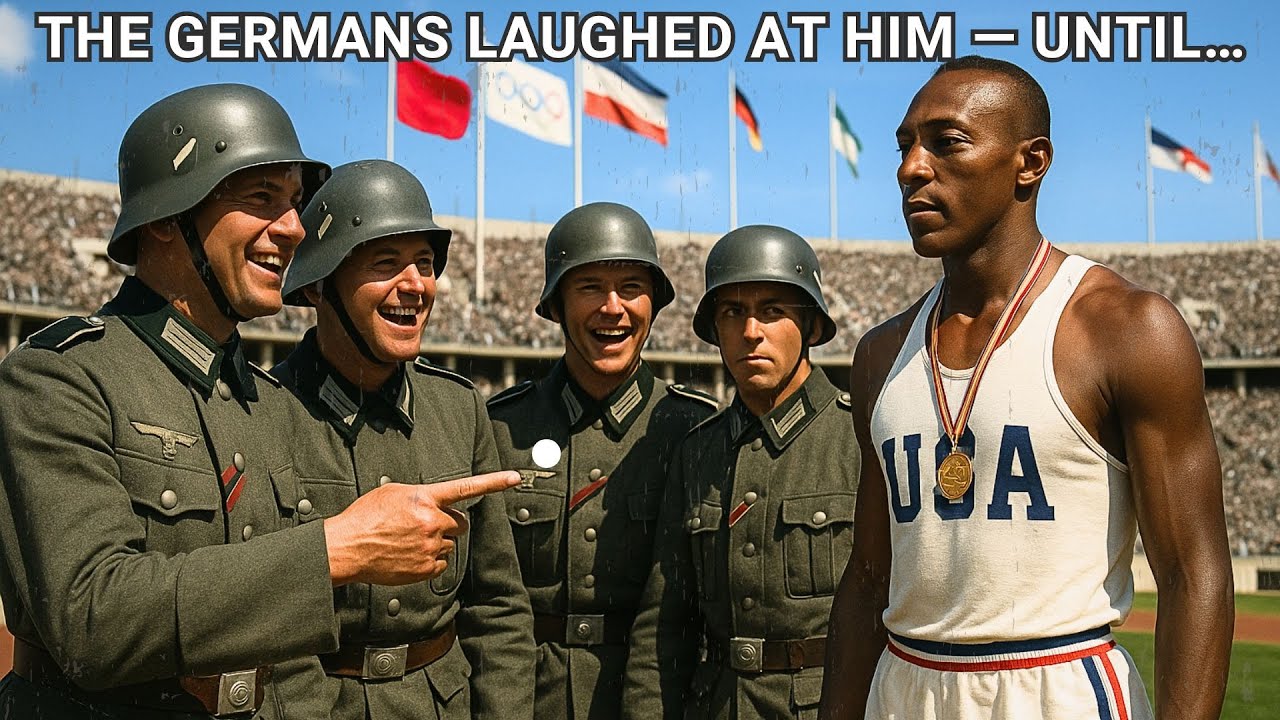
August 1st, 1936. Opening ceremony. The day dawned gray and drizzly, unseasonably cool for August in Berlin. But that didn’t dampen the spectacle Hitler had planned. At 300 p.m., the athletes began marching into the Olympia Stadion, team by team in alphabetical order. As the Americans entered, 110,000 Germans stood and watched. Some cheered, some gave the Nazi salute, arms raised, shouting, “Hile Hitler!” The sound was deafening, overwhelming, a wall of noise and ideology. The American team walked past Hitler’s box.
He sat surrounded by Nazi officials, watching with the intensity of a man who believed everything depended on the next two weeks. This was his Olympics, his stage, his propaganda coup. The Hindenburg, the massive German airship, flew overhead, trailing the Olympic flag. A choir of 3,000 voices sang Deutseland Uber Alice. Everything bigger, louder, more impressive than any Olympics before. Hitler had commissioned composer Richard Strauss to conduct. Nothing was left to chance. Every moment choreographed for maximum impact, and cameras captured it all.
Lenny Reefentol, Hitler’s favorite filmmaker, had been given 1.5 million Reichs marks to document the games. She had cameras positioned throughout the stadium, some in pits dug into the ground for low angles, some on towers for sweeping vistas. Her film Olympia would be released in 1938 as a testament to Nazi glory and German athleticism. This was also the first Olympics broadcast on television. 25 viewing rooms across Berlin showed live feeds. The technology was primitive, the picture grainy, but it represented the future.
Hitler understood media, understood propaganda, understood that controlling the image meant controlling the narrative. The torch relay was introduced for the first time at these Olympics. A runner carrying a flame all the way from Olympia, Greece to Berlin, passing it from person to person across Europe. The final runner entered the stadium and lit the Olympic cauldron. The flame would burn for the next 16 days. Hitler stood and proclaimed the games open. His voice echoed through the stadium. The crowd roared its approval and Jesse Owens sitting with his teammates in the American section felt the weight of what was coming.
Tomorrow the competitions would begin. Tomorrow he would run his first race. Tomorrow he would start proving what should never have needed proving. That night, Jesse couldn’t sleep. Lying in his bed in the Olympic village, he thought about the journey that had brought him here. From that sharecropper’s cabin in Alabama to a stadium in Nazi Germany, from picking cotton to setting world records, from poverty to standing on the edge of immortality. He thought about his family, Ruth and their daughters back home.
his parents who’d sacrificed everything to give him opportunities they never had. The teachers and coaches who’d believed in him when the world said he wasn’t worth believing in. He thought about every person who’d told him what he couldn’t do. Every racist who’d said black people were inferior, every system designed to keep him down, every obstacle placed in his path simply because of melanin in his skin. And he thought about Hitler sitting in that box seat, believing with absolute conviction that Jesse and the 17 other black athletes were subhuman, inferior, incapable of matching Aryan excellence.
Jesse smiled in the darkness. Tomorrow the education would begin. Tomorrow he would show Hitler and the world what happens when talent meets opportunity. When excellence is given a stage. When artificial barriers fall before natural ability, tomorrow, the Buckeye Bullet would start his sprint toward history. And nothing, not racism, not Nazi ideology, not the most powerful dictator in Europe, would be fast enough to stop him. August 2nd, 1936. Morning. Olympic Village. Jesse woke up with his stomach in knots.
Not fear exactly, something else. Anticipation mixed with pressure mixed with the weight of everything riding on the next few hours. His first event, the 100meter dash, the race that would determine if all the hype, all the expectations, all the world records meant anything when it mattered most. Ralph Metaf stopped by his room. Ralph, the 26-year-old leader of the Black Athletes, the man who’d won Olympic silver four years earlier in Los Angeles, who’d been considered the fastest man on the planet in 1934 and 1935.
Who knew exactly what Jesse was feeling because he’d lived it. “You ready?” Ralph asked. Jesse nodded. “Ready as I’ll ever be. Remember what I told everyone on the ship. We’re here to represent our country. We’re here to run. Everything else is noise. Just focus on the track. Good advice. But easier said than done when you’re about to compete in a stadium filled with 110,000 Germans. Many of them convinced you’re subhuman. When the dictator who built an ideology on your supposed inferiority is sitting in his box watching, when every major newspaper in the world is waiting to see if you’ll crack under the pressure.
Jesse later admitted that the 100 meters terrified him more than any other event in Berlin. The long jump, he held the world record. The 200 m, he dominated that distance. But the 100 m was different. It was the marquee event, the race everyone watched. Winning it meant becoming known as the fastest human being on Earth. And Jesse wanted that title more than anything. 10:30 a.m. First heat. Jesse walked into the Olympia Stadium and felt the atmosphere hit him like a physical force.
The massive concrete structure. The sea of faces. The Nazi flags hanging alongside Olympic banners. Cameras everywhere. Lenny Reefenstall’s crews positioned in pits and on towers capturing every angle for posterity and propaganda. And noise. So much noise. 110,000 people creating a sound that seemed to shake the ground itself. Jesse found his lane, checked his starting blocks. These weren’t the solid blocks used in modern competition. In 1936, runners dug holes in the cinder track with tels, created their own starting positions.
The track itself was cinder, not synthetic turf. When it rained, the surface became messy and uneven. The shoes were heavy leather with spikes, nothing like the lightweight footwear that would come later. The starter raised his gun. Jesse crouched in his holes, fingers behind the line. Every muscle tensed, ready to explode. The gun fired. Jesse launched himself forward like he’d been shot from a cannon. His form was perfect, arms pumping, legs churning, head up, driving toward the finish line with everything he had.
He crossed the tape in 10.3 seconds, tying the Olympic record in his first race in front of Hitler and the world. The crowd erupted. And here’s something the American newspapers didn’t expect. The German spectators cheered loudly. They’d come to see great athletics and Jesse Owens was delivering something spectacular. Nazi ideology be damned. They recognized excellence when they saw it. Jesse qualified for the quarterfinals. No surprise there, but the statement was made. The Buckeye bullet from Ohio State had arrived.
3 p.m. quarterfinals, same stadium, bigger crowd, more pressure. Jesse lined up again. The gun fired. Jesse exploded. This time even faster. He crossed the finish line in 10.2 seconds. The world record, breaking his own mark set two months earlier at the Olympic trials. Except the judges ruled the wind assistance was too great. The time wouldn’t count for official record purposes. But everyone watching knew what they’d seen. Jesse Owens running faster than any human had ever been timed.
The crowd went wild again. “Who is Jesse?” they’d been chanting before the races. “Where is Jesse?” Now they were watching him demolish records and field alike. Some German spectators gave the Nazi salute to Hitler. Others just clapped and cheered for the remarkable athlete destroying the competition. Jesse qualified for the semi-finals. Again, no surprise, but the confidence was building. The nerves settling. He’d run two races, won both easily, tied or broken records in both. The pressure that had felt crushing that morning was transforming into momentum.
Semi-finals later that afternoon. One more race before the final tomorrow. Jesse needed to conserve energy while still running fast enough to qualify easily. It was a delicate balance. Push too hard, waste energy. Don’t push enough, risk not making the final. Jesse ran smart. He qualified for the final without burning himself out. Ralph Metaf qualified, too. The Netherlands tinus. Osandarp made it through. Germany’s Eric Bormeer, their great hope for stopping the Americans, also qualified. The final would be tomorrow, August 3rd.
Jesse had survived day one. Three races, three victories, no problems. But as he left the stadium, walked back through the Olympic Village, ate dinner with his teammates, he couldn’t stop thinking about the final. Tomorrow was when it mattered. Tomorrow was when the gold medal would be won or lost. Tomorrow was when he’d either become the world’s fastest human or just another runner who couldn’t handle the biggest stage. That night, Jesse barely slept again. His mind wouldn’t shut off, running through the race over and over, visualizing the start, the drive phase, the finish, imagining every scenario.
What if he stumbled? What if someone had a perfect race and beat him? What if all the pressure finally crushed him at the worst possible moment? Ralph’s words echoed in his head. Focus on the track. Everything else is noise. August 3rd, 1936. Late afternoon, the day of the 100meter final. Jesse had spent the entire day in controlled anxiety, trying to stay loose, trying to stay focused, trying not to think about the magnitude of what was coming. Other events had filled the stadium.
Other athletes had competed. But everyone knew what the main event was, the 100meter final. Jesse Owens against Ralph Metaf against the best sprinters in the world. 5:45 p.m. The call came for the finalists to report to the track. Jesse walked into the stadium and the crowd noise hit him again. Bigger than yesterday, louder, more intense. The entire world was watching. Not metaphorically, literally. These were the first Olympics broadcast on television. Cameras were transmitting live to viewing rooms across Berlin.
Radio broadcasts were going out to dozens of countries. Newspapers from every major city had reporters in the stadium. This was the most watched sporting event in history to that point. Hitler sat in his box surrounded by Nazi officials. Yseph Gerbles, the propaganda minister, Herman Guring, Hinrich Himmler, the architects of Nazi ideology, watching to see if their theories would hold up or crumble on the track. Jesse found his lane, lane three. Ralph Metaf was in lane four, right next to him.
Old rivals, college competitors, friends, about to run for Olympic gold. Jesse dug his starting holes, checked them twice, positioned himself, looked down the track at the finish line 100 meters away. The distance seemed both impossibly short and infinitely long. The starter raised his gun. Jesse crouched, hands behind the line, weight balanced, every nerve in his body firing. This was it. Everything came down to the next 10 seconds. On your marks, Jesse settled into position. set,” he tensed, ready to explode.
Bang! The gun fired and Jesse erupted from his starting position. The first three steps were everything, getting the angle right, driving forward, building momentum. By 10 m, Jesse was slightly ahead. By 20 m, he’d opened up a small lead. By 30 m, the race was effectively over. Jesse had already decided it in his favor. His form was perfect. His speed was overwhelming. The other runners were fast, the best in the world, but they weren’t Jesse Owens. Behind him, Ralph Metaf was running the race of his life.
At 70 m, Ralph broke free from the pack, pulling into clear second place. But Jesse was untouchable. The lead was insurmountable. Jesse crossed the finish line in 10.3 seconds, tying the Olympic record. Again, his third race at that time. Consistent, dominant, undeniable. Ralph finished in 10.4 seconds. Silver medal. Tinus Osendarp took bronze in 10.5 seconds. Eric Bormeer, Germany’s Hope, finished fifth. Almost half a second behind Jesse. An eternity in sprinting. Jesse crossed the line and felt something he’d never felt before.
Relief mixed with elation mixed with validation. He’d done it under the most intense pressure imaginable. In front of Hitler, in front of the world, he’d proven he was the fastest human on earth. The crowd erupted in what Jesse would later describe as one of the greatest ovations of his entire career. “Woo, Jesse,” they’d been chanting. “Now they had their answer. Jesse Owens was standing on their track, demolishing records, defying expectations, proving that excellence transcended race and ideology.” German spectators cheered.
Many gave the Nazi salute to Hitler. Many others simply applauded genuine athletic greatness. Even in a stadium decorated with swastikas, even in a nation gripped by racist ideology, people recognized what they were witnessing. Something special, something historic. Jesse raised his arm in acknowledgement, smiled, waved to the crowd, then turned to congratulate Ralph. They’d trained together, competed against each other for years, and now they’d taken gold and silver for America in front of Adolf Hitler. Not bad for two black kids who weren’t supposed to be able to compete with white athletes.
But here’s where the story gets interesting and where myth starts to overtake reality. American newspapers immediately started reporting that Hitler had stormed out of the stadium, that he’d refused to congratulate Jesse, that he’d been so angry at seeing a black man win that he couldn’t bear to watch. It made for a great story. Hitler humiliated. The Nazi myth of Aryan supremacy shattered. The dictator running away from the evidence of his own ideological failure. Except it didn’t happen that way.
Here’s what actually occurred. On August 1st, the first day of track and field competition, Hitler had congratulated German winners and a few Finnish athletes. The Olympic Committee leadership got angry. Told Hitler he had to congratulate all medal winners or none at all. No playing favorites. Those were the rules. Hitler chose none. After day one, he stopped congratulating any athletes. Period. When Cornelius Johnson won the high jump on August 2nd, Hitler didn’t congratulate him. When Jesse won the 100 meters on August 3rd, Hitler didn’t congratulate him, not because Jesse was black, but because Hitler had decided to stop acknowledging all winners.
Jesse himself later confirmed this. Said Hitler had waved at him, that they’d exchanged acknowledgements, that the whole snub story was fabricated by American newspapers looking for drama. Hitler had a certain time to come to the stadium and a certain time to leave. Jesse explained later. It happened he had to leave before the victory ceremony. But before he left, I was on my way to a broadcast and passed near his box. He waved at me and I waved back.
But the myth was more powerful than the truth. The story of Hitler storming out became gospel. Still is in many history books because it fit the narrative perfectly. Good versus evil. Black athlete versus racist dictator. Democracy versus fascism. The reality was more nuanced. Hitler didn’t storm out. He didn’t throw a tantrum. He just followed the Olympic Committee’s directive and stopped congratulating anyone. But that doesn’t make for as dramatic a headline. What mattered more than Hitler’s reaction was the crowd’s reaction.
And the crowd loved Jesse Owens. They chanted his name, gave him standing ovations, asked for his autograph when they saw him outside the stadium. German citizens living under Nazi rule, celebrating a black American athlete who represented everything their government claimed was inferior. That disconnect mattered. It showed that propaganda had limits. That witnessing excellence in person could override years of indoctrination. That human nature’s appreciation for greatness transcended politics. Evening, August the 3rd. Jesse stood on the victory podium, gold medal around his neck, the American flag rising on the center pole, the star spangled banner playing over the loudspeakers.
To his right, Ralph Metaf stood on the silver medal platform, also American, also black, also proving that the Nazi theories were garbage. To his left, Tinus Ozendarp of the Netherlands on the bronze platform. The photographers captured the moment. Jesse raising his right arm in salute as the anthem played, the smile on his face, the medals reflecting the late afternoon sun. Officials presented Jesse with a small potted oak tree. Every gold medalist received one, a German tradition, something to take home and plant as a living memory of Berlin, 1936.
Jesse accepted it with thanks, though he probably didn’t imagine the oak tree would die shortly after he got it back to America. The tree didn’t survive the journey, but the memory would last forever. Jesse was also given a diploma and a laurel wreath, traditional Olympic honors. He stood there, 22 years old, grandson of slaves, son of sharecroppers, now the fastest man in the world with an Olympic gold medal to prove it. “That’s a grand feeling standing up there,” Jesse said to reporters after the ceremony.
“I never felt like that before. The weight that had pressed down on him for months suddenly felt lighter. He’d won the first gold, the hardest one, the one that carried the most pressure, the one that determined whether he’d be remembered as great or just good. Now he had three more events to go, the long jump tomorrow, the 200 m the day after, and possibly the relay. Each one its own challenge, each one carrying its own pressure. But Jesse had proven something crucial.
He could perform under pressure. He could handle the biggest stage. He could run fast when it mattered. Most the first gold medal was in his pocket. The first nail in the coffin of Nazi racial ideology was hammered in. Back at the Olympic Village, the black American athletes celebrated. 18 men and women who’d made the journey into Hitler’s capital, who’d represented America despite the racism they faced at home, who’d competed with dignity and excellence and pride. Cornelius Johnson had won gold in the high jump the day before.
Dave Albrittton had taken silver in the same event. Now Jesse had the 100 meters. The Black Eagles were soaring and Germany couldn’t do a damn thing about it except watch. Jesse called Ruth back in America, told her about the race, about the crowd, about the gold medal. She cried with joy, asked when he’d be home, told him how proud she was, how the whole country was talking about him, how even the white newspapers couldn’t ignore what he’d accomplished.
That night, Jesse slept better than he had in weeks. The first victory was complete. The impossible had become real. The kid from Alabama who’d picked cotton and lived in poverty had just become an Olympic champion in front of the most powerful dictator in Europe. Tomorrow would bring new challenges. The long jump. An event where Jesse held the world record but would face fierce competition from Germany’s own lose long. An event where one mistake could cost everything. But tonight, Jesse Owens was the fastest man on earth.
The first gold medal was won. And Hitler’s myth of Aryan supremacy had taken its first major body blow. Three more golds to go. Three more chances to prove what should never have needed proving. Three more opportunities to show the world that human excellence knows no racial boundaries. The education of Adolf Hitler had begun. And Jesse Owens was the teacher Hitler never wanted but desperately needed. The fastest lesson in history was being taught on a cinder track in Berlin and the whole world was taking notes.
Jesse woke up with gold medal number one safely won. The 100 m was his fastest man on earth. Check. But there was no time to celebrate. Today brought two more events. First the 200 meter heats in the morning. Then the long jump qualifying and finals in the afternoon. And the long jump terrified him for a different reason than the 100 m had. In the 100, he worried about performance. In the long jump, he was walking into something more complicated.
Politics, pressure, and a German competitor who represented everything Hitler wanted the world to see. Lutz Long. Carl Ludvig Long, 23 years old, from Leipig, a law student and practicing lawyer, 6 feet tall, blonde hair, blue eyes, the physical embodiment of Hitler’s Aryan ideal, and the European record holder in the long jump. Long had jumped 7.87 m earlier in the year. Jesse held the world record at 8.13 m set during that legendary May 1935 day at the Big 10 Championships.
But records set in practice or regular competitions don’t always translate to Olympic finals. The pressure was different. The stakes were different. Jesse ran his 200 meter heat first. Made it look easy. Cruz threw in 21.1 seconds, setting a new Olympic record without even pushing hard. One heat down. Now for the main event afternoon long jump qualifying. The rules were straightforward. 43 jumpers from 27 nations. Each athlete got three attempts. Jump 7.15 m or better, you advanced to the finals.
Fail to hit that mark in three tries. Go home. For Jesse, who jumped 8.13 m the year before, this should have been a formality, a warm-up. No pressure. Except Jesse was feeling the pressure in ways he hadn’t anticipated. He stood at his starting mark, looking down the runway toward the takeoff board and the sand pit beyond. 110,000 Germans in the stands. Hitler in his box, cameras everywhere, the weight of expectations, the memory of yesterday’s gold medal, the knowledge that another victory today would drive another nail into the coffin of Nazi ideology.
Jesse started his approach, building speed, arms pumping, legs driving. He hit the takeoff board and launched himself into the air. Foul. He’d overstepped the board by inches. The officials raised the red flag. Jesse’s first attempt didn’t count. He walked back, frustrated, but not worried. Two attempts left. No problem. Second attempt. Jesse adjusted his starting position slightly. approached the board, built up speed, hit his mark, and flew. Foul again. Red flags went up. The officials were clear. Another overstep.
Two fouls. One attempt remaining. Now Jesse was worried. Actually worried. He sat on the field, head in his hands. This wasn’t supposed to happen. He was the world record holder. Qualifying at 7.15 m should have been automatic, but the pressure, the occasion, something was off. His approach wasn’t right. His timing was wrong. And he had one jump left to save himself from the humiliation of not even making the finals. One more foul and Jesse Owens, world record holder, Olympic 100meter champion, would be eliminated from the long jump, going home with one gold when everyone expected four.
This is where the story gets interesting and where history and legends start to blur. Jesse later told a story that became famous, iconic, the kind of tale that gets repeated in books and documentaries and taught in schools. He said that as he sat there dejected and panicking, LS Long walked over to him, the German competitor, Hitler’s perfect Aryan specimen, and Long offered him advice. According to Jesse’s version, Long suggested he move his takeoff mark back, start his jump well before the board.
Jesse could jump 7.15 meters in his sleep. Long supposedly said, “Why risk fouling when all he needed was to qualify? Start a foot before the board, make a legal jump, advance to the finals.” It’s a beautiful story. The German athlete helping the American rival. sportsmanship transcending politics, humanity defeating hatred, long risking his own chances at gold to help Jesse right in front of Hitler and the Nazi leadership who believed in Aryan supremacy and black inferiority. The only problem, it might not have happened exactly that way.
Decades later, sports journalist Grantland Rice, who was at the Olympics with binoculars trained on Jesse during qualifying, said he never saw Jesse and Long talk. Tom Ecker, another sports historian, asked Jesse directly about it in 1965. And Jesse admitted they hadn’t actually met until after the competition was over. Those stories are what people like to hear, Jesse reportedly said. So you tell them. So what actually happened? The truth is probably this. Jesse fouled twice. He panicked. He adjusted his approach on his own, started further back from the board, and made his third jump without fouling.
But the deeper truth, the truth that actually matters is that Jesse Owens and LSE Long did become genuine friends. And what happened after the competition was absolutely verifiably real and more powerful than any advice given during qualifying. Third attempt, last chance. Jesse stood at his mark, adjusted his position back from where he’d started the first two jumps. This time he’d play it safe. Make sure he didn’t foul. The distance didn’t matter. He just needed to clear 7.15 m.
He ran down the runway, hit his takeoff point, launched into the air, landed in the sand, 7.64 m, well over the qualifying mark. Legal jump. He was through to the finals. Jesse stood up, brushed the sand off himself, and felt relief wash over him. Crisis averted. He’d made it. Now for the finals, where the real competition would begin, the finals. Later that afternoon, 12 jumpers qualified. Jesse Long, Naoto, Tajima from Japan, the bronze medalist from 1932, 10 others.
But everyone knew the gold medal would come down to Jesse and LSE. The format. Six jumps each. Best jump wins. Olympic records on the line. World records within reach. First round. Jesse stepped to his mark. No more mistakes. No more fouls. Time to show why he held the world record. He sprinted down the runway, hit his mark perfectly, exploded off the board, flew through the air, arms and legs extending. Landing 7.87 87 m 25 ft 9 and 3/4 in.
New Olympic record on his first jump. Jesse had just beaten the old Olympic record by more than an inch. The crowd erupted. Even German spectators recognized the excellence on display. But LE Long wasn’t finished. Third round. Long took his approach, built speed, launched himself, landed 7.84 84 m, just 3 cm behind Jesse’s mark. The German had also beaten the old Olympic record. This was going to be a battle. Fifth round, Long stepped up again, this time perfect, 7.87 m.
He’d matched Jesse’s Olympic record from the first round. The two were tied. The pressure was immense. Gold medal hanging in the balance. Jesse had two jumps left. Fifth and sixth rounds. He needed something special. Fifth jump. Jesse’s approach was flawless. The takeoff clean. The flight phase beautiful. He landed deep in the sand. 7.94 m. 26 ft and 1/4 in. New Olympic record again. Jesse had pulled ahead by 7 cm. But he wasn’t done. Sixth and final jump.
One more chance to make a statement. Jesse ran down the track like he was being chased. Hit the board. Launched himself with everything he had. Flew further than he had all day. Landed. 8.06 m. 26 ft 5 and 1/4 in. Olympic record again. The third time Jesse had broken or matched the Olympic record in one competition. And while it wasn’t his world record of 8.13 m from 1935, it was dominant, decisive, undeniable. Long finished with 7.87 m, silver medal, still an incredible performance.
He’d matched Jesse’s earlier Olympic record, but Jesse had simply been better when it counted most. Naoto Tajima of Japan took bronze with 7.74 m. And then something happened that made the history books for reasons having nothing to do with the actual jumping. The competition ended. Jesse stood near the sand pit celebrating his second gold medal in his many days. And Loose Long walked over to him. Not to offer congratulations from a distance, not a polite handshake and retreat.
loose long. Hitler’s perfect Aryan specimen. The blond-haired, blue-eyed German long jumper embraced Jesse Owens, a black American in front of 110,000 German spectators. In front of Adolf Hitler, in front of the world, they stood there, arms around each other, talking and laughing. Two competitors who just battled for Olympic gold. Two men who represented opposite sides of a massive ideological divide. Two humans who recognized in each other something more important than politics or race or national pride. Lenny Reefenstall’s cameras captured it.
The image of Jesse Owens and Loose Long walking arm in-armm through the Olympic stadium. It’s one of the most iconic photographs from the 1936 Olympics. And it represented everything Hitler’s ideology couldn’t explain away. The German spectators cheered for both men. They’d just witnessed one of the greatest long jump competitions in Olympic history. Two athletes pushing each other to excellence, breaking records, creating moments that would echo through time. Nazi officials in Hitler’s box were reportedly furious. Loose Long would later be scolded by Nazi party members for his public friendship with Jesse.
But in that moment, Long didn’t care. He just competed in the Olympics, won a silver medal, and made a friend in the process. Jesse later said about that moment, “It took a lot of courage for him to befriend me in front of Hitler. You can melt down all the medals and cups I have and they wouldn’t be a plating on the 24 karat friendship I felt for LS Long at that moment.” Think about that. Jesse Owens, who would win four gold medals, said the friendship he formed with LS Long was worth more than all his medals combined.
That’s not hyperbole. That’s not sentimentality. That’s Jesse recognizing something profound. That human connection, genuine respect between competitors transcended everything else happening in that stadium. The medal ceremony came later. Jesse on the top platform, gold medal around his neck. Loose on the second platform to his right, silver medal gleaming. Now Tajima on the third platform, bronze. The German flag rose alongside the American flag. The anthems played. Jesse saluted, accepted his second potted oak tree, his second diploma, his second Olympic victory in two days.
But the real victory, the one that mattered beyond medals and records, was the friendship that had formed between Jesse and Loose. And that friendship didn’t end when the Olympics did. After Berlin, Jesse and Loose stayed in contact. They wrote letters to each other, shared their lives, their hopes, their concerns as Europe moved closer to war. Jesse back in America dealing with the racism and lack of opportunities waiting for him. Loose in Germany watching his country descend into madness and militarization.
When World War II broke out in September 1939, the letter stopped for a while. Loose was serving in the German military. Jesse was in America watching from across the ocean as Europe tore itself apart. Then in 1942 or 1943, Jesse received one final letter from LSE written from somewhere in North Africa or Italy where German forces were fighting Allied troops. The letter was brief but devastating. Things become more difficult and I am afraid, Jesse. Not just the thought of dying.
It is that I may die for the wrong thing. But whatever might become of me, I hope only that my wife and son will stay alive. I am asking you who are my only friend outside of Germany to someday visit them if you are able to tell them about why I had to do this and how the good times between us were. It was signed simply loose. On July 14th, 1943, Loose Long died in Sicily. He’d been wounded during the Allied invasion of Italy and succumbed to his injuries.
He was 30 years old, a husband, a father to a young son named Kai, a lawyer, an Olympic silver medalist, and a man who’d had the courage to embrace an enemy of his state’s ideology in front of 110,000 witnesses. When Jesse heard about Luc’s death, he was devastated. He’d lost one of his truest friends, a man who’d shown him that humanity could exist even in the darkest political circumstances. That individual character could transcend national propaganda. Years later, in 1951, Jesse traveled to Germany.
He’d promised loose he would find his son, and Jesse Owens kept his promises. He met Kai Long, then 10 years old, told him about his father, about the long jump competition, about the friendship they’d formed, about how LSE had been brave enough to see a person instead of a political pawn, about how their friendship had meant more to Jesse than all his Olympic medals combined. That meeting was filmed in 1966 for a documentary called Jesse Owens Returns to Berlin.
The footage shows Jesse and Kai walking through the Olympic Stadium. Jesse telling stories about LSE. Kai listening intently to tales about the father he barely remembered. The friendship extended to the next generation. Jesse became close with Kai. Later, Jesse’s granddaughter Marlene and Luc’s granddaughter Julia met at the 2009 World Championships in Berlin. 73 years after the 1936 Olympics, the families were still connected, still honoring the friendship that had formed in a sand pit in Nazi Germany. Evening August 4th, 1936, Jesse sat in the Olympic village with his second gold medal.
Two events down, two golds won, two Olympic records set, and he’d made a friend who would influence him for the rest of his life. Tomorrow would bring the 200 meter final, then possibly the relay, four golds within reach. But tonight, Jesse reflected on something bigger than medals. He’d just witnessed humanity triumphing over hatred in real time. A German athlete living under Nazi rule, surrounded by propaganda about Aryan supremacy and racial hierarchy, had chosen friendship over ideology, had embraced a black American in front of Hitler, had risked social and political consequences to acknowledge that competition and respect and genuine human connection mattered more than the politics surrounding them.
Jesse wrote in his diary that night about loose, about the courage it took, about what it meant, about how he hoped the world was watching and learning. The world was watching, but whether it was learning remained to be seen. Two gold medals down, two more to go, and every victory was another blow against the foundations of Nazi ideology. Every time Jesse stepped on a podium, every time he broke a record, every time he proved his excellence on the world’s biggest stage, the lies about racial inferiority crumbled a little more.
Tomorrow, the 200 meters, another race, another chance to prove what should never have needed proving. Another opportunity to show that greatness has nothing to do with skin color and everything to do with character, dedication, and heart. But tonight, Jesse Owens had a friend, a German friend who’d seen past the propaganda to the human being beneath. And in 1936, Berlin, that might have been the greatest victory of all. Jesse had already won two gold medals, the 100 meters, the long jump, both with Olympic records, both dominant performances.
And now, just hours after the emotional long jump victory and the friendship with Loose Long, he had to run again. The 200 meter heats, the first step toward a third gold medal. Another chance to prove what shouldn’t need proving. Another opportunity to hammer another nail into the coffin of Nazi racial theory. But Jesse was exhausted. Not just physically, though. 4 days of constant competition were taking their toll. Mentally, emotionally, the pressure never stopped. Every event carried the weight of history.
Every race was about more than just running fast. It was about proving human worth, about challenging an ideology that declared him inferior, about representing millions of black Americans who saw themselves in his success. Some athletes thrive on that kind of pressure. Feed off it. Let it fuel them. Jesse was learning to do that, but it didn’t mean the weight wasn’t heavy. The 200 meter dash was different from the 100, twice the distance, more about endurance and speed management, about maintaining form through a curve and then exploding down the straightaway.
Jesse had set world records in the 220 yard dash back at the Big 10 Championships. This was his distance as much as the 100 was. The heats were scheduled for late morning, right before the long jump qualifying. Jesse would literally go from running 200 meters to jumping for distance within hours. The Olympic schedule was brutal. No rest, no recovery time, just event after event, demanding peak performance each time. Jesse’s heat was stacked with good runners, but not great ones.
Not anyone who could match his speed when he was on. Still, he couldn’t take anything for granted. One mistake, one false start, one moment of overconfidence, and he’d be eliminated. The gun fired, Jesse exploded out of the blocks. His form through the curve was textbook perfect, arms pumping, legs churning, maintaining speed without burning out early. Coming out of the curve into the straightaway, he opened up his stride. Let his natural speed take over. He crossed the finish line in 21.1 seconds.
new Olympic record. Just like that, in a preliminary heat, he’d broken the Olympic record without even pushing to his absolute limit. The German crowd recognized it, cheered. “Jesse, Jesse,” they chanted. The man they’d been told was inferior, kept proving otherwise, and they couldn’t help but appreciate the excellence on display. Jesse’s teammate, Bob Packard, won his heat in 21.2 seconds. close to Jesse’s record, but not quite there. The fastest American challenger seemed to be someone else, though. Someone who’d been flying under the radar while everyone focused on Jesse.
Mac Robinson, 22 years old, from Pasadena, California, a sprinter who’d finished second to Jesse at the US Olympic trials. Now, he was cruising through his heats with times that suggested he might actually challenge Jesse for gold. Mac Robinson. Remember that name. His younger brother, Jackie, was 13 years old back in Pasadena, watching his older brother compete in the Olympics. Jackie would later break baseball’s color barrier in 1947, becoming the first black player in Major League Baseball. But in 1936, it was Mac’s turn to make history.
Mack advanced through his heats easily. Not as fast as Jesse, but confident. Smooth, dangerous. August 5th, 1936, the 200 meter semi-finals. Jesse had survived day four with three events, won the long jump, advanced in the 200 m, bonded with Luz Long in a friendship that would last beyond the Olympics. Now it was day five, time for the semi-finals and finals of the 200 meters. Win today and Jesse would have three gold medals in three consecutive days. something unprecedented, something that would cement his place in Olympic history regardless of what happened in the relay.
The semi-finals were about managing energy while still running fast enough to guarantee advancement to the finals. Jesse couldn’t coast, not with quality sprinters pushing him, but he couldn’t burn out either. The final would be later that same day, maybe just hours later. Jesse ran his semi-final smart, fast enough to win easily. Not so fast that he’d have nothing left for the final. He knew how to pace himself by now. Knew the difference between dominating and demolishing. But then M.
Robinson ran his semi-final and suddenly everyone watching realized the final wasn’t going to be a coronation. It was going to be a race. Matt crossed the finish line in 21.1 seconds, matching Jesse’s Olympic record from the Heats. For the first time in Berlin, someone had run a time equal to Jesse’s. Not just close, equal. The pressure ramped up immediately. Jesse was still the favorite, still the better athlete on paper. But Mack had just announced that he was coming for gold, that he wasn’t intimidated by Jesse’s reputation or his previous victories, that the final would be decided by who ran the better race, not who had the better resume.
Jesse heard about Mac’s time, nodded. Good competition made you better, pushed you to heights you couldn’t reach alone. If Mac was running 21.1 in the semi-finals, Jesse would just have to run faster in the finals. Later that day, the 200 meter final, Jesse Owens, M. Robinson, the two American sprinters, plus four others, including the Netherlands Tinus Osendarp, who’d taken bronze in the 100 m behind Jesse and Ralph. This was Jesse’s eighth race in Berlin. He’d won all seven previous races, seven heats, quarterfinals, semi-finals, and finals.
Seven victories, no losses. But eight races in five days, that was a lot of wear on a body, on muscles and joints and tendons that were being pushed to their absolute limits. Jesse stood at his mark in the 200 meter final, looked around the stadium, 110,000 Germans, Hitler in his box, cameras everywhere, history watching. He thought about the journey that brought him here. Oakville, Alabama, Cleveland, Ohio, Ohio State, the Big 10 Championships, the Olympic trials, the ship to Germany, the Olympic Village, two gold medals already won, and he thought about what winning this race would mean.
Three golds in three days, something no track athlete had done at these Olympics, something that would prove once more that excellence transcended race. that Nazi ideology was built on lies. That human potential couldn’t be limited by skin color or origin or anything except the content of your character and the strength of your dedication. The gun fired. Jesse erupted from the blocks. The start was crucial in the 200. Get behind early. Spend the whole race trying to catch up.
Get ahead early. Dictate the pace and make everyone else chase. Jesse got ahead early. By the time he hit the curve, he was already in front. His form through the turn was perfect, leaning into it, arms pumping in rhythm, legs driving, maintaining speed without losing balance or form. Coming out of the curve, Jesse opened his stride. This was where the race was won or lost. The straightaway, the final 100 m, where pure speed and endurance met, where conditioning and talent and will all collided.
Jesse was flying, moving faster than he had in any of his previous seven races. The pressure, the competition from Mack, the desire to cement his legacy, all of it combined into one explosive performance. Behind him, M. Robinson was running the race of his life. Matching Jesse’s pace through the curve, staying close down the straightaway, but not close enough, Jesse had found another gear, something extra that only champions possess. Jesse crossed the finish line and immediately looked for the clock.
Time 20.7 seconds. Olympic record again. For the third time in the 200 meter event, Jesse had set a new Olympic record. And this one was massive. He destroyed his previous Olympic record by 4/10en of a second. In sprinting, that’s an eternity. That’s the difference between good and legendary. It was also an unofficial world record for the 200 m run on a curved track. The official world record was for a straight 200 meter track, which was slightly different.
But everyone watching knew they’d just witnessed something special. Something that wouldn’t be matched for decades. Mac Robinson finished in 21.1 seconds. Silver medal, 4/10en of a second behind Jesse. It was a fantastic time. would have won gold in almost any other Olympics, but not this one. Not against Jesse Owens at the peak of his powers. Tinus Osondarp took bronze again with 21.3 seconds. The Dutchman was having a hell of an Olympics. Bronze in the 100 m, bronze in the 200 m.
Not winning gold, but standing on the podium twice against the best sprinters in the world. Jesse walked over to Mac, shook his hand, congratulated him. They were both black Americans. Both from backgrounds that said they shouldn’t be here. Both proving the world wrong together. Mack had pushed Jesse to his fastest 200 m of the Olympics. That deserved respect. The German crowd erupted again. For the eighth time in 5 days, Jesse Owens had won a race in the Olympia Stadium.
For the third time, he’d won gold. And the crowd, despite living under Nazi rule, despite years of propaganda about racial hierarchy, couldn’t help but recognize greatness. They chanted his name. Jesse. Jesse. Jesse. The sound echoing through the massive stadium. Hitler sat in his box, stonefaced. Gerbles beside him, calculating how to spin this for propaganda purposes. the Nazi leadership trying to figure out how to explain that their Aryan athletes kept losing to black Americans. There was no explanation that worked.
The results spoke for themselves. Excellence was excellence. Speed was speed. And Jesse Owens was faster than everyone else. Medal ceremony. Later that day, Jesse stood on the top platform for the third time. Gold medal number three around his neck. The American flag rising on the center pole. The national anthem playing for him again. M. Robinson stood to his right on the silver platform. Also American. Also black. Also proving Nazi theories wrong. Two black Americans on the medal stand in Hitler’s Germany.
The symbolism was overwhelming. Tenisarp stood on the bronze platform to Jesse’s left. Third place for the second time. Officials presented Jesse with another potted oak tree, another diploma, another moment of Olympic glory, three gold medals in three consecutive days. August 3rd, the 100 m. August 4th, the long jump. August 5th, the 200 m. Three events, three golds, three Olympic records, and one more event to go. The 4x 100 meter relay was scheduled for August 9th. 4 days away, 4 days to rest, to recover, to prepare for one more race, one more chance at Olympic gold, one more opportunity to make history.
If Jesse won the relay, he’d have four gold medals, something no American track athlete had ever done at a single Olympics. Something that would stand as his ultimate achievement. the perfect response to everyone who doubted him. The perfect answer to Hitler’s racist ideology. But the relay came with complications. Politics, controversy, decisions that would haunt American Olympic officials for decades. Jesse didn’t know it yet, but the fourth gold medal would cost more than just physical effort. For now, though, Jesse celebrated.
Three golds, eight races, won. Zero losses. in front of Hitler, in front of the world. The kid from Alabama who’d picked cotton and lived in poverty had just become one of the greatest Olympic athletes in history. And he’d done it with grace, with dignity, with respect for his competitors and love for the sport. Jesse hadn’t gloated, hadn’t rubbed his victories in anyone’s face. He’d just run fast, jumped far, and treated everyone around him with the humanity they deserved.
That night, back in the Olympic Village, the black American athletes gathered to celebrate. Cornelius Johnson with his high jump gold. Dave Albrittain with his high jump silver. Jesse with his three golds. John Woodruff who’d won the 800 meters. Archie Williams and James Laval who’d meddled in the 400 meters. M. Robinson with his 200 meter silver. 18 black athletes had come to Berlin and they were dominating, winning medals, breaking records, making Hitler’s Olympics into a showcase of black excellence rather than Aryan superiority.
The irony wasn’t lost on anyone. They were experiencing racial integration in Nazi Germany that they couldn’t experience in many parts of America. living in the Olympic village with white athletes, eating in the same dining halls, training on the same grounds, using the same facilities. Back home, many of them couldn’t vote, couldn’t eat in white restaurants, couldn’t stay in white hotels, faced violence and discrimination at every turn. But here in the capital of Nazi Germany, they were Olympic champions, heroes.
Living proof that the racist theories of both Hitler and Jim Crow America were lies. Jesse lay in his bed that night. Three gold medals stored safely in his room. Three potted oak trees that probably wouldn’t survive the journey home. Three moments of Olympic glory that would last forever. He thought about Ruth and his daughters back in Cleveland. they’d be proud, celebrating, telling everyone they knew about Jesse’s victories. He missed them, wanted to share this with them. But four more days, one more race, then he could go home.
Then he could hold his family and show them the medals and tell them the stories. Tomorrow was a rest day. No competitions, no races, just recovery. Letting his body heal from 5 days of intense competition. preparing for the relay, enjoying being an Olympic champion for a moment before diving back into the pressure. Three down, one to go, and Jesse Owens was ready to make history one more time. The German newspapers the next morning couldn’t ignore the results.
Even the Nazi papers had to report Jesse’s victories, though they twisted the coverage, trying to diminish the significance, suggesting that black athletes had natural advantages that made their victories less impressive. The propaganda machine working overtime to explain away what couldn’t be explained away. But the German people who’d watched in person knew the truth. They’d seen Jesse Owens run, seen him jump, seen him compete with honor and grace, and no amount of propaganda could erase what they’d witnessed with their own eyes.
Excellence is undeniable. Greatness transcends politics, and Jesse Owens, in three days of competition, had proved both those things beyond any doubt. The fourth gold medal awaited. But first, rest, recovery, and the knowledge that no matter what happened in the relay, Jesse Owens had already secured his place in Olympic history. Already proved what needed proving, already shown the world what a black man from Alabama could accomplish when given the chance. Hitler’s Olympics were supposed to showcase Aryan supremacy.
Instead, they were showcasing Jesse Owens. And that was a victory no medal could properly measure. Three gold medals, three world records destroyed. Hitler’s myth of Aryan supremacy lay in ruins on the track at Olympia Stadium. Jesse Owens had done what he came to Berlin to do. Proved everything that needed proving. Showed the world that excellence has no color. That talent doesn’t care about ideology. He should have been done. should have been able to rest, celebrate, let his body recover from the most intense week of competition any athlete had ever endured.
But there was one more event, the 4×100 meter relay. And what happened in the days leading up to that race would reveal something uglier than Hitler’s racism. Something that cut deeper because it came from Jesse’s own team, from America itself. August 7th, 1936, two days before the relay final. The American 4×100 relay team had been set for months. Marty Glickman, Sam Staler, Frank Wyoff, Foy Draper. Four sprinters who’d trained together, bonded, prepared for this moment. They were ready, fast, synchronized.
They had the gold medal locked. There was just one problem. Two of them were Jewish. Marty Glickman was 19 years old from Brooklyn. The son of Romanian Jewish immigrants, fast as lightning, confident, maybe too confident for some people’s taste. He’d made the Olympic team as the youngest member, earned his spot. This was supposed to be his moment. Sam Staler was 21, from Cincinnati, also Jewish, also brilliant, also ready. and they were about to learn a lesson about American anti-semitism that would haunt them for the rest of their lives.
The American coaches called a meeting. Lawson Robertson and Dean Cromwell, the decision makers. They had news about the relay team. Glickman and Staller were out. Jesse Owens and Ralph Metaf were in. The room went silent. Nobody understood. Why change a team that had been training together for months? Why mess with chemistry that worked? Why bench two talented sprinters who’d earned their spots? The coaches had their explanation ready. They’d heard rumors. Supposedly, the Germans were hiding their best sprinters, saving them for the relay, planning a surprise that would embarrass America.
The only way to guarantee victory was to put in the fastest men, Owens and Metaf, America’s best. It was Complete and transparent Germany wasn’t hiding secret sprinters. Jesse had already beaten their best runners, destroyed them. There was no mystery team waiting in the wings. The German relay squad was good, but not unbeatable. The original American team would have won easily. This wasn’t about winning. This was about something much uglier. Hitler was in the stands watching every race.
An American Olympic Committee president Avery Brundage along with the coaches didn’t want to embarrass Hitler by having Jewish athletes win gold medals on his stage in his stadium. They wanted to appease the furer, show him respect, accommodate his anti-semitism. American officials were protecting Hitler’s feelings. Think about that. They traveled thousands of miles to Berlin, brought their best athletes, watched Hitler’s ideology get demolished by Jesse Owens, and when given the choice between letting Jewish athletes compete or sparing Hitler’s discomfort, they chose Hitler.
Marty Glickman figured it out immediately, stood up in that meeting, and said what everyone was thinking. Coach, there’s no need to worry. Sam and I can win this race. We’ve been training for months. We’re ready. Robertson wouldn’t budge. The decision is made. Owens and Metaf are running. Glickman pushed harder. This is about us being Jewish, isn’t it? You don’t want Jews on the podium in front of Hitler. The coaches denied it, claimed it was purely strategic, just about winning.
Nothing personal. But their faces told a different story. Their silence said everything. Sam Staler sat there devastated. quiet, broken. He dreamed of this moment his entire life, trained for years, made the Olympic team, traveled to Berlin, and now 2 days before the race, he was being told he wasn’t needed. Not because he wasn’t good enough, but because of his religion. And then came the moment that made this betrayal complete. The coaches looked at Jesse Owens, the man who’d already won three gold medals, who’d proven everything, who was exhausted, whose body was screaming for rest.
Jesse, you’re running the relay. Jesse said, “No, not quietly. Not reluctantly, firmly. Definitely.” Number. I’ve won three gold medals. Jesse said, “I’m done.” Marty and Sam trained for this. They earned their spots. let them run. The room fell silent again. Jesse Owens, the star of the Olympics, the man who’d embarrassed Hitler, was refusing to compete, was standing up for two Jewish teammates he barely knew. Ralph Metaf backed him up. I agree with Jesse. The original team should run, but the coaches weren’t interested in solidarity, weren’t interested in fairness.
They knew exactly what buttons to push. Jesse Robertson said, “You need to think about your future, your career. There are a lot of people watching, a lot of important people. If you refuse to run, if you cause problems, that could affect your opportunities when you get home.” There it was, the threat, barely disguised. Compete or face consequences. Your choice. And Jesse Owens at 22 years old, carrying the weight of being America’s greatest Olympic hero, felt the trap close around him.
He looked at Glickman and Staler, saw the devastation on their faces, wanted to keep fighting, wanted to refuse, but he also thought about Ruth back home, his daughters, the opportunities he might lose, the doors that might close if he made the wrong people angry. The pressure wasn’t just about a race. It was about survival in a country that barely tolerated black excellence and would punish any hint of rebellion. Jesse agreed to run. Marty Glickman would later say that moment destroyed something inside him.
Not anger at Jesse. Never anger at Jesse. Glickman understood the impossible position Jesse was in. the choice Jesse was forced to make, but anger at the coaches, at the system, at America itself for putting profit and politics above fairness. Sam Staler never really recovered, would carry that betrayal for the rest of his life, not the betrayal of losing his spot. But the betrayal of learning that in 1936, even in the Olympics, even representing your country, being Jewish made you expendable.
And here’s the kicker. Avery Brundage, the American Olympic Committee president who supported removing the Jewish athletes, would later become president of the International Olympic Committee, the most powerful position in Olympic sports. He’d used that platform to maintain his sympathies toward Nazi Germany and his documented anti-semitism for decades. August 9th, 1936, the 4x 100 meter relay final. Jesse Owens lined up for his fourth race. Fourth gold medal attempt. The one he never wanted to run. The one that represented everything wrong with the Olympics he was dominating.
Frank Wyoff would run first leg, Ralph Metaf second, Foy Draper third, Jesse would anchor. Germany lined up in the next lane. Italy, Netherlands, Great Britain, Canada, all wanting to knock off the Americans. Hitler sat in his box watching, probably pleased that he wouldn’t have to watch Jewish athletes on his podium. Unaware that the American coaches had done his dirty work for him, the gun fired. Woff exploded from the blocks. Smooth handoff to Metaf. Perfect baton pass to Draper.
Then Draper to Jesse. Jesse took the baton in third place. Italy was ahead. Germany was competitive. And then Jesse Owens did what Jesse Owens did. He ran not with joy, not with the pure excitement he’d felt in his other races, but with professional precision, with the understanding that if he was forced to be here, he might as well finish the job. Jesse pulled away from the pack, lengthened his stride. The gap between him and second place grew with every step.
By the time he hit the finish line, the Americans had won by 15 yards. A blowout. New world record 39.8 seconds obliterating the previous mark. Four gold medals, four world records. The most dominant Olympic performance in history. Jesse crossed the line and didn’t celebrate. Didn’t throw his arms up. Didn’t smile for the cameras. He’d won. But the victory tasted like ashes. The American team stood on the podium. Gold medals draped around their necks. The national anthem played.
The flag rose. Everything looked perfect from the outside. But Marty Glickman and Sam Staler stood in the stadium watching. Two Jewish athletes who should have been up there, who earned the right to be up there, who were removed not because they weren’t good enough, but because their religion made powerful men uncomfortable. Jesse knew it. The whole team knew it. And later when historians analyzed what happened in Berlin, they’d recognize that moment for what it was. Not just anti-semitism from Hitler, but anti-semitism from America, the country that claimed moral superiority while accommodating the same prejudices it condemned in others.
Years later in 1998, the United States Olympic Committee officially acknowledged what happened, issued an apology to Marty Glickman and Sam Staler, admitted that the decision to remove them was based on anti-semitism. Too late to matter. Too late to give them back what was stolen, but at least an admission of truth. Glickman would go on to become one of America’s greatest sports broadcasters. Called Knicks Games for decades. became a legend in his own right. But he never stopped talking about Berlin.
Never stopped pointing out that American anti-semitism didn’t need Nazi encouragement. It was already there, already active, already making decisions. Sam Stalar never achieved the same success. The disappointment of Berlin seemed to follow him. He’d drift through jobs, struggle with the weight of what might have been, die in 1985, still carrying that pain. Jesse Owens walked away from the relay with his fourth gold medal, knowing the victory was complicated, knowing he’d been used as a tool in something ugly, knowing that standing up for Glickman and Staler might have cost him everything back home.
The photos from that day show Jesse on the podium looking tired, drained, not the exuberant champion from his other victories, but a young man who just learned that excellence wasn’t enough. That even when you’re the best in the world, you’re still playing in a system designed to break you. Four gold medals. Four times Jesse Owens stood on that podium while the Star Spangled Banner played. Four times he showed Hitler what humanity actually looked like. But that fourth medal came with a price.
A reminder that the enemy wasn’t just in Germany. The enemy was everywhere. In the coaches who made the call, in the officials who supported it, in the system that forced Jesse to choose between his conscience and his future. Berlin had shown the world Jesse Owens could beat Hitler’s ideology on the track. But it also showed something else. that America still had its own racial and religious prejudices to confront, and those would prove much harder to defeat than any German sprinter.
Jesse Owens left Olympia Stadium on August 9th, 1936 with four gold medals around his neck and the weight of the world on his shoulders. He’d won everything, proved everything, changed everything. Now came the hardest part. going home to a country that celebrated him as a hero but treated him as less than human. To a place where his Olympic glory would matter less than the color of his skin. Where the same nation that sent him to defeat Hitler’s racism would remind him daily of its own.
The Berlin Olympics were over. Jesse Owens had conquered Hitler. Now he had to face America. Four gold medals, four world records, one week that changed history forever. Jesse Owens had done the impossible. Walked into Hitler’s showcase of Aryan supremacy and systematically destroyed it event by event, race by race, until the whole world had to acknowledge what should have been obvious from the start. That human excellence has nothing to do with race. That talent doesn’t care about ideology.
That Hitler was catastrophically wrong. The German press tried to spin it. Tried to minimize what had happened. They called Jesse and the other black athletes American auxiliaries, implied they weren’t really American, suggested their victories didn’t count the same way. Desperate attempts to salvage the narrative Hitler had spent years building. It didn’t work. The truth was too obvious, too undeniable. Jesse Owens had become the face of the 1936 Olympics. The story everyone was talking about, the athlete who made a dictator look like a fool.
But here’s what most people don’t know about those final days in Berlin. The story behind Hitler’s reaction. What really happened in those moments when Jesse was on the podium and Hitler was in his box. The popular narrative says Hitler refused to shake Jesse’s hand. That he snubbed the black athletes out of racism. That he stormed out of the stadium rather than acknowledge Jesse’s victories. The truth is more complicated and in some ways worse. On the first day of competition, August 1st, Hitler had been in the stadium watching.
When German athletes won, he congratulated them personally, called them to his box, shook hands, posed for photos, made a big show of his pride in Aryan victory. But then some non-German athletes started winning. Cornelius Johnson, a black American high jumper, won gold. Hitler left the stadium before the medal ceremony. Didn’t acknowledge the victory. didn’t congratulate anyone. The Olympic Committee noticed, told Hitler he had two choices. Either congratulate all the winners publicly, regardless of nationality or race, or congratulate none of them.
No selective recognition. That was the rule. Hitler chose option two. No more public congratulations for anyone. He’d stay in his box, watch the races, but no more personal interactions with athletes during medal ceremonies. So when Jesse won his gold medals, Hitler wasn’t snubbing him specifically. He was following the Olympic Committee’s directive. He stayed in his box, watched, and by all accounts looked increasingly miserable as Jesse kept winning. But here’s what makes it worse. Hitler’s decision to stop congratulating athletes came specifically because black athletes were winning.
He’d have continued the congratulations if only German or acceptable white athletes were victorious. The policy change was itself racist, a way to avoid having to acknowledge black excellence while maintaining a veneer of neutrality. And there’s something else, something darker that rarely gets discussed. After Jesse’s victories, Hitler reportedly told his architect, Albert Shar, that the Americans had brought in unfair help, that allowing black athletes to compete was essentially cheating, that they were closer to animals than humans, and therefore had physical advantages that made competition meaningless.
This wasn’t a man who’d learned anything from Jesse’s performance. Wasn’t a man whose mind had been changed by watching undeniable excellence. Hitler doubled down, convinced himself that Jesse’s victories somehow proved his racial theories rather than demolished them. The cognitive dissonance was staggering. Hitler watched a black man destroy his best athletes, set world records, perform at levels that seemed superhuman. And his response wasn’t to question his ideology. It was to decide that Jesse wasn’t fully human. That the victories didn’t count because they came from someone he’d classified as inferior.
That’s the thing about racism, about any prejudice. It’s not rational. You can’t logic someone out of a position they didn’t logic themselves into. Hitler had built his entire worldview on racial supremacy. Watching Jesse Owens demolish that worldview didn’t change his mind. It just made him angrier. But while Hitler sat in his box making excuses, the rest of the world saw what actually happened. Saw a young black man from Ohio embarrassed the Third Reich on its own stage.
Saw excellence triumph over ideology. Saw talent destroy propaganda. The international press went wild. Jesse Owens was front page news everywhere, not just in sports sections. Front page headlines in New York, London, Paris, Tokyo. The fastest man in the world, the Olympic champion who made Hitler look away. German citizens, despite years of Nazi propaganda, couldn’t help but be impressed. Jesse would later recall walking through Berlin streets and having Germans approach him for autographs. young people especially. They’d seen what he did, recognized greatness regardless of what their government told them to think.
There was one interaction that stood out, one moment that showed how Jesse’s performance had cut through even Nazi indoctrination. Lis Long, the German long jumper Jesse had befriended during the competition, stayed close to Jesse throughout the remaining days in Berlin. They were photographed together, talked for hours. long introduced Jesse to German athletes and friends. In front of Hitler, in front of the whole Nazi establishment, a German athlete born and raised under Nazi ideology, publicly embracing the black American who’d beaten him.
Long would later write to Jesse. They’d correspond until Long’s death during World War II. Their friendship became one of the most powerful symbols to emerge from the Berlin Olympics. proof that individual connection could transcend even the most intensive propaganda. But while Jesse was being celebrated internationally, while the world saw him as a hero, something strange was happening back in America. The response was complicated, contradictory, perfectly American. White newspapers celebrated him, called him the greatest athlete in the world, praised his victories as proof of American superiority.
Look what our country produced. Look how we defeated Hitler. But those same newspapers still ran stories about Jesse in the negro sections, still described him with racial language that would make modern readers sick, still made sure everyone knew he was black first, American second. Black newspapers celebrated him as vindication. as proof of what they’d been saying all along that given equal opportunity, black Americans could compete with anyone, could excel at the highest levels. That segregation and discrimination were holding back incredible talent.
But the celebration was tinged with anxiety because everyone in black America knew what came next. Jesse had conquered Berlin. Now he had to come home to Jim Crow, to segregation, to a country that would celebrate his Olympic glory while denying him basic human rights. August the 24th, 1936, Jesse boarded the SS Manhattan for the voyage home, the same ship that had brought the American Olympic team to Europe. But now he was returning as the most famous athlete in the world.
The 9-day voyage was surreal. Jesse was treated like royalty, constantly surrounded by people wanting autographs, photos, conversations. Everyone wanted to be near the man who’d beaten Hitler. But Jesse was exhausted, physically drained from the most intense competition of his life. Emotionally rung out from the pressure, the controversy, the weight of representing an entire race. He spent much of the voyage sleeping, recovering, trying to process what had just happened. Ralph Metaf, his teammate and fellow black athlete, talked with Jesse during quiet moments.
They both knew what was waiting for them back home. The parades, the celebrations, the brief moment where America would pretend race didn’t matter. And then reality, the return to a segregated country where Olympic glory couldn’t buy a meal at a white restaurant. September 3rd, 1936, the SS Manhattan arrived in New York Harbor. The reception was insane. Thousands of people lined the docks, crowds cheering, bands playing, reporters everywhere. Jesse Owens stepping off the ship into Pandemonium. New York had planned a ticker tape parade up Broadway, the Canyon of Heroes, the same route used for returning war heroes and visiting dignitaries.
Jesse would ride through Manhattan while the city celebrated. It was massive. Estimated 100,000 people lined the streets, paper and confetti raining down, people hanging out windows, screaming his name. Jesse sat in an open car, waving, overwhelmed by the scale of it all. But even in that moment of triumph, the contradictions emerged. The parade was segregated. Black crowds on one side, white crowds on the other. Separate but equal celebration. America honoring its Olympic hero while maintaining the racial barriers that hero had supposedly transcended.
After the parade, there was a reception at the Waldorf Histori, one of New York’s most prestigious hotels. Jesse walked in through the front doors as the guest of honor. The first time he’d ever been in a hotel like that. The first time a black man had been invited to an event at the Waldorf, not as staff, but as the centerpiece. And yet, when it came time to eat, Jesse and the other black athletes were directed to a separate area.
When it came time for photographs, they were carefully positioned. The celebration had limits, boundaries, unspoken rules about how far equality could go before it became uncomfortable. Jesse noticed. Of course, he noticed. How could he not? But he smiled for the cameras, shook hands, said the right things. Because what choice did he have? This was his moment. His brief window where America was paying attention, where doors might open, where opportunities might appear. He couldn’t afford to seem ungrateful.
Couldn’t afford to point out the hypocrisy. Not yet. Not when his future depended on playing the game. From New York, Jesse traveled to Cleveland, his adopted hometown, the city where he’d transformed from JC the sharecropper’s son to Jesse the Olympic champion. Cleveland went crazy. Another parade, more crowds, more celebrations. Ohio State University threw a banquet. Jesse was the hometown hero who’d made good. But again, the contradictions, the segregation, the celebrations that acknowledged his excellence while maintaining the racial hierarchy.
Jesse could be celebrated, praised, honored as long as everyone understood he was still black, still subject to the rules, still in his place. The governor of Ohio presented Jesse with awards, praised his accomplishments, called him a credit to his race. That phrase, a credit to his race, meant as a compliment, but revealing in its assumption that Jesse’s excellence was exceptional, unusual, not what you’d expect from a black man, therefore worthy of special recognition. Jesse handled it all with grace, with the same composure he’d shown in Berlin.
But the exhaustion was visible. Not just physical exhaustion from the competition and travel, but emotional exhaustion from constantly navigating a society that celebrated him while reminding him of his place. During his speeches in Cleveland and New York, Jesse was careful, diplomatic. He praised America, talked about opportunity, about how the Olympics proved that talent could triumph over prejudice. He said what people wanted to hear. But there were moments, brief flashes, where the reality broke through. When asked about Hitler, Jesse would note that he’d been treated with more respect in Berlin than he often experienced in America, that German fans had cheered for him without regard to race, that Loose Long had befriended him publicly without fear.
The comparison was there, subtle, but present. Hitler was evil, yes, Nazi Germany was horrifying, absolutely. But America had its own demons to confront, its own racism to address. You couldn’t defeat Hitler’s ideology abroad while practicing it at home. The press didn’t like those moments. Wanted Jesse to stick to the triumphant narrative, the story of American excellence defeating German evil. They didn’t want complicated truths about American racism. Didn’t want to acknowledge that Jesse faced discrimination at home that mirrored what Hitler believed.
And then came the moment that revealed everything. The moment that showed Jesse exactly where he stood despite his Olympic glory. President Franklin D. Roosevelt never invited Jesse Owens to the White House. Never sent a telegram, never made a phone call, never acknowledged the greatest Olympic performance in American history. Think about that. The president of the United States, leader of the nation Jesse had just represented on the world stage, couldn’t be bothered to recognize his achievement. Roosevelt was busy, had other priorities.
A presidential election coming up in November 1936. Southern Democrats to keep happy, a segregated coalition to maintain. Inviting Jesse Owens to the White House would anger southern voters would suggest too much equality, too much recognition of black excellence. So Roosevelt did nothing, said nothing, pretended the Olympics hadn’t happened. It wasn’t personal, it was political, which somehow made it worse. Roosevelt didn’t hate Jesse, didn’t think he was inferior. He just valued southern white votes more than recognizing an Olympic champion.
Jesse would later say that Hitler’s snub didn’t bother him. The German dictator’s racism was expected, obvious. But Roosevelt’s silence cut deeper because it came from the leader of his own country, the nation he’d represented, the place he called home. That silence told Jesse everything he needed to know about his future. The parades would end, the celebrations would stop, the crowds would disperse, and he’d be left facing the same America he’d left. An America where Olympic gold medals couldn’t overcome the color of his skin.
September 1936, a month after his triumphs in Berlin, Jesse Owens sat in his Cleveland home with four gold medals and an uncertain future. He’d beaten Hitler, changed history, proved to the world that race-based ideology was garbage, become one of the most famous people on Earth, and now he had no idea how to pay his rent. The Olympics were strictly amateur. No prize money, no endorsements, no salary, just glory. And Glory didn’t buy groceries, didn’t pay for his wife and daughters, didn’t provide security.
Jesse had turned down numerous offers during and after the Olympics. Promoters wanted him to capitalize on his fame, do exhibitions, endorsements, professional races. But the Amateur Athletic Union had strict rules. Accept money for athletic performance and you’d be banned from amateur sports forever. Lose your eligibility. Forfeit your records. Jesse had tried to play by the rules to maintain his amateur status to do things the right way. And now he was broke. Famous but broke. Celebrated but desperate.
The offers kept coming, some legitimate, many exploitative. Everyone wanted a piece of Jesse Owens. Wanted to profit from his Olympic glory. Wanted to parade him around as proof of American superiority while paying him as little as possible. Jesse had a decision to make. stick with amateur sports and stay poor or accept that the system wasn’t designed to support him. That Olympic glory was its own reward because actual financial reward wasn’t coming. The choice wasn’t really a choice at all.
Jesse needed money. His family needed money. The rules that supposedly protected amateur purity, they protected rich white athletes who could afford to compete for glory. They punished poor black athletes who needed to eat. So Jesse started accepting offers, exhibition races, personal appearances, endorsements, anything that would pay. The AAOU immediately threatened to ban him, to strip his amateur status, as if that mattered anymore. As if Jesse had any intention of competing in another Olympics when this one had left him broke.
But even as Jesse tried to capitalize on his fame, he discovered another harsh truth. Black athletes didn’t get the same endorsement deals as white athletes, didn’t get the same appearance fees, didn’t have the same opportunities. Companies wanted to use his image, wanted to associate with his Olympic glory, but they didn’t want to pay what he was worth. Didn’t want a black man as the face of their products. Wanted the glory without the full commitment. Jesse Owens had conquered Hitler, set world records, become the most dominant Olympic athlete in history, and America was going to make sure he paid for it.
Not with recognition, not with opportunity, but with the same discrimination he’d faced his entire life. Just dressed up in congratulations and ticker tape parades. The hero had returned home. Now came the hard part, surviving the country he’d represented. And nobody, not the press, not the politicians, not the crowds who cheered his name, seemed particularly interested in helping. He’d defeated Hitler’s ideology in front of the world, shattered the myth of Aryan supremacy, become the most celebrated athlete on Earth, and now 2 months after Berlin, Jesse Owens couldn’t get a table at a restaurant in his own country.
This is the part of the story that gets glossed over. The part that makes people uncomfortable because it forces a question America didn’t want to answer in 1936 and still struggles with today. What does it mean to be a hero in a country that won’t treat you like a human being? October 1936. Jesse was invited to a campaign rally for presidential candidate Alf Landon. Not because Landon particularly cared about Jesse, but because having the Olympic champion appear at your event looked good, drew crowds, created photo opportunities, Jesse showed up, did his duty, waved to the
crowds, said supportive things, and then he tried to enter the hotel where the event was being held through the front door. Like everyone else, security stopped him. Colored entrance is around back. Jesse explained who he was. Olympic champion, invited guest, here for the rally. Didn’t matter. The rules were the rules. Black people used the service entrance. No exceptions. Not even for the fastest man in the world. So Jesse Owens, wearing his Olympic team jacket with four gold medals at home, walked around to the back of the hotel, through the kitchen, past the trash bins to attend an event where he was supposed to be the guest of honor.
And when he got inside, when the speeches were done and it was time for the reception, Jesse wasn’t allowed to sit with the white guests. Separate table, separate area, separate but equal, the American way. This happened constantly, not occasionally, not in isolated incidents, constantly. Jesse would be invited to speak at a university, would deliver his remarks to a packed auditorium. Students would cheer, faculty would applaud, everyone would celebrate the Olympic hero. And then when it was time to eat, Jesse would be directed to a separate dining area or told he couldn’t use the main facilities or informed that housing wasn’t available for him on campus.
He traveled by train for appearances, had to sit in segregated cars, even though he was famous, even though white passengers recognized him and wanted autographs. The rules were the rules. Colored section only. Hotels were worse. The best hotels in America wouldn’t rent Jesse a room. Didn’t matter that he could pay. Didn’t matter that he was an Olympic champion. No colors. Policy. Can’t make exceptions even for you, Mr. Owens. Surely you understand. Jesse would have to find black hotels, boarding houses, places in the negro section of whatever city he was visiting, places without the amenities, without the service, without the respect, because that’s where he belonged.
Not because of his accomplishments, because of his skin. There’s a story Jesse told later in life that captured the absurdity perfectly. He was in a major city, invited to a formal dinner, black tie event, the kind of thing where you’re supposed to feel honored to attend. Jesse arrived in his tuxedo, walked to the entrance, was stopped by staff. I’m sorry, sir. This is a private event. I know. I’m Jesse Owens. I’m speaking tonight. The staff member looked uncomfortable.
Yes, Mr. Owens, but you’ll need to use the service entrance. We can’t have you coming through the front. Jesse stood there in his tuxedo, Olympic gold medalist, invited speaker, and he was being told to walk through the kitchen like he was delivering groceries. He did it because refusing meant not speaking. Not speaking meant not getting paid. Not getting paid meant his family didn’t eat. So, he swallowed his pride and walked through the service entrance again. And here’s what made it more painful.
Jesse would talk to German athletes who’d competed against him in Berlin. They’d write him letters, tell him about their experiences. Some of them had treated him with more respect in Nazi Germany than he received in democratic America. Long, his German friend, wrote about how he couldn’t understand American segregation. How it seemed more extreme than anything he’d witnessed in Germany. How could a country that claimed moral superiority over Nazi racism practice such blatant discrimination against its own Olympic hero?
Jesse didn’t have a good answer because there wasn’t one. The Roosevelt silence haunted him. Not because Jesse needed the president’s validation, but because it was so perfectly symbolic of where he stood. Good enough to represent America in Berlin. Good enough to embarrass Hitler. Not good enough for a phone call from the White House. Roosevelt was running for reelection in November 1936. Needed southern Democrats. Needed to maintain his coalition. Recognizing Jesse Owens too publicly would anger segregationists. Would suggest federal approval of racial equality, would risk votes.
So Roosevelt made a calculation. Jesse’s Olympic glory was less valuable than maintaining segregation. The political equation was simple, and Jesse was on the wrong side of it. Other athletes from the 1936 Olympics got White House invitations. White athletes. Not all of them, but some. The ones whose success didn’t complicate things politically, the ones whose presence wouldn’t anger powerful constituencies. Jesse read about these invitations in the newspapers, watched other Olympians get recognized by the president, and understood exactly what it meant.
He’d represented America, won more medals than almost anyone, set world records, and his reward was being politically inconvenient. The irony was crushing. Hitler had refused to shake hands with black athletes because of racism. Everyone condemned it, called it disgraceful, proof of Nazi evil, and then Roosevelt did essentially the same thing, just more politely, with better PR, with plausible deniability. The president is very busy. Schedule conflicts. Perhaps another time. The excuses were endless. The message was clear. Jesse started speaking more openly about it.
Not loudly. He couldn’t afford to be militant. Couldn’t afford to alienate the people who might hire him. But in interviews, when asked about Berlin, he’d point out the contradictions. When I came back to my native country, after all the stories about Hitler, I couldn’t ride in the front of the bus. I had to go to the back door. I couldn’t live where I wanted. I wasn’t invited to shake hands with Hitler, but I wasn’t invited to the White House to shake hands with the president either.
That quote became famous, still gets cited today because it captured something essential. The United States had sent Jesse to Berlin to prove American values were superior to Nazi ideology. to show that democracy and equality triumphed over fascism and racism. And then America came home and proved it didn’t actually believe in those values. Not when it came to black citizens. Not when equality became inconvenient. Not when it meant actually changing anything. The hypocrisy was staggering. Americans who condemned Hitler’s treatment of Jews were perfectly comfortable with segregation.
Perfectly fine with denying black Americans basic rights saw no contradiction in celebrating Jesse’s Olympic victories while maintaining the racial hierarchy that said he was inferior. Jesse was trapped. He couldn’t be too angry. Couldn’t be too political because the moment he stepped out of line, the moment he demanded actual equality instead of just asking nicely, he’d be labeled an agitator. ungrateful, someone who didn’t appreciate his opportunities. The acceptable role for Jesse Owens was clear. Be a symbol of American triumph.
Proof that the system worked. Evidence that anyone could succeed with enough talent and effort. Smile for the cameras. Tell inspiring stories. And never ever suggest that maybe the system was rigged. But Jesse was living proof the system was rigged. every segregated hotel, every service entrance, every whites only restaurant, every time he was celebrated as an Olympic hero and then told where he could and couldn’t sit. The evidence was everywhere and the financial pressure made it impossible to resist.
Jesse needed money desperately. The Olympic glory had cost him. He’d turned down work to train, maintained amateur status, represented his country, and got nothing in return except fame that couldn’t pay his rent. By late 1936, Jesse was taking almost any offer that came. Exhibition races, personal appearances, endorsements that paid almost nothing. He was famous but broke, celebrated but desperate, and everyone knew it. Promoters would lowball him, offer a fraction of what white athletes received. Jesse would negotiate, try to get fair compensation, and they’d remind him he didn’t have many options.
Take it or leave it. Someone else will take your spot. Jesse took it again and again because his family needed to eat because saying no meant staying broke. Because Olympic gold medals didn’t pay the grocery bill. The Amateur Athletic Union, which had prevented him from earning money during his athletic peak, now watched him scramble for cash and did nothing. They’d gotten what they wanted. Jesse had maintained amateur purity, brought glory to American athletics, and now he was on his own.
There were moments when Jesse wondered if it had been worth it. The Olympics, the glory, the pressure. He’d given everything, sacrificed for years, represented his country at the highest level, and his reward was the same discrimination he’d faced before Berlin, just with more publicity. He’d watch white athletes from the 1936 Olympics get college coaching jobs, corporate positions, endorsement deals that actually paid, opportunities that led to real careers, real security. and he’d wonder why his four gold medals and world records didn’t open the same doors.
The answer, of course, was obvious. Those athletes were white. Jesse was black. And in 1936 America, that difference mattered more than any athletic achievement. Jesse tried to stay positive, to focus on the good things. He had Ruth, his daughters, his health, his memories of Berlin, the knowledge that he’d accomplished something historic that had to count for something. But late at night, when the bills piled up and the opportunities dried up and the weight of being a symbol pressed down on him, Jesse would think about that moment in Berlin, standing on the podium.
Four gold medals, the whole world watching, and he’d wonder if that was the peak, if everything afterward was just a slow decline back to where he started. A sharecropper’s son, who got one perfect week before America, reminded him of his place. The hero’s welcome had lasted about a month. The parades ended. The crowds dispersed. The newspapers moved on to other stories. And Jesse Owens was left navigating the same racist system he’d faced his entire life. Just with more people watching, more pressure to smile through it, more expectations to be grateful for opportunities that still came with asterisks and limitations.
He’d beaten Hitler, proved that racism was garbage, showed the world what excellence looked like, and America had learned absolutely nothing. The same country that sent him to Berlin to prove democratic values still enforced segregation, still denied him basic dignity, still treated him as less than, still made sure he knew that Olympic glory didn’t erase the color of his skin. Jesse Owens was the most famous athlete in America. And he couldn’t eat in most of America’s restaurants, couldn’t stay in most of America’s hotels, couldn’t shake hands with America’s president.
He’d shown Hitler what America was supposed to stand for. Now America was showing him what it actually believed. And the lesson was painful, clear, undeniable. Excellence wasn’t enough. Achievement wasn’t enough. Being the best in the world wasn’t enough. Because in America in 1936, being black meant none of that mattered. Jesse Owens had conquered Berlin. Now he had to survive the country that sent him there. And survival, it turned out, would be harder than any race he’d ever run.
The 1950s arrived. Jesse Owens was in his late 30s, still hustling, still struggling, still trying to find solid ground. The Olympic glory was nearly 15 years behind him. The world was changing slowly, painfully, but changing. And Jesse was about to discover that his story wasn’t over. That the seeds he’d planted in Berlin, the example he’d set, the barriers he’d broken were about to bear fruit in ways he never imagined. The civil rights movement was building. Black Americans were organizing, demanding equality, refusing to accept segregation as permanent.
And they looked to figures like Jesse Owens as proof of what was possible, as evidence that the system was wrong, that black excellence deserved recognition and opportunity. But Jesse’s relationship with the movement was complicated. He wasn’t Malcolm X or Martin Luther King Jr., wasn’t a revolutionary, wasn’t comfortable with confrontation. Jesse had survived by being palatable, diplomatic, by not making white America too uncomfortable. That approach had its costs, but it had also kept him employed. When young activists pushed for aggressive change, demanded immediate equality, challenged the system directly.
Jesse sometimes held back, not because he disagreed with their goals, but because his experience taught him that pushing too hard meant losing everything. that black men who challenged the system too openly ended up broke or dead or both. Some activists criticized him for being too cautious, too accommodating, too willing to work within a system that needed to be torn down and rebuilt. They weren’t entirely wrong. Jesse had made compromises, had stayed quiet when speaking up might have mattered, had prioritized survival over revolution.
But Jesse also understood something the critics sometimes missed. Not everyone could afford to be a martyr. He had a family, responsibilities, bills that didn’t care about principles. And the same system that celebrated Martin Luther King Jr.’s speeches would destroy a black man who couldn’t pay his rent. Still, Jesse contributed in his way. He spoke to young people about possibility, about excellence, about how his Berlin victories had proven that racial theories were garbage. He wasn’t leading marches, but he was showing a generation of black youth that they could compete at the highest levels, could win, could excel, and slowly, quietly, opportunities began to open.
Not because America had suddenly become fair, but because Jesse had survived long enough to see attitudes begin to shift. In 1955, the State Department asked Jesse to serve as a goodwill ambassador. They wanted him to travel the world, representing American values. The irony wasn’t lost on Jesse. The same country that had denied him basic rights now wanted him to sell democracy abroad. But Jesse took the assignment, traveled to India, Malaya, the Philippines, spoke about athletics and opportunity and the American dream, and tried not to think too hard about the contradiction of representing values America didn’t fully practice.
The work was steady, paid decently, gave Jesse something beyond exhibition races and county fairs. It wasn’t what he deserved, but it was better than what he’d had. progress, even if painfully slow. The travel exposed Jesse to something interesting. In many countries, he was treated with genuine respect. No segregation, no service entrances, no reminders of his place. People saw him as an Olympic champion first, an American second, a black man third, if at all. It was disorienting, liberating, and deeply frustrating because it proved what Jesse had always known.
The discrimination at home wasn’t natural, wasn’t inevitable. It was a choice America made, a system America maintained. When Jesse returned from these trips, the contrast was stark. He’d be honored abroad, celebrated, treated like the accomplished athlete he was. Then he’d land in America and face the same barriers, the same limitations, the same reminders that his Olympic glory only went so far. Through the 1960s, as the civil rights movement reached its peak, Jesse remained complicated. He supported equality, believed in the cause, but criticized some of the methods, the protests, the confrontations.
He’d give speeches about working within the system, about patience, about proving your worth through excellence. Young activists called him out. Said he was an Uncle Tom. Said he’d sold out. Said he was protecting his corporate sponsors and speaking fees by refusing to take bold stands. And they weren’t entirely wrong. Jesse had endorsement deals by then. A measure of financial security he’d fought decades to achieve. Rocking the boat threatened that security. The criticism stung. Jesse wanted to be seen as a hero, as someone who’d fought racism and won.
But the younger generation saw him as a compromise, as someone who’d made peace with an unjust system rather than demanding it change. There was truth in both perspectives. Jesse had lived through a different era, had fought his battles in a different way. In Berlin, he hadn’t protested, hadn’t refused to compete. He’d simply won, simply been undeniably excellent. And that excellence had spoken louder than any speech. Jesse believed in that approach. believed that demonstrating capability was more powerful than demanding recognition.
It was a generational divide, a difference in tactics, not goals. But it created tension between Jesse and some civil rights leaders. The 1968 Olympics in Mexico City brought this tension to a head. Tommy Smith and John Carlos raised their fists on the medal podium. a black power salute, a protest against racism and inequality, a statement that being an Olympic champion didn’t mean accepting second-class citizenship. Jesse publicly criticized them, said they disrespected the Olympics, the flag, that there were better ways to make their point, that they should have focused on their athletic achievement rather than making it political.
The backlash against Jesse was immediate. Young black activists were furious. How could Jesse Owens, of all people, criticize athletes for taking a stand? Didn’t he understand what they were fighting for? Didn’t his own experience prove the system needed challenging? Jesse doubled down initially, defended his position, talked about dignity and respect and working within the system, but privately he was wrestling with it because he did understand, did remember what it felt like to return home to discrimination. did know the anger and frustration that drove Smith and Carlos.
Years later, Jesse would admit he’d been wrong, that Smith and Carlos had every right to protest, that their gesture was brave and important, that his criticism came from a place of fear, fear of losing the security he’d finally achieved. Fear of being associated with militancy that might cost him opportunities. It was one of Jesse’s most honest admissions that he’d prioritized his comfort over supporting athletes doing what he’d been too afraid to do. That survival had made him cautious when courage was needed.
But in the moment in the late 1960s, the criticism damaged Jesse’s reputation among young black Americans. He was seen as out of touch, part of the old guard, someone who’d made his compromises and expected others to do the same. The 1970s brought change. Real change. Not perfect, not complete, but measurable. Segregation was legally ended. Voting rights were protected. Opportunities that hadn’t existed for black Americans in the 1940s and50s were opening. And people started remembering Jesse Owens differently.
Not as a cautionary tale. Not as a symbol of what went wrong, but as a pioneer. someone who’d broken barriers when it was dangerous to do so, who’d achieved at the highest level when the system was designed to prevent exactly that achievement. The reassessment was gradual. Articles revisiting his Berlin performance. Documentaries exploring his impact. Younger athletes who hadn’t lived through Jesse’s compromises appreciating what he’d accomplished. Jesse was still speaking, still traveling, still sharing his story. But the audiences were different now, more appreciative, more understanding of the context he’d operated in.
Less quick to judge his choices through the lens of a different era. In 1976, 40 years after Berlin, President Gerald Ford awarded Jesse the Presidential Medal of Freedom, the highest civilian honor in the United States. 36 years after Roosevelt’s silence, but finally, acknowledgement from the White House. Jesse stood in that ceremony, now 62 that ceremony, now 62 years old, and years old, and accepted the medal he accepted the medal he should have should have received in 1936.
received in 1936. Ford spoke about Jesse’s Olympic Ford spoke about Jesse’s Olympic achievements, his service as a goodwill achievements, his service as a goodwill ambassador, his contributions to ambassador, his contributions to American sports and culture. What Ford American sports and culture. What Ford didn’t say, but everyone understood, was didn’t say, but everyone understood, was that this was an apology, belated, that this was an apology, belated, insufficient, but real. Jesse stood in insufficient, but real. America was finally acknowledging what it had done to Jesse Owens, how it had treated him, how it had failed him.
Jesse gave a gracious speech, thanked the president, talked about his love of country, didn’t dwell on the discrimination, the struggles, the decades of being celebrated, and denied simultaneously. That wasn’t his style. Never had been. But anyone who knew his story understood what that medal represented. not just recognition for Olympic achievement, but acknowledgment that Jesse had been right all along, that his excellence had mattered, that his example had helped change a nation. The ceremony was emotional, not just for Jesse, but for everyone who’d watched his journey from Alabama sharecroers cabin to the White House.
From racing horses for money to receiving the nation’s highest honor, the ark was undeniable. Ruth was there. His wife of 41 years. The woman who’d stood beside him through everything, the poverty, the discrimination, the desperate years, the slow climb back to recognition. She’d never doubted him. Never stopped believing he mattered. His daughters were there. Gloria, Marlene, Beverly, grown women now who’d watched their father struggle, watched him maintain his dignity, watched him refuse to become bitter. They understood better than anyone what this moment meant.
The honors kept coming after 1976. Universities gave him honorary degrees. Sports organizations inducted him into halls of fame. Ohio State, his alma mater, honored him with the Jesse Owens Memorial Stadium. Cities named streets and facilities after him. The recognition Jesse had deserved decades earlier finally arrived in abundance. It felt good, validating. Jesse had lived long enough to see his contributions acknowledged, to be treated with the respect he’d earned in Berlin, but been denied at home. To watch his legacy solidify into something permanent.
But Jesse was also honest about what it meant. In interviews, he’d reflect on his journey, the victories and the struggles, what he’d learned, what it had cost. The battles that count aren’t the ones for gold medals, he said. The struggles within yourself. The invisible, inevitable battles inside all of us. That’s where it’s at. He understood that his real victory wasn’t in Berlin. It was surviving, maintaining his dignity through decades of discrimination, providing for his family despite systemic barriers, refusing to become bitter even when bitterness would have been justified.
Jesse had started to write, working on his autobiography, trying to tell his story in his own words. Not the sanitized version, not the inspirational tale that left out the painful parts, but the truth. the whole complicated truth about excellence and racism and survival. He wanted people to understand what it had really been like. Not just the Olympic glory, but what came after, the decades of struggle, the compromises he’d made, the dignity he’d maintained, the cost of being a pioneer.
The late 1970s found Jesse at peace in ways he’d never been before. The financial struggles were over. The recognition had come. His family was stable. He could look back on his life and see the impact. See how his example had inspired others. See how the barriers he’d broken had made things easier for those who followed. He’d reconnected with some of the activists he’d criticized. Had conversations about tactics and strategies. Gained perspective on both approaches. Acknowledged that the movement needed people willing to work within the system and people willing to challenge it.
That both roles mattered. Jesse had mellowed. The desperation that had driven so many of his decisions was gone, replaced by reflection, understanding, acceptance of both his triumphs and his failures. He’d achieved something remarkable. Not just the four gold medals, but survival, endurance, the ability to maintain his humanity when the system tried to strip it away, to inspire others even while struggling himself. America had finally acknowledged what Jesse Owens had always been. Not just an athlete, but a pioneer, a barrier breaker.
Someone whose excellence had forced the country to confront its own racism and slowly, painfully begin to change. The redemption was incomplete. Nothing could give back the decades of struggle, the opportunities denied, the respect withheld, the security that should have been his by right of achievement. But it was something, an acknowledgment, a beginning, a recognition that Jesse Owens’s story mattered not just for what he’d done in Berlin, but for what he’d endured afterward. He’d run four races in 1936 and changed history.
But his real race had been the 40 years that followed. The marathon of surviving in America as a black man whose excellence threatened the racial hierarchy. And now in the late 1970s, Jesse Owens could finally see that he’d won that race, too. Not by being the fastest, but by refusing to stop running. That was his redemption. Not perfect, not complete, but real. And it would have to be enough. Late 1979, Jesse Owens wasn’t feeling well. A persistent cough, shortness of breath, weight loss.
He’d been a smoker for decades. started young back when nobody understood the danger. Now it was catching up to him. The diagnosis came back. Lung cancer advanced. The doctors explained the options. Treatment might extend his life. Might buy him months or a year, but the prognosis wasn’t good. Jesse took the news the way he’d taken everything else in his life. with quiet determination, with the understanding that some races you can’t win, but you run them anyway. You fight until you can’t.
He started treatment, chemotherapy, radiation. The same man who’d set world records, who’d trained his body to peak perfection, now watching that body betray him, watching it weaken, watching his strength drain away. Ruth stayed by his side. 43 years of marriage. Through everything, the poverty, the discrimination, the desperate years, the slow climb to recognition, she’d never left. Never stopped believing in him. And she wasn’t leaving now. His daughters visited constantly. Gloria, Marlene, Beverly, bringing their families. Jesse’s grandchildren.
The next generation who’d grown up knowing their grandfather was an Olympic champion, but might not fully understand what that had cost, what it had meant. Jesse used the time to reflect, to look back on everything, the journey from Alabama to Berlin to wherever this was, the victories and defeats, the moments of triumph and the years of struggle. trying to make sense of it all. He thought about those four races in Berlin, how young he’d been, how confident, how he’d stood on those podiums and believed he’d changed the world.
In some ways, he had. In other ways, the world had proven stubbornly resistant to change. He thought about the desperate years, racing horses, taking any work that paid, the humiliation of watching his Olympic glory fail to translate into security. The understanding that excellence in America came with conditions. That being the best wasn’t enough if you were black. He thought about the activists he’d criticized, Smith and Carlos with their raised fists, the young civil rights leaders who’d called him an Uncle Tom.
He understood them better now. Saw that they’d been right. That sometimes you had to demand respect rather than waiting to earn it. That the system wouldn’t change on its own. But he also knew his path had mattered. That being undeniably excellent, proving capability, demonstrating that racial theories were garbage through performance rather than protest had its own value. Different tactics for a different time, both necessary, both valid. Jesse’s health continued declining through early 1980. The treatments weren’t working.
The cancer was spreading. The doctors started talking about making him comfortable, about accepting the inevitable, about preparing for the end. March 31st, 1980, Tucson, Arizona. Jesse Owens died in the arms of his wife. He was 66 years old. Had lived long enough to see his legacy recognized. had survived long enough to watch the world he’d helped change begin to acknowledge what he’d accomplished. The news spread immediately. Obituaries in every major newspaper, television tributes, radio remembrances, the world pausing to note the passing of an Olympic legend.
President Jimmy Carter issued a statement. Perhaps no athlete better symbolized the human struggle against tyranny, poverty, and racial bigotry. His work with young athletes as an unofficial ambassador overseas and a spokesman for freedom are a rich legacy to his fellow Americans. The statement was careful, political, but it acknowledged something important. Jesse Owens hadn’t just been an athlete. He’d been a symbol, a representation of something larger than sports. A man whose excellence had challenged systems of oppression and helped tear them down.
The funeral was held in Chicago. Massive. Thousands attended. Athletes from multiple generations. Civil rights leaders including some who’d criticized him. Corporate executives, politicians, ordinary people who’d been inspired by his story. All gathering to honor a man who’ changed history by running fast and refusing to quit. Tommy Smith was there, the athlete Jesse had criticized for his Black Power salute 12 years earlier. He stood in that funeral, tears streaming down his face, understanding that Jesse’s path and his own had both been necessary, that pioneers paid in different ways.
That judgment was easy, but understanding was harder. Muhammad Ali was there, the greatest boxer of his generation, who’d fought similar battles in a different arena, who’d also been criticized for his methods, who understood what it cost to be excellent and black in America. He spoke at the funeral, talked about debt, about owing Jesse for making the path easier, for showing what was possible. I owe him a lot, Ally said. He didn’t complain. He didn’t shout. He just did his thing.
And by doing it, he made it easier for all of us. That was Jesse’s genius. Understanding that in 1936 in Hitler’s Berlin, the most powerful statement he could make was simply being undeniable. not giving speeches about equality, just winning so convincingly that no one could deny what they’d seen. Four gold medals, four world records, a week that shattered Hitler’s ideology and exposed its emptiness. That was Jesse’s gift to history. But his greater gift was what came after.
the decades of surviving, of maintaining dignity in the face of discrimination, of refusing to become bitter when bitterness would have been understandable, of continuing to inspire even when inspiration didn’t pay the bills. The funeral speakers talked about Berlin, about those perfect races, the records that stood for decades, the moment when Jesse made Hitler look away. Those were the highlights, the moments everyone remembered. But some speakers talked about what came after. The struggles, the discrimination, the desperate years, the complexity of Jesse’s relationship with the civil rights movement, the full truth of his life.
Not just the sanitized version, because that’s what mattered. Not just the triumph, but the cost. Not just the victory, but the survival. Not just the records, but the decades of proving that excellence, even when denied its due, still mattered. Jesse Owens was buried with full honors. His casket draped in an American flag. The country that had failed him, that had denied him basic rights, that had made him raceh horses for money, now claiming him as a hero.
The irony wasn’t lost on anyone paying attention. But maybe that was the point. That America could acknowledge its failures, could recognize how it had treated Jesse, could honor him, not just for what he’d accomplished despite America, but acknowledge what America had done to him. The weeks after Jesse’s death brought reflection, articles examining his legacy, documentaries revisiting his life, athletes and activists debating his tactics and choices, everyone trying to understand what Jesse Owens had meant, what he’d represented, what he’d changed.
The consensus emerged slowly. Jesse Owens had been a pioneer, imperfect, complicated, but absolutely essential. He’d shown that excellence could be a form of resistance. That being undeniably great at something forced the world to acknowledge you even when it wanted to ignore you. He’d also shown the limits of that approach. That excellence alone wasn’t enough. That systemic barriers required systemic change. That individual achievement, no matter how extraordinary, couldn’t overcome structural racism without broader movement. But his example had inspired the people who created that broader movement.
Every black athlete who followed him stood on his shoulders. Every barrier he broke made the next one easier. Every time he demonstrated excellence, he made it harder for racists to justify discrimination. The impact was measurable. After Berlin, after Jesse’s victories, it became harder to argue for racial inferiority with a straight face. Not impossible. Racists are creative, but harder, less credible, more obviously absurd. Jesse had exposed Hitler’s ideology as garbage. And in doing so, he’d exposed all racial ideologies as garbage.
Shown that talent doesn’t correlate with melanin. That excellence is human, not racial. That claims of inherent superiority are just insecurity dressed up as science. That was revolutionary in 1936. still matters today. The years after Jesse’s death saw his legacy grow, the Jesse Owens Award given annually to the top American track and field athlete. The Jesse Owens Memorial Stadium at Ohio State. Streets and schools named after him across the country. His story taught in classrooms. His name becoming synonymous with Olympic excellence and breaking barriers.
In 1990, 10 years after his death, President George HW Bush awarded Jesse the Congressional Gold Medalostuously. Another recognition, another acknowledgement of what he’d meant, what he’d accomplished, what America owed him. Ruth accepted the medal. 63 years after Jesse had first run at that junior high school track in Cleveland. 54 years after Berlin, a lifetime of struggle and triumph and recognition that came too late and yet still mattered. The medal ceremony included words that captured something essential. Jesse Owens became a living legend by proving that individual excellence knows no racial boundaries.
His achievements provided hope and inspiration to millions of Americans and significantly advanced the cause of equal rights. That was the truth. Incomplete, but real. Jesse had proven something that should never have needed proving. And in proving it, he’d helped change a nation. Today, Jesse Owens is remembered primarily for Berlin, for those four gold medals, for making Hitler look away. That’s the story that gets told. The heroic narrative, the triumph of excellence over hatred. But the Fuller story matters, too.
The discrimination he faced at home, the decades of struggle, the compromises he made, the criticism he received, the redemption that came late, the complexity of being a pioneer when the path is impossible and the world is watching, and survival requires choices that look different from the outside than they feel from the inside. Jesse Owens wasn’t perfect. Made mistakes, said things he later regretted, took positions that history judged harshly, failed to lead when leadership was needed, prioritize survival over revolution.
But he was human and his humanity, his struggles, his imperfections make his achievements more remarkable, not less. because he wasn’t a superhero, just a man who refused to quit. Who kept running when every reasonable person would have stopped, who maintained his dignity when the system tried to strip it away. That’s the real legacy. Not the medals, not the records, but the example of how to survive with grace when survival seems impossible. How to inspire others even while struggling yourself.
how to maintain your humanity when the world treats you as less than human. Jesse showed us that excellence matters, that achievement counts, that being undeniably great at something forces the world to pay attention, even when that world doesn’t want to. But he also showed us the cost. What you have to sacrifice, what you have to endure, what it takes to be first when being first means absorbing punishment so others can follow an easier path. Every black athlete today stands on Jesse’s shoulders.
Every person who breaks barriers owes him a debt. Not because he was perfect, but because he went first. Because he survived. Because he showed it could be done. Jackie Robinson integrating baseball. Muhammad Ali fighting for his principles. Wilma Rudolph winning gold medals. Arthur Ash breaking tennis barriers. Michael Jordan becoming global icon. Serena Williams dominating her sport. Every single one of them benefited from what Jesse proved in Berlin. That black excellence was undeniable. That talent transcended race. That Olympic gold looked the same regardless of skin color.
The path Jesse cleared didn’t make the journey easy for those who followed, but it made it possible. Proved it could be done. Showed that the system could be challenged and changed, even if slowly, even if imperfectly. Even if the cost was enormous. In the end, Jesse Owens’s greatest victory wasn’t defeating Hitler’s athletes. It was surviving Hitler’s ideology when it came home with him. when he discovered that racism wasn’t just a German problem, that America had its own version.
That Olympic glory couldn’t protect him from it, he survived. He endured. He inspired. And by doing so, he helped change the country that had failed him. That’s not just athletic achievement. That’s heroism. The quiet kind. The unglamorous kind. The kind that doesn’t get you parades or White House invitations when you need them. But that changes the world. Anyway, Jesse Owens ran four races in Berlin in 1936, set four world records, won four gold medals, made Adolf Hitler look away.
But his real race was his life. 66 years of running, sometimes fast, sometimes slow, sometimes forward, sometimes just trying not to fall behind. Always moving, always refusing to quit. always proving that excellence, even when denied its due, still matters. That race, hard one and painful and incomplete as it was, mattered more than any medal ever could. Jesse Owens proved that one person through talent and determination and refusal to quit can change history. Even when history fights back, even when the cost is everything, even when victory looks nothing like you imagined, he ran.
He won. He survived. He inspired and in doing so he showed us all what’s possible. When excellence meets courage, when talent meets determination. When humanity refuses to be denied. That’s the legacy of Jesse Owens. The sharecropper’s son who made Hitler look away. The Olympic champion who couldn’t get a table at an American restaurant. The hero who survived the country he represented. The man who proved that excellence, dignity, and persistence can change the world. Four gold medals that shattered an empire and a lifetime that changed a nation.
That’s Jesse Owens. That’s his story. That’s what he gave us. And we’re still learning from it today. In classrooms where his story is taught on tracks where young athletes train. In moments when someone faces impossible odds and refuses to quit. In every barrier that gets broken. in every person who proves that excellence has no color. Jesse Owens lives on, not just in history books, but in the reality he helped create. A world where what you can do matters more than what you look like.
Where achievement can transcend prejudice, where one person’s excellence can inspire millions. The path from that sharecropper’s cabin in Alabama to those Olympic podiums in Berlin to the presidential medal of freedom to that grave in Chicago is long, winding, painful, triumphant, complicated, beautiful. It’s the American story, the real one. Not the sanitized version. The version with struggle and discrimination and injustice, but also with persistence and dignity and change. Slow change. incomplete change, but real change. Jesse Owens made that change possible.
Not alone, never alone, but as part of a larger movement, a longer struggle, a deeper fight for equality and recognition and human dignity. He ran his race, finished his course, left us with an example we’re still trying to live up to. Four gold medals, a thousand struggles, one life that mattered. That’s Jesse Owens. That’s what he gave us. That’s why we remember. Not just for Berlin, but for everything that came after, the survival, the dignity, the refusal to quit, the inspiration that continues decades after his death.
Jesse Owens showed us what’s possible, what it costs, what it means to be first, what it takes to change the world. And the world is still changing because of him. That’s legacy. That’s impact. That’s immortality. Jesse Owens, Olympic champion, barrier breaker, survivor, hero. His race is over, but ours continues. And we run it on the path he cleared. That’s how you change history. One race at a time, one barrier at a time, one life at a time. Jesse Owens did that.
