In the immediate aftermath of surrender, the Allied powers issued orders for the total dissolution of the SS and all its branches. Units of the Waffen-SS, from front-line divisions like Leibstandarte Adolf Hitler and Das Reich to auxiliary formations drawn from occupied territories, were rounded up by American, British, and Soviet troops. Thousands were marched into captivity, often in the same uniform that had made them a symbol of terror just weeks before. The legal reckoning came quickly. At the Nuremberg Trials, held from November 1945 to October 1946, prosecutors argued that the entire SS, including the Waffen-SS, had been a key instrument of Nazi crimes.
On 30 September 1946, the International Military Tribunal formally declared the SS a criminal organization. That judgment meant that simply belonging to the Waffen-SS could constitute a crime, though exceptions were made for those conscripted after 1943 or proven to have avoided ideological involvement. Denazification courts sprang up across occupied Germany, sorting millions of former Nazis into categories from “major offenders” to “followers.” For Waffen-SS members, verdicts depended heavily on rank, theater of service, and local politics. A few well-known figures, such as SS-Brigadeführer Kurt Meyer of the 12th SS Panzer Division, were tried and imprisoned for atrocities in France and Belgium.
Others faced military tribunals for their roles in Italy, the Balkans, or the Eastern Front. But the vast majority of lower-ranking men were released within months, their records marked but their lives largely intact. Conditions in post-war camps were harsh. Many prisoners were kept in improvised enclosures under the open sky, struggling with disease, hunger, and uncertainty. Allied authorities, faced with millions of detainees, focused on identifying high-ranking or notorious offenders. Those not immediately prosecuted were gradually released during 1946–47, often with no clear future.
Some returned to ruined towns in Germany or Austria; others drifted through displaced-persons camps in Allied zones. A minority chose flight. With forged papers and sympathetic networks, a number of ex-Waffen-SS officers escaped Europe altogether. Karl Nicolussi-Leck, a former Panzer commander, reached Argentina in 1948, where he built a quiet life under Juan Perón’s regime. Similar routes took fugitives to Spain, Syria, and even Egypt. These escapes later fueled stories of “Nazi ratlines” organized by clerical or intelligence circles, claims that remain partly documented, partly debated.
For those who stayed, the early post-war years brought disillusionment. The name “Waffen-SS” had become synonymous with brutality and fanaticism. Their veterans were excluded from employment, pensions, and even from official war-grave commemorations. By 1948, Germany’s new political authorities, under Allied supervision, still considered the Waffen-SS a criminal entity, not a branch of the army. In less than three years, a force that had once numbered nearly a million men was reduced to scattered individuals, each facing judgment or obscurity. Their collective reputation was sealed in the courtroom at Nuremberg, but their individual fates were only beginning to unfold.
(1949-1960’s) The creation of the Federal Republic of Germany in May 1949 marked a new chapter not only for the nation but also for the men who had worn the black uniform. The country’s first leaders, tasked with rebuilding society under Allied supervision, inherited a population that included hundreds of thousands of former Nazi Party members and soldiers. Among them were many ex-Waffen-SS men, often younger, battle-scarred, and politically toxic. For the Western Allies, the initial stance was clear: the Waffen-SS remained a criminal organization, and its veterans were to be excluded from civil service, pensions, and public employment.
But West Germany’s rapid reconstruction soon collided with the practical realities of reintegrating millions of demobilized soldiers. As the Cold War deepened, political pragmatism began to outweigh strict denazification. The new state needed stability, and votes. By the early 1950s, political debates over veteran welfare dominated the Bundestag. The introduction of the Bundesversorgungsgesetz, the Federal War Victims Relief Act of 1950, became a turning point. Designed to support disabled veterans and war widows, it ignited fierce controversy: should men of the Waffen-SS receive benefits like regular Wehrmacht soldiers?
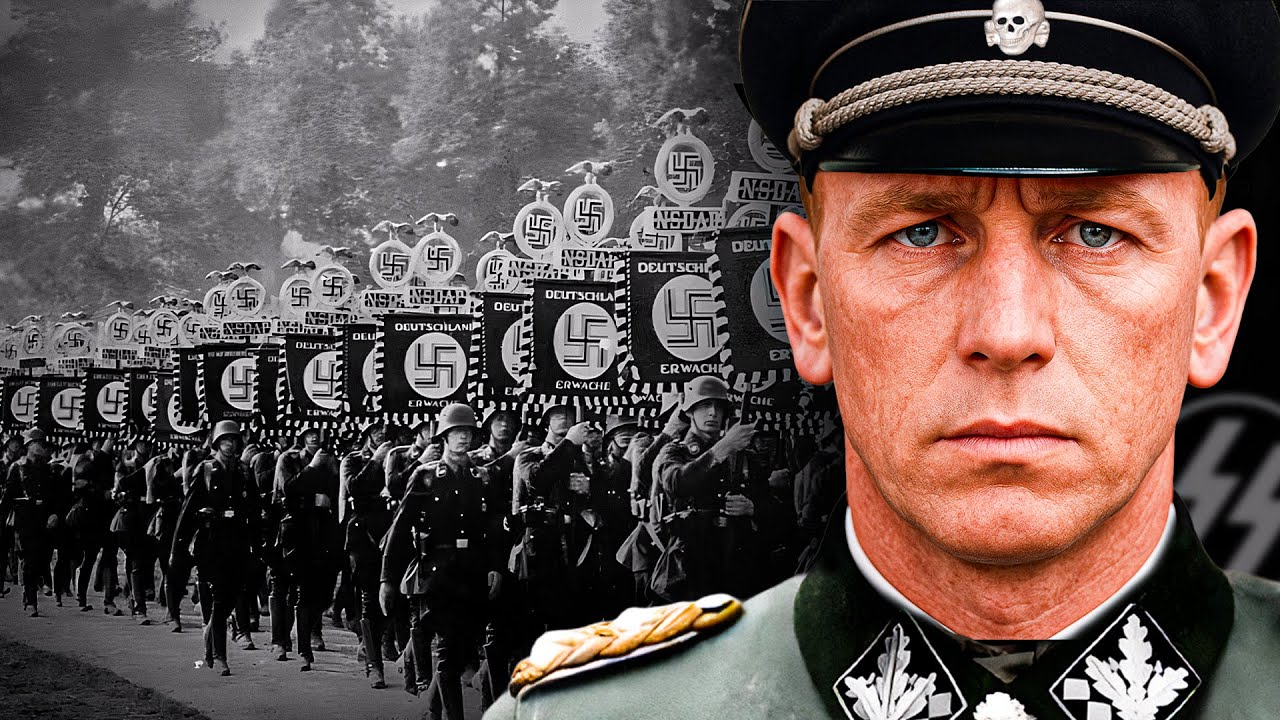
Conservative politicians, including Chancellor Konrad Adenauer, eventually agreed that excluding them would risk alienating a large and organized voter base. In 1953, Adenauer publicly declared that the men of the Waffen-SS “had fought as soldiers, just like others.” That statement carried heavy symbolic weight. It signaled West Germany’s quiet shift toward normalizing Waffen-SS veterans as part of the broader soldier community. In practice, it meant many former SS men could now claim limited pensions, especially those who could show post-1943 conscription rather than voluntary enlistment.
By 1956, the issue extended to the newly formed Bundeswehr, West Germany’s modern army. The question arose: could ex-SS men serve again? In theory, they could. In practice, only a fraction were accepted. Records show that by September 1956, out of 3,117 former Waffen-SS applicants, just 508 were approved. The rest were rejected for ideological concerns, criminal records, or pressure from Allied advisors who feared the Bundeswehr could inherit a tainted legacy. Still, those who made it back into uniform often kept quiet about their wartime pasts.
Beyond official structures, former Waffen-SS men found work in factories, construction, or small business. Their military discipline and network of comrades sometimes helped them find jobs, though stigma lingered. In towns and cities across West Germany, many avoided discussing their service, instead blending into the collective silence that characterized the 1950s, when most Germans preferred to look forward rather than back. Yet the wounds of recognition and justice remained raw. For many victims of the regime, the idea that Waffen-SS veterans could collect pensions felt like moral betrayal.
Survivor organizations and left-leaning newspapers condemned the policy, while conservative outlets defended it as reconciliation. Historians today still note that economic reintegration often came long before moral reckoning. By the early 1960s, West Germany’s economy was booming. For most ex-Waffen-SS men, life had stabilized, but resentment simmered beneath the surface. Many felt they had been abandoned, vilified, or denied proper recognition for their wartime “sacrifice.” Those grievances would soon find an organized voice, a movement that would reshape how post-war Germany remembered its most controversial soldiers.
In the early 1950s, as West Germany rose from the ruins, former Waffen-SS officers began to organize. In 1951, a group led by Paul Hausser, Otto Kumm, and Felix Steiner founded HIAG, the Hilfsgemeinschaft auf Gegenseitigkeit der Angehörigen der ehemaligen Waffen-SS, translated roughly as the “Mutual Aid Association of Former Waffen-SS Members.” HIAG started as a welfare organization to support comrades denied state pensions and benefits. But it quickly evolved into something larger: a political and historical lobby. Its founders were former generals, articulate and well-connected, who believed the Waffen-SS had been unfairly condemned as a criminal organization.
Their central argument was simple but powerful: the Waffen-SS, they claimed, had been an apolitical fighting force, soldiers like any other. This narrative found an audience. West Germany’s conservative politicians, facing tight elections and keen to mobilize veterans’ votes, began to court HIAG. Chancellor Adenauer met privately with its leaders, and prominent figures like Franz Josef Strauss addressed veteran rallies. In 1953, Adenauer’s public comment that Waffen-SS men “had fought as soldiers, just like others” was partly the result of HIAG lobbying.
By the mid-1950s, HIAG had branches across West Germany and claimed tens of thousands of members. It published magazines such as Der Freiwillige (“The Volunteer”), organized reunions, and even financed the publication of memoirs that reframed SS divisions as elite military units rather than ideological forces. Paul Hausser’s 1953 book Soldaten wie andere auch (“Soldiers Like Any Other”) became the cornerstone of this myth. HIAG’s influence peaked in the 1960s. Some former SS officers managed to secure public positions, and commemorative events for Waffen-SS divisions were often covered by local media without criticism.
But as Germany’s younger generation confronted the Nazi past more directly during the 1970s, public tolerance began to erode. Historians and journalists exposed HIAG’s revisionist tendencies and its efforts to minimize war crimes. In 1978, a Der Spiegel investigation revealed HIAG’s deep political ties and attempts to pressure officials on pension reforms. The scandal marked a turning point. Mainstream political parties began to distance themselves, and HIAG’s credibility weakened. Yet the group remained active for another decade, sustained by aging veterans determined to defend their version of history.
By the 1980s, HIAG’s membership was declining. The association fought local battles over memorials and cemetery plaques, while anti-fascist organizations protested Waffen-SS reunions. In 1992, facing dwindling ranks and public disapproval, HIAG officially dissolved. When HIAG disbanded in 1992, many believed the debate over the Waffen-SS would finally fade into history. But the legacy of those men, and the myths surrounding them, proved remarkably persistent. Even decades after the last Waffen-SS divisions ceased to exist, their story continues to shape discussions of war memory, justice, and national identity in Germany and beyond.
After the fall of the Berlin Wall in 1989, reunified Germany started to confront its wartime past more openly. Newly opened archives and survivor testimonies revealed how Waffen-SS units operated alongside the security police and Einsatzgruppen, disproving the long-standing myth of a “clean,” purely military force. Yet even as scholarship dismantled these illusions, political and social controversies emerged. In the 1990s, journalists discovered that some former Waffen-SS members were still receiving state pensions under the old Federal War Victims Relief Act.
Reports in Der Spiegel and The New York Times sparked outrage, especially when it became clear that many Holocaust survivors had never received comparable compensation. Successive German governments debated reforms, but pension laws, rooted in post-war legal compromises, proved difficult to undo. Beyond Germany’s borders, the Waffen-SS legacy took on new and troubling forms. In parts of Eastern Europe, especially the Baltic states and Ukraine, veterans of locally recruited SS divisions began to be commemorated as national fighters against Soviet occupation.
Annual marches in Riga honoring the 15th and 19th Latvian SS Divisions drew sharp criticism from Jewish organizations and the European Parliament. These events underscored how the image of the Waffen-SS had become entangled with post-Soviet identity politics. Inside Germany, attitudes shifted again. By the 2000s, open admiration for the Waffen-SS was taboo. Displaying SS symbols was banned under Section 86a of the Criminal Code. Yet far-right groups online continued to use SS imagery, portraying the Waffen-SS as models of strength or “European brotherhood.” German authorities have cracked down repeatedly, calling it a threat to democracy.
In academic circles, the conversation moved from moral judgment to historical context. Scholars like Sönke Neitzel and Peter Longerich analyzed how ideology, discipline, and violence fused within the Waffen-SS structure. Their research emphasized that the organization was never separate from Nazi politics, it was its armed extension. At the same time, social historians explored how post-war Germany’s silence toward the Waffen-SS reflected the nation’s broader struggle with guilt and memory. Today, few Waffen-SS veterans remain. Their associations have vanished, but their legacy endures, in the debates, books, and myths that still surround them.
Eighty years later, their story remains a warning about how easily history can be reshaped, and how long its echoes can last. If you found this video insightful, watch “What Happened to the Hitler Youth After WW2?” next — a look at how one of Hitler’s most devoted organizations faced the end of the Reich and the struggle to rebuild its members’ lives.
