July 10th, 1942. Accutin Island, Alaska Territory. The binoculars trembled slightly as machinist mate Albert Knack peered through the PBY Catalina’s observation window, his heart racing at what lay below in the marsh. The red circles on the wings, unmistakable rising sun emblems, confirmed what every American pilot had been told was nearly invincible. A Japanese Zero fighter sitting upside down in the wet grass, apparently intact. Lieutenant William Thez, piloting the patrol plane, had become lost in the fog banks that shrouded the Illutian Islands.
By dead reckoning, he reoriented over the Shiman Islands and chose the most direct route back to Dutch Harbor, directly over Akutan Island. A route rarely flown, a route that would change the course of the Pacific War. The Americans must be seeing things, Knack thought. No Japanese pilot would leave such a prize. For over a year, this aircraft had been the terror of the Pacific skies, the mystery weapon that had shredded American, British, and Chinese air forces with contemptuous ease.
At Pearl Harbor, over the Philippines, across Burma, and Malaya, the Zero had achieved what seemed impossible, a carrier-based fighter that outperformed land-based interceptors. As thighs circled the crash site three times, marking the position carefully on his chart, neither man could have known they had just discovered what American historians would later call a prize almost beyond value to the United States. What they were about to recover would expose the most profound paradox in aircraft design philosophy of World War II.
A paradox that would be written not in technical manuals, but in the lives saved and battles won through a single shocking discovery. The Zero’s reputation had been built on a foundation of fear and respect. In the seven months since Pearl Harbor, American pilots had encountered an aircraft that defied every assumption about Japanese industrial capability. Fast, maneuverable, and long- ranged, it dominated Pacific skies. In early engagements over China against obsolete Soviet-built fighters, Zeros achieved kill ratios as high as 12:1.
In April 1942, a Japanese strike force that included 36 Zero fighters attacked son, shooting down 27 British aircraft for the loss of five Japanese planes. The official American strategy when encountering a zero was simple and humiliating. Run away. Avoid engagement. Do not attempt to dogfight. These orders came not from cowardice, but from brutal mathematics. American fighters that tried to turn with zeros died. Pilots who attempted traditional aerial combat tactics against this nimble adversary rarely survived to report their mistakes.
June 4th, 1942. The same day as the pivotal battle of Midway, 1500 m to the south, as part of Japan’s complex operation to seize Midway Atoll, a diversionary force struck the Illusian Islands to draw American attention northward. 19-year-old flight petty officer Tadayoshi Koga launched from the Japanese carrier Ryujo as part of the second strike against Dutch Harbor. His zero serial number 4593 was part of a three-plane section assigned to strafe the American naval base on an Alaska Island.
Koga and his wingmen, Chief Petty Officer Makoto Endo and Petty Officer Tsugo Shicarda dove on the harbor with devastating effect. They shot down an American PBY5A Catalina flying boat and strafed survivors in the water. But during the attack, small arms fire from the ground struck Koga’s aircraft. A bullet severed an oil line. Not catastrophic immediately, but fatal within minutes as precious engine oil sprayed into the Alaskan air. 25 mi east of Dutch Harbor sat Akuten Island, pre-desated by Japanese planners as an emergency landing field.
A Japanese submarine waited offshore specifically to rescue downed pilots. As Koga’s oil pressure dropped, he signaled his wingmen and turned toward Akutan. From above, the grassy flat looked perfect. Half a mile inland from Broadbite, the field appeared solid, inviting, safe. Shikard, circling overhead, suddenly noticed water glistening between the grass stalks. He realized with horror that the ground was not firm, but marshland. He tried to signal Koga to make a belly landing, but it was too late. Koga had already lowered his landing gear and committed to a conventional landing.
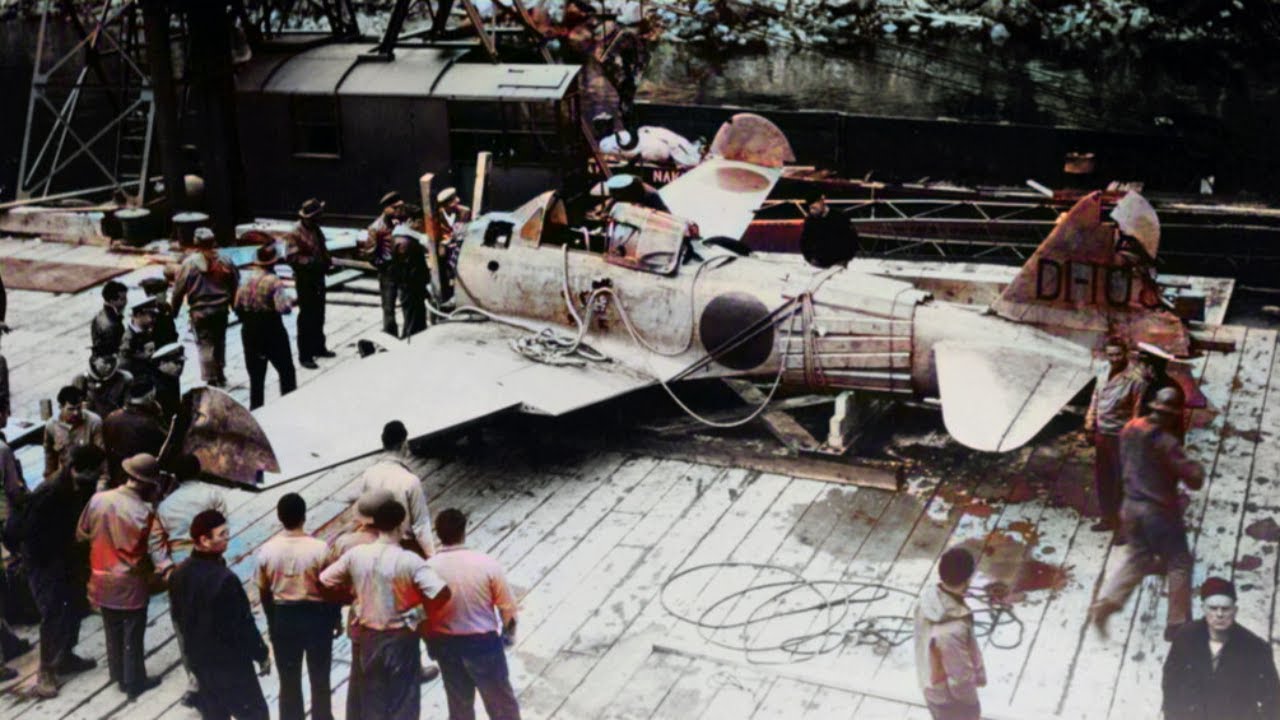
The Zero’s wheels touched the grass and immediately sank into the soft mud beneath. The aircraft pitched forward violently, flipping end over end. It came to rest upside down, wings and fuselage nearly intact. Inside the inverted cockpit, Tadayoshi Koga died instantly, his neck broken by the tremendous impact. Endo and Shicada circled the wreckage, torn by conflicting orders. Every Japanese pilot carried explicit instructions to destroy any zero that crash landed in enemy territory. The aircraft’s secrets were too valuable, its capabilities too important to allow capture.
But Koga might still be alive. They could not bring themselves to strafe their friend. After several agonizing circles, low on fuel and with weather closing in, they turned west toward their carrier, believing a Japanese submarine would retrieve Koga soon. The submarine searched for hours, but was driven away by the USS Williamson, an American destroyer patrolling the area. Koga’s body remained in the cockpit. The Zero sat undisturbed in its marsh, invisible from standard flight paths unknown to American forces.
One month passed. Fog and rain concealed the prize. Then Albert Knack spotted what looked like a small aircraft through a break in the clouds. On July 11th, Lieutenant Thieves returned with a landing party. They approached the overturned Zero cautiously, weapons ready, unsure what they would find. Chief aviation pilot William Scarbor, an experienced Navy pilot assigned to the recovery team, waded through the marsh to reach the aircraft. He peered into the cockpit and found Kog’s body still strapped in the pilot’s seat.
The recovery team stood in silence, studying the aircraft that had terrorized American pilots across the Pacific. Even inverted and damaged, the Zero possessed an almost predatory elegance. sleek lines, minimal protrusions, a design that whispered speed and agility. They photographed the wreckage from every angle, documenting their find before attempting recovery. Koga was removed from the cockpit and given a Christian burial nearby. Whatever their nation’s conflict, he was a warrior who deserved respect. Then the real work began. The team carefully examined the zero structure, noting every detail.
What they observed in those first hours would prove as significant as the test flights to come. The aircraft was remarkably light, not just in overall weight, but in every component. The skin felt thin under their hands, almost fragile. Scarbor tapped the fuselage and heard a hollow sound that reminded him of a tin can, not a combat aircraft. He looked for armor plating around the cockpit and found none. He searched for armored glass in the windscreen and found standard clear panels.
He inspected the fuel tanks and discovered they were nothing more than simple aluminum containers with no self-sealing capability whatsoever. This was wrong. This contradicted everything American aircraft designers believed about fighter construction. Modern combat aircraft were being built with progressively more protection. armor behind the pilot’s seat, armored glass windcreens, self-sealing fuel tanks with rubber bladders that swelled shut when punctured. These features added substantial weight but saved pilots lives. The Zero had none of these protective features. Three recovery attempts were needed.
The illutian weather, notorious for sudden storms and impenetrable fog, frustrated initial efforts. On July 12th, a recovery team led by Lieutenant Robert Kerms gave Koga a proper Christian burial, replacing the hasty grave from the day before. Then they attempted to recover the aircraft, but the delivery ship lost its anchors in the rough conditions. Finally, on July 15th, a barge reached the site. Workers constructed a makeshift sledge to drag the Zero through the marsh to the beach. The aircraft, even waterlogged and damaged, weighed remarkably little.
Six men could maneuver it. The Zero was loaded onto the USS St. Miil and transported to Seattle, arriving August 1st. From Seattle, it traveled by barge to Naval Air Station North Island near San Diego, California. The journey took the better part of a month. During that time, American intelligence officers poured over photographs, debating what they had captured. At North Island, the Zero was placed under 24-hour military police guard, not to prevent sabotage, though that was a concern, but to prevent souvenir hunters from dismantling the aircraft piece by piece.
Every mechanic, every pilot, every engineer wanted a fragment of the legendary fighter. The guards had orders to shoot anyone attempting unauthorized access. Navy mechanics began the meticulous repair work. Experienced aircraft technicians approached the Zero with professional curiosity mixed with suspicion. Japanese aircraft were rumored to be crude copies of Western designs built with inferior materials and sloppy workmanship. Propaganda had prepared them to find a clumsy imitation. What they found instead astonished them. The Zero was a masterpiece of weight reduction engineering.
Every component had been designed with obsessive attention to minimizing mass. The main wing spars were constructed from extra super duralin, a lightweight aluminum alloy developed by Sumitomo Metal Industries in 1936. This alloy combined zinc with aluminum to create a material that was lighter and stronger than standard aircraft aluminum, though prone to corrosion. The Japanese had countered this weakness with a zinc chromate coating applied after fabrication. It was sophisticated metallurgy equal to or ahead of American capabilities at the time.
Structural components revealed ingenious weightsaving measures. Wing attachment fittings were minimized by permanently bonding wings to the fuselage, eliminating massive removable joints. The aft fuselage detached just behind the cockpit for maintenance while keeping forward structure light. Engine placement near the wing’s leading edge allowed a shorter, lighter tail section while maintaining balance. Control surfaces used fabric covering where American designs employed heavier metal. Landing gear struts were narrower than American equivalents. The cockpit framework was minimalist, offering excellent pilot visibility, but no protection whatsoever.
The repair team straightened the bent vertical stabilizer, rudder, wing tips, flaps, and canopy. The landing struts, sheared off during the crash, required complete replacement. The threeblade Sumitomo propeller was dressed and reused. Even damaged, it remained serviceable, testament to Japanese manufacturing quality. As repairs progressed, detailed measurements revealed the A6M2 weighed 5,555 lbs fully loaded. The Grumman F4 F4 Wildcat, America’s primary carrier fighter, weighed 7,426 lb. The Zero was 1871 lb lighter, nearly 2,000 lb of difference. That weight gap translated directly into performance.
The Zer’s Nakajima Sakai 14cylinder radial engine produced 950 horsepower. The Wildcats Pratt and Whitney R1830 twin Wasp generated 1,200 horsepower. The American fighter had 250 more horsepower but carried 2,000 more pound. Powertoe ratio favored the Zero decisively. Wing loading told the same story. The Zero carried 24.3 lb per square foot of wing area. The Wildcat carried 28.6 lb per square foot. Lower wing loading meant the Zero could turn tighter, climb faster, and maneuver more aggressively. In a turning dog fight, physics gave the Zero an insurmountable advantage.
But as mechanics examined the fuel system, they found something that troubled them deeply. The fuel tanks were simple aluminum containers, thinwalled, unprotected. American aircraft used self-sealing tanks with multiple layers. An outer layer of rubber, a middle layer of vulcanized fabric, and an inner layer that swelled when punctured, closing holes and preventing fuel leakage. These self-sealing tanks added significant weight to aircraft. They were heavy, expensive, and reduced fuel capacity, but they saved lives. A single bullet through a standard tank meant fire and death.
A bullet through a self-sealing tank meant a small leak, manageable, survivable. The Zero had chosen performance over survival. Every Japanese pilot flying this aircraft knew that a single bullet in the fuel system meant probable death. There would be no leak, no gradual fuel loss, no chance to nurse a damaged aircraft home. There would be ignition, explosion, catastrophic fire. American pilots had reported zeros bursting into flames from minimal damage. Now the reason was clear. The lack of pilot armor was equally shocking.
American fighters mounted thick steel plates behind the pilot’s seat, adding substantial protective weight to guard against enemy fire from behind, the most common attack angle. The Zero had nothing. A pilot’s seat was a thin metal frame with a fabric cushion. A 50 caliber machine gun bullet would pass through the seat and the pilot with equal ease. The windscreen used standard glass, perhaps slightly thicker than civilian aircraft, but offering no ballistic protection. American fighters increasingly mounted armored glass, heavy transparent plates that could stop small arms fire.
The Zero saved the weight and left its pilots vulnerable to head-on attacks. September 20th, 1942, 2 months after the crash, Lieutenant Commander Eddie Sanders climbed into the cockpit of the repaired Zero for its first test flight. Sanders was one of the Navy’s most experienced test pilots, a man whose life depended on accurate assessment of aircraft capabilities and limitations. He settled into the lightweight seat, noting immediately how cramped the cockpit felt compared to American designs. The engine started smoothly.
Japanese engineering, whatever its other qualities, produced reliable power plants. Sanders taxied carefully, aware that the narrow track landing gear made ground handling tricky. He advanced the throttle and felt the aircraft accelerate with surprising eagerness. Takeoff roll was remarkably short. The Zero lifted off and climbed with an immediacy that startled him. At altitude, Sanders began systematic testing. He started with basic handling characteristics. Level flight, gentle turns, climbs, and descents. The controls felt light, almost sensitive. Small stick movements produced immediate aircraft response.
After years flying American fighters, the Zero felt like switching from a pickup truck to a sports car. He pushed the test envelope further. Maximum speed runs revealed the Zero could reach approximately 330 mph, faster than the Wildcat, but not dramatically so. But then he attempted a hard roll at cruise speed. The ailerons, the control surfaces that produced roll, suddenly stiffened. Above 200 knots, rolling maneuvers became slow, requiring excessive force on the control stick. Sanders tried rolling left, then right.
The aircraft rolled to the left much easier than to the right. This asymmetry would be crucial information for American pilots. In a dog fight, a zero pilot would naturally prefer left roles. Knowing this, an American pilot could exploit the tendency, forcing the Zero into right rolls where it was slower and less responsive. The next test was potentially lethal. Sanders put the Zero into a dive, then pulled hard on the stick to generate negative acceleration. The engine coughed, sputtered, and quit.
Silence except for windstream. He was flying a glider at 3,000 ft over the California coast. Sanders maintained composure, leveled out, and the engine restarted. He repeated the test twice more with identical results. The Zero’s float type carburetor, which relied on gravity-fed fuel delivery, could not handle negative G forces. Under negative acceleration, fuel flow to the engine stopped completely. This was the answer American pilots needed. When being pursued by a zero, don’t turn. Don’t try to outmaneuver it.
Instead, push the stick forward hard, diving with negative gforce. The American aircraft with its pressure type carburetor would continue running. The Zero’s engine would quit. In those crucial seconds of silence, an American pilot could open range and escape. Sanders flew 24 test flights between September 20th and October 15th. Each flight revealed new details. The Zero’s famous maneuverability was real, but came with limitations. At low speeds, below 200 mph, it could turn inside any Allied fighter. But at high speeds, above 250 mph, it became stiff and sluggish.
American fighters, heavier and more powerful, gained advantages as speed increased. The test data was compiled into technical reports distributed to every fighter squadron in the Pacific. Pilots read with intense interest about the enemy aircraft that had haunted their nightmares. The report confirmed what some experienced pilots had begun to suspect. The Zero could be beaten, not by fighting its fight, but by imposing a different type of combat. Commander John Thak had already developed his famous Thakweave maneuver before the Akutan Zero was recovered.
first using it in combat at Midway on June 4th, 1942, the same day Koga crashed. Working from intelligence reports about the Zer’s capabilities, Thak devised a defensive tactic where two wild cats flying side by side would weave toward each other when attacked, bringing pursuing Zeros into the hook plane sights. But the captured Zero validated and expanded his theories, providing precise data on the Zero’s limitations that made American tactics even more effective. American pilots learned to fight Zeros using boom and zoom tactics.
Gain altitude advantage. Dive at high speed. Make a single firing pass. Continue diving past the target. Use superior speed to zoom back to altitude. Repeat. Never get slow. Never try to turn with a zero. Use American advantages in diving speed, structural strength, and pilot protection. The captured Zero was flown against every American fighter type. Mock dog fights pitted it against Wildcats, P38 Lightnings, P40 Warhawks. Each engagement was filmed and analyzed. Pilots learned firsthand how to exploit the Zero’s weaknesses.
The ailerons freezing at high speed, the engine cutting under negative G, the inability to dive as fast as heavier American fighters. But the most important revelation was psychological. The Zero was not invincible. It was an excellent aircraft, brilliantly designed for specific missions. But it had vulnerabilities. It could be defeated. American pilots who had felt outclassed and helpless now had answers. They had tactics. They had hope. Lieutenant Commander Eddie Sanders wrote in his report, “These flights covered performance tests such as we do on planes undergoing Navy tests.
The very first flight exposed weaknesses of the zero, which our pilots could exploit with proper tactics. Immediately apparent was the fact that the ailerons froze up at speeds above 200 knots, so that rolling maneuvers at those speeds were slow and required much force on the control stick. The knowledge spread through the fleet like wildfire. Fighter squadrons modified their training. New pilots learned boom and zoom before they ever faced a zero in combat. Veterans shared the intelligence with relief and vindication.
Their losses had not been in vain. The sacrifices of those early battles had bought time for this knowledge to reach them. Marine pilot Lieutenant Colonel Kenneth Walsh, credited with 21 confirmed kills and awarded the Medal of Honor, later said that knowing what to do with a zero on my tail. Information that came from Koga’s Zero saved my life several times. Walsh’s tactical knowledge derived from the captured aircraft enabled him to survive encounters that would have been fatal otherwise.
Fighter Ace William Leonard, who would retire as Rear Admiral with six confirmed victories, stated that the captured Zero was a treasure. To my knowledge, no other captured machine has ever unlocked so many secrets at a time when the need was so great. Japanese military historian Masatake Okumia, a left tenant general in the Japan Air Self-Defense Force, wrote that the revelations from the Akutan Zero were as dire for the Japanese military as the loss at the Battle of Midway.
But the Autoutan Zero’s influence extended beyond tactics. American aircraft designers studied the wreckage intensely. Grman had already begun work on the F6F Hellcat to replace the Wildcat. The Hellcat’s design had been partially influenced by intelligence reports from pilots who fought Zeros at Coral Sea and Midway. The first production F6F3 made its first flight on October 3rd, 1942, just weeks after Sanders began testing the Accutan Zero. But the captured Zero provided hard data to validate design choices. The Hellcat that entered service in January 1943 incorporated lessons from understanding the Zero.
It was faster with a maximum speed of 380 mph. It had a rate of climb that matched or exceeded the Zero. It retained armor protection and self-sealing fuel and tanks, but was designed to fight Zeros on more favorable terms than the Wildcat could. The Hellcat also incorporated knowledge of the Zeros weaknesses. It was designed to excel at high-speed combat where the Zero struggled. Its powerful Pratt and Whitney R2800 double Wasp engine produced 2,000 horsepower, more than double the Zero’s output.
This power enabled boom and zoom tactics, allowing Hellcat pilots to dictate engagement terms. In November 1943, the Akutan Zero was displayed at Washington National Airport as a war prize during celebrations of the 25th anniversary of air mail service. Thousands of Americans viewed the aircraft that had terrorized the Pacific, seeing firsthand the enemy fighter their sons and brothers faced in combat. The Zero looked sinister, predatory, dangerous. Few viewers understood that they were looking at the physical embodiment of a fundamentally different design philosophy.
In 1944, the Zero was recalled to North Island for use as a training plane. New pilots flew against it, learning its capabilities and limitations in controlled combat. A model 520 captured during the liberation of Guam joined it for training purposes. American pilots who would face zeros over the Philippines. Ewima and Okinawa first fought the Akutan Zero in California skies, building experience and confidence. The contrast between American and Japanese aircraft design philosophy became starker as the war progressed.
American designers continuously improved fighter protection. The F4U Corsair, entering service in 1943, featured armor, self-sealing tanks, and overwhelming power from its 2,000 horsepower Prattton Whitney R2800 engine. The P38 Lightning mounted twin engines and heavy armament while protecting its pilot. Japanese designers attempted to add protection to later Zero models. The A6M5 variant introduced in 1943 included a 55mm armored glass windscreen and an 8 mm armor plate behind the pilot’s seat. But these additions increased weight without corresponding power increases.
The Nakajima Sakai engine remained limited to around 1,000 horsepower. Weight increased 28%. Horsepower increased only 16%. The later Zeros were slower, less maneuverable, and less effective than the A6M2 that Koga had flown. Japanese engineers had tried to adopt American protection philosophy, but lacked the powerful engines needed to maintain performance with the added weight. The result was a fighter that had lost its primary advantage without gaining compensating strengths. By 1944, American fighter pilots dominated Pacific skies. The Great Mariana’s Turkey shoot in June 1944 saw devastating Japanese losses.
Allied fighters and anti-aircraft guns shot down over 500 Japanese warplanes. American losses included approximately 43 aircraft in combat and 80 more to operational accidents during night carrier landings and fuel exhaustion. Inexperienced Japanese pilots flying zeros against veteran Americans in Hellcats and Corsair’s faced overwhelming odds. Japanese pilot attrition was catastrophic. The experienced aviators who had attacked Pearl Harbor, who had dominated the early Pacific campaigns, were being systematically killed in aircraft that could not protect them. Japan’s training pipeline could not replace them fast enough.
Replacement pilots had less training, less experience, less chance of survival. The quality gap widened month by month. In October 1944, during the battle for the Philippines, Zeros began to be used in kamicazi attacks. When aircraft could no longer compete in conventional combat, they became guided missiles. Pilots were ordered to crash their aircraft into American ships. Kamicazis used a 6M fighters more than any other aircraft for these suicide missions. The Zero designed to dominate dog fights over China ended its career as a disposable weapon.
The design philosophy that created the Zero had been based on assumptions that proved fatally flawed. Japanese planners believed the war would be short. They plan to strike decisively, defeat the Americans quickly, and negotiate from a position of strength. In a short war, pilot attrition would not matter. Long-term survival rates would be irrelevant. What mattered was immediate combat effectiveness. They also believed their pilots were superior, that intensive training and warrior spirit would compensate for any material disadvantages. Both assumptions failed catastrophically.
The war was not short. It lasted four years of brutal attrition. And American pilots, initially less experienced, learned quickly. Combat experience accumulated. Tactics evolved. Training improved. By 1943, American pilots were equal to Japanese pilots in skill. By 1944, with veteran Japanese pilots dead and inexperienced replacements facing combat, Americans held a decisive skill advantage. The Zero’s lack of protection, acceptable in a short war, became catastrophic in a long war. A pilot in a protected American fighter might survive being shot down once, twice, even multiple times.
He would bail out, be rescued, return to combat. He would learn from each encounter, becoming more effective with each mission. A zero pilot shot down once was likely dead. No second chance, no learning curve, no accumulated experience. Every zero shot down meant one experienced pilot lost forever. In May 1937, the Imperial Japanese Navy issued specifications for a new carrier fighter. The requirements were daunting. Maximum speed of 310 mph at 13,120 ft altitude. climbed to 9,840 ft in 3 minutes 30 seconds.
Armament of two 20 mm cannons and two 7.7 mm machine guns, full radio and direction finder, plus critically range sufficient to escort bombers over vast Pacific distances. Meeting those requirements with available engine technology seemed impossible. Nakajima Aircraft Company concluded the specifications could not be met and withdrew from the competition. Only Mitsubishi remained with chief designer Jiro Horoshi accepting the challenge. Horicoshi later wrote, “Instead of pondering the future of the aircraft, our immediate goal was to win the contract.” Horicoshi’s solution was radical.
Make the aircraft as light as possible. Eliminate everything not absolutely essential to meeting the specified requirements. Armor was not mentioned in the requirements. Self-sealing tanks were not mentioned. Therefore, they were emitted. Weight saved could be used for fuel, enabling the required range. Lightweight construction enabled the required maneuverability. The decision reflected Japanese military doctrine that prioritized offensive capability. Attack was emphasized. A warrior accepted risk as inevitable and sought effectiveness in combat. The captured Akutan Zero exposed this philosophical divide to American analysis.
US Navy reports noted that the Zero was designed purely for the attack role, emphasizing long range, maneuverability, and firepower at the expense of protection of its pilot. American designers had made different choices. Protection was not weakness. Survival was not cowardice. A pilot who lived to fight again was more valuable than one who died in a single engagement, no matter how effective that engagement might be. The industrial implications were equally profound. An armored protected aircraft was more expensive to build, required more materials, took longer to manufacture, but it lasted longer in combat, and more importantly, its pilot lasted longer.
Japan could build aircraft faster than it could train replacement pilots. America could train pilots faster than Japan could build replacement aircraft. The mathematics of attrition favored the side that protected its people. After the war, captured Japanese aircraft designers were interviewed by American technical intelligence teams. Their testimony confirmed what the Akutanzero had revealed. The lack of armor and self-sealing tanks was not oversight. It was intentional design choice based on tactical requirements and operational philosophy. Jiro Horoshi stated in his postwar memoir that armor protection was never mentioned in the initial design requirements.
Weight restrictions meant prioritizing armament range and maneuverability. Japanese military doctrine assigned low priority to armor. The underlying attitude was that such protective features were luxuries rather than necessities. Only after wholesale attrition of pilots did they finally see that living to fight another day was more important in modern warfare than achieving maximum performance in a single engagement. The American pilots who flew the Akutan Zero came away with profound respect for Japanese engineering skill combined with recognition of the design’s fundamental vulnerability.
Test pilot Edward Sanders later wrote that the Zero was the finest aircraft he had ever flown at low speed. Its maneuverability was extraordinary, its handling delightful, but he would never want to take it into combat. One bullet could kill you. The aircraft gave you no protection, no second chance. Captain Eric Brown, the Royal Navy’s chief test pilot, flew a Captured Zero and called it the most maneuverable fighter he had ever flown. He could turn inside any Allied aircraft, but he also noted the complete absence of armor or protected fuel tanks and called it a death trap for modern combat.
Beautiful to fly, terrible to fight in, the fate of Tadayoshi Koga, the 19-year-old pilot who crashed on Akutan Island, became symbolic of the Zero’s flawed philosophy. Koga was an experienced, skilled aviator. He had survived combat and multiple missions over the illusions. But a single bullet through an oil line meant his death. If his aircraft had been designed with survival in mind, if vital systems had been protected, he might have made it back to his carrier. He might have fought again.
His experience and skill might have been preserved. Instead, he died in an Alaskan marsh, his sacrifice inadvertently contributing to American victory. The aircraft he died in became the teacher that trained his enemies. The secrets he never intended to reveal were extracted from the wreckage by a foreign power. His death and his zero’s capture changed the war’s course in ways he could never have imagined. In February 1945, the Accutin Zero met an ignominious end. It was being fed from San Diego when commander Richard Gromlin was taxiing the Zero at NAS North Island.
A Curtis SB2C Hell Diver crashed into it during ground operations. The aircraft was damaged beyond repair. It was scrapped shortly thereafter, its service complete, but the intelligence it provided lived on. Thousands of American pilots owed their lives to the tactics developed from studying Koga’s Zero. The Hellcat’s design reflected lessons learned from understanding the captured aircraft. The boom and zoom tactics, the understanding of the Zero’s high-speed limitations, the exploitation of its carburetor weakness, all stemmed from the Accutan Zero’s test flights.
The parallel development of American and Japanese fighters told the larger story. American aircraft became progressively more protected, more powerful, more capable. The F6F Hellcat gave way to the F8F Bearcat, an even more powerful and protected fighter. Japanese aircraft tried to add protection but lacked the industrial capacity to do so effectively. The gap widened until Japanese aircraft were obsolete by 1944 standards. The ultimate lesson of the Akutan Zero was not technical but philosophical. Aircraft design reflects cultural values and strategic assumptions.
The Zero reflected Japanese values of offensive capability, acceptance of risk, and belief in short, decisive war. American fighters reflected values of pilot protection, long-term attrition warfare, and industrial sustainability. In a long war of attrition between industrial powers, the American philosophy proved superior. This did not make American pilots braver or more skilled. It made them more likely to survive. Survival meant experience. Experience meant effectiveness. The cycle compounded over time until American air superiority became absolute. The Zero’s lack of protection, initially an acceptable trade-off for performance, became the fatal flaw that destroyed Japanese air power.
Modern historians studying the Pacific Air War inevitably returned to the Yakutan Zero as a turning point. The capture did not change aircraft that were already in production. It did not directly influence the Hellcat’s initial design, which was already well advanced, but it changed American understanding of the enemy. It revealed vulnerabilities that could be exploited. It provided hope when hope was desperately needed. In July 1942, America was losing the Pacific War. 6 months after Pearl Harbor, American forces were retreating across the Pacific.
Zeros dominated the skies. The Akutan Zero arrived at precisely the moment when American morale needed a boost, when tactical innovation was essential, when understanding the enemy was critical for survival. Lieutenant Commander Sanders first test flight report circulated through naval aviation like electricity. Pilots read and reread the section about the Zero’s engine cutting under negative G forces. Finally, an answer. Finally, a way to escape. Push the stick forward. Dive with negative G. The Zero’s engine would quit. Your engine would keep running.
You would live. That single tactical revelation saved hundreds of lives. Marine or pilots at Guadal Canal, Navy pilots at Santa Cruz, Army pilots in New Guinea, all applied the lesson. They survived encounters they would otherwise have lost. They returned to base to fight again. Their experience accumulated, their skills improved, and gradually the balance shifted. The captured Zero also affected Japanese strategy. When word reached Japanese intelligence that an intact Zero had been recovered, there was constonnation. They knew what it meant.
Their primary fighter secrets were compromised. American pilots would learn to defeat it. The psychological advantage of the seemingly invincible Zero was lost. Japanese strategists began planning replacement fighters, but development took years and required resources Japan lacked. The Zero would have to continue in service, increasingly obsolete, until replacements arrived. Those replacements would be too late and too few. The Zero’s capture accelerated the timeline of Japanese defeat by exposing vulnerabilities years earlier than combat attrition alone would have revealed.
In the final analysis, the most shocking discovery about the Zero was not its capabilities, but its vulnerabilities. American expectations had been shaped by propaganda and fear. They expected a super weapon, an invincible fighter built by a mysterious enemy with unknown capabilities. What they found was a brilliantly engineered aircraft with fatal design flaws. No armor meant death from minor damage. No self-sealing tanks meant fire and explosion. Float type carburetor meant engine failure under negative G. Ailerons freezing at high speed meant inability to roll effectively in high-speed combat.
Each weakness was the price paid for the Zero’s strengths. Maneuverability cost protection. Range cost robustness. Lightweight cost survivability. American designers had made different choices because they had different priorities and greater industrial resources. Pilot survival was paramount. Aircraft could be replaced. Trained pilots could not. Therefore, protection justified its weight penalty. Armor was acceptable if it brought pilots home. Self-sealing tanks were mandatory despite reduced fuel capacity. Rugged construction was required even if it reduced performance. These choices reflected American industrial and cultural values.
America had the industrial capacity to build more aircraft and train more pilots. They could afford to make aircraft heavy and expensive if those aircraft kept pilots alive. Japan could not afford this approach. Limited industrial capacity meant aircraft needed to be simple, lightweight, and quick to produce. But that approach rational in the short term proved catastrophic in the long term. The story of the Akuten Zero became more than a war tale. It became a case study in design philosophy, cultural values, and strategic thinking.
Every aircraft embodies the assumptions and priorities of its designers. The Zero embodied Japanese assumptions about war, combat, and the nature of conflict. American fighters embodied different assumptions about industrial capacity, pilot value, and long-term strategy. The clash between these philosophies played out across Pacific skies for four years. Gradually, inevitably, the philosophy that valued pilot survival prevailed over the philosophy that accepted pilot sacrifice as the price of performance. The zero, magnificent in 1941, was obsolete by 1943, and suicidal by 1944.
Not because Japanese engineering was inferior, but because Japanese strategy was unsustainable. Today, the legacy of the Auton lives in aviation museums, history books, and tactical manuals. It remains the most significant captured aircraft of World War II, the intelligence coup that helped turn the tide in the Pacific. Tadeoshi Koga’s unintentional sacrifice saved thousands of American lives and shortened the war by months, perhaps years. The Zero itself remains a symbol of the Pacific Wars tragedy. A beautiful aircraft, perfectly executed to meet its specifications, fundamentally flawed by the assumptions behind those specifications.
Japanese pilots loved flying it. American pilots learned to defeat it. Both sides recognized it as a masterpiece of lightweight design and a cautionary tale of valuing performance over protection. In the end, the most profound lesson was simple. In warfare, as in life, choices have consequences. Choose speed over protection. Pay in lives lost. Choose maneuverability over robustness. Pay in aircraft destroyed. Choose short-term performance over long-term sustainability. Pay in strategic defeat. The Zero made these choices consciously, brilliantly, fatally.
And on a foggy July morning in 1942, when Albert Knack spotted red circles through the mist, those choices were laid bare for American engineers to study, understand, and exploit. The abandoned zero in an Alaskan marsh became the teacher that revealed not just how to defeat one aircraft type, but how to win the entire air war. That discovery, more than any single battle, helped ensure American victory in the Pacific.
