The story of the prisoner of war camps in Minnesota, people don’t know much about it today. – We had Germans. They’re from World War II. There were prisoners working just north of the house here. You know, 100 yards. – [Dean] Agricultural use was the number one use of the prisoners during the war.
– Not everybody was excited to have the enemy right outside of town. The challenge was, you are the caretaker of your enemy. Which road are you gonna take? – Under the Geneva Convention, you’re required to treat prisoners with a certain respect. What we hear back from the POWs that went back to Germany is that it changed their life.
– I take the liberty of writing a letter to you. In 1944, I worked for you at your farm as a prisoner of war. I thank you, and you treated me so well. – The time I spent in a Owatonna, especially on your command, was the best time in my life as a prisoner of war. – [Sherry] Please be so kind and send me something to eat.
Where everyone looks, nothing but rubble, despair, and cold. – Over the course of time, which is now 80-plus years, time has just eroded, and that generation has mostly passed. So those stories haven’t been passed along to a lot of people. – It’s unbelievable to me that for the most part, the folks that were given that choice treated these guys as human beings.
I’d like to think we would do the same today. – En route to prison camps throughout the United States, 3,000 German prisoners of war arrive in New York. – The story of the prisoner of war camps in Minnesota really has its beginning with some of the major World War events that were occurring.
The prisoners were arriving from Europe in two main waves: the Afrika Korps soldiers after the surrender to the British Eighth Army in 1943, and then the large influx of prisoners following the D-Day invasion. About 380 some thousand were German, 50 some thousand were Italians, and the remaining being Japanese, a very small amount.
Most of them were housed out west. Those prisoners then were housed eventually out of more than 500 camps throughout the entire United States. – When it comes to moving prisoners around the country, they’re moving them from the East Coast by rail. There’s some stories about some German prisoners throwing leaflets out the windows as they’re going through, you know, warning citizens that they’re gonna lose the war, and so on.
(machine gun firing) – World War II was on, and it was not going particularly well for the Allied powers. Hitler had spread across Europe, was threatening Great Britain, was on the march to Russia, and it looked like he was unstoppable. Things were not going well in the Pacific, either. – The British, they couldn’t take care of the prisoners very well in North Africa.
Mainland Europe was occupied by Nazi Germany, so other Allied powers couldn’t house these and take care of the prisoners. And so the British government asked the Americans, “Can you take these prisoners?” So you have 200,000-plus Afrika Korps soldiers sitting in North Africa. Conveniently enough, at that time, the US Military was bringing war supplies into North Africa for the invasion into Sicily and up Italy.
Cargo ships were dropping off supplies in North Africa, but they were going back to the United States empty. So primarily Liberty-class cargo ships, which were for used to bring the war supplies to North Africa, then on the return trip to the United States, started bringing the Afrika Korps soldiers back to the United States.
– We had no beds on the ship. – No beds. – No beds. No. – [Michael] How fast was it? – Every one of us got a blanket and a- – The swim vest. – The swim vest. (speaking in German) – [Michael] Life jacket. – Life jacket. – Life jacket. – [Michael] But what did the other POW, the other (speaking in German) talk about in the boat? Was there panic? Was there anger? – No. Panic, no.
But we were very afraid and angry. – What is the English expression for (speaking in German)? They looked forward. – [Michael] Optimistic. – Yeah, optimistic. (somber music) – A really important part of the story of Minnesota’s prisoners, and it’s true nationwide, was a large result of the fact that the United States was adhering to the Geneva Convention of 1929.
So essentially, every aspect of their welfare was to be taken care of. They were provided with reading materials, medical care, dental care. And that word did get back to the battlefront. Germans were well aware. They were more apt to surrender to Americans. Not only would they be more apt to surrender to Americans, but they would just be simply more apt to surrender, knowing that they’d be well treated.
So all of this information was part of the plan, and as it played out throughout the course of the war, it proved to be largely successful on that level. – When given the opportunity to treat folks one way or the other, whichroad are you gonna take? Right? Are you gonna take the high road? And not everybody was excited to have the enemy right outside of town.
But by and large, across this country, prisoners were treated according to the Geneva Convention. And what that says is that they have to have food of the same quality and quantity as their American counterparts. They had to have housing that mimicked what the American personnel had. And I don’t know if it was that way in every camp, but I know in camps in Minnesota, that Geneva Convention was adhered to pretty strictly.
– For years, for centuries, what do you do with prisoners? We’ve had them in every war. Most of the time they were treated very poorly. And in the 1800s, they began to create some movements toward rules of war or rules of treatment of prisoners in war, but really never took hold until World War II. And so in World War II, the United States decided, “All right, if we’re in this war, we’re gonna play it by the book.”
– What would it have been like if we had mistreated the prisoners and not adhered to the Geneva Convention? We don’t know how our prisoners would’ve been treated. We don’t know how many more American soldiers might have been killed on the battle front because the Germans didn’t wanna become a prisoner of the Americans and would’ve shot, let’s say, another American soldier or something like that.
So we don’t know. But what we do know is that it did help facilitate some of those things that we were after With the Geneva Convention. The prisoners would’ve been processed, they would’ve been interviewed, they would’ve had medical examinations, and then they would’ve arrived on the East Coast, primarily. And then from there, they would’ve been transported by train to various locations.
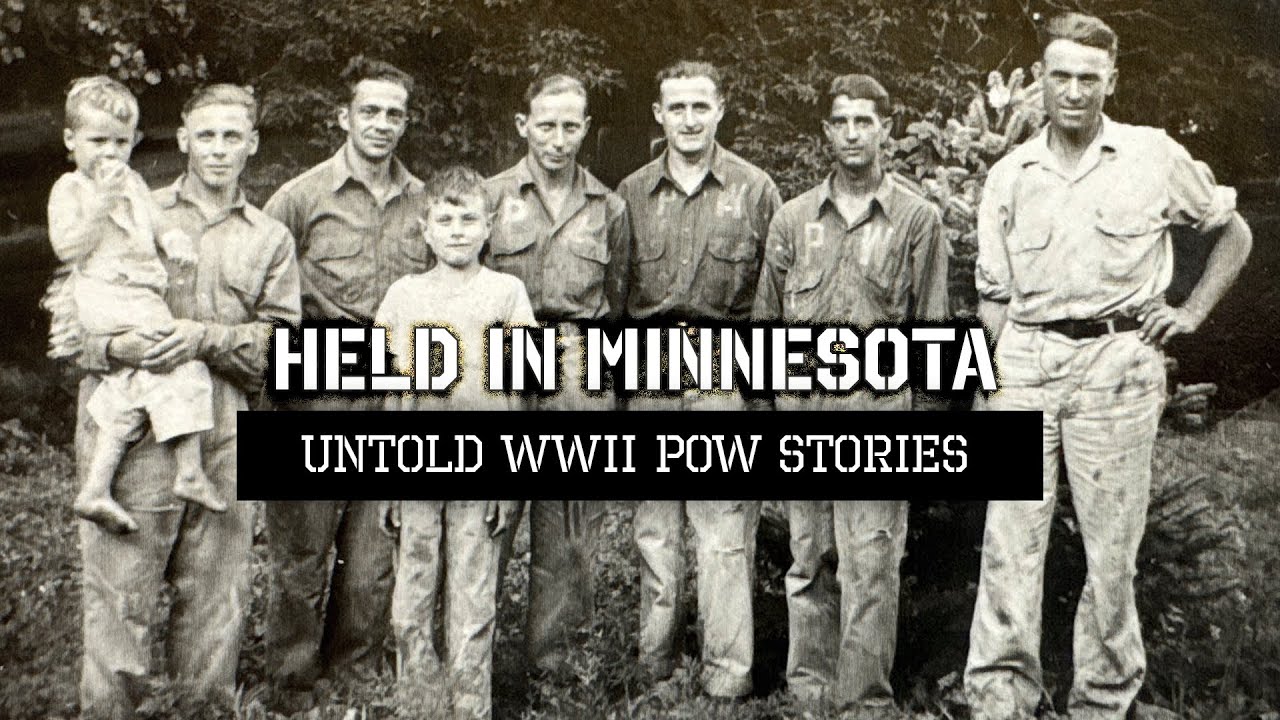
– They would be taken to camps then where they could be given different uniforms. The ones that they fought in would be taken and put aside for them, and be given World War I uniforms that had a P and a W painted on their pants and their shirt. – [Narrator] By doing work like this in the shoe shop, captives are able to buy cigarettes and other luxuries.
War prisoners received the same rations as American soldiers. – So these larger, what we call base camps, which were year-round facilities to house thousands and thousands of prisoners, were then established. It became pretty much an official objective to have the prisoners work. Above all, agricultural use was number one use of the prisoners.
– [Jerry Yocum] They worked our fields. They helped plant our food crops. They helped to harvest them. And unwittingly then, what they were doing is allowing us to grow food to not only feed the local population, but feed our soldiers and the Allies. – Minnesota started to experience some labor shortages. By the fall of 1943, the University of Minnesota Ag Extension officer Paul Miller organized farm help for the entire state of Minnesota, realizing that there was
gonna be some serious needs for farm labor. (reflective music) (Uwe speaking in German) (Uwe continues speaking in German) (interviewer speaking in German) (Uwe speaking in German) (reflective music) – So this is the actual location where the prisoners arrived in September 1943? – Yeah. Yeah, right here. In fact, these tracks have been restored to the exact location where the mainline track was in 1943.
– The Italians were only here at the very beginning of the Minnesota POW experience and then at the very end, after the war had ended. And in Olivia, they worked for a seed company and also would do other incidental farm work that was needed. And then in Princeton they worked for Odin Odegard. Had a large potato farm operation there.
– This was a big business. They kept meticulous records as was necessary at the time. – It’s nice ’cause you have some of the stuff from the war era, which shows- – Yeah. Yeah. This was a event of necessity because it was fall harvest time in September and potatoes were coming in and onions were coming in. And this was, at the time, a very manual process.
It had not been deeply automated. So they needed help. Many of the young men who would have helped had been in the National Guard Unit in Princeton that got called up, you know, years earlier. So they were gone. They could not help with this. And this was an important war effort also to feed domestically and to provide some food for the overseas troops, too.
At that time also, there had been young men from Princeton who went off to war, who had died. And there were lots of reasons not to be hospitable or even decent to prisoners of war from the enemy. Yet this guy, O.J. Odegard, set the tone with his group of Italian prisoners of war by being more than decent. He was certainly not brutal.
He was not indifferent. He was respectful of these people. He set up a canteen where the Italians had their tent camp on the bog, and they could buy beer and cigarettes from the canteen. They were paid $3 a day, which was the going rate for field help.They worked 10 hours a day, as the local people did, who were working also.
(opera singer singing in German) – Everyone who heard the Italian prisoners passing by commented on their singing. They loved to sing. They were singing all day while they worked. They were singing on the flatbed trucks that brought them into town for either warehouse work, or on the weekends, they were taken to the local movie theater.
– They were just a jolly bunch. That’s mainly what I remember, seeing them riding in the truck when they went to and from the bog area. And I suppose they were happy that they were out of the war area and up here in a nice pleasant deal. So they were getting the best of both worlds out of that. (opera singer singing in German) (uplifting orchestral music) – Folks in these parts had not seen a lot of Mediterranean men before.
It’s kind of the Nordic stock. We’ve got a lot of Germans and lots of Norwegians and Swedes, of course. And one of the comments that was made as they arrived at this building, the Princeton Great Northern Railway Depot, was, why would they send these men all the way to Princeton? Because people didn’t travel to Europe, or vice versa, with any frequency at all in the 1940s.
So just a backdrop. And people talk about this story. If you approach people who are of a certain age, and today, that’s pushing 90, they have a vivid recollection, if they had any contact with the Italian prisoners, of who these people were. So eight weeks with their boots on the ground here, and 80 years later, people are still talking about it.
– I’m from Olivia, Minnesota, originally, and Olivia was one of the first locations for the prisoners, the Italians, in 1943. So when I grew up in Olivia, people would talk about the prisoners. Farmers talked about it. It was something you heard about. It wasn’t a lot. But if you’re there in a small town and you paid attention to some of those stories, you would be aware of it.
(somber music) So initially, part of the concern was sabotage. As time went along, though, it was realized that sabotage was not a major concern. So the addition of the need for the labor to establish this branch camp system was because of the labor, but it was also because of the fact that it became clear that sabotage was not gonna be a real concern.
So as Minnesota then moved into 1944, the labor needs became very severe. Multiple applications were put in for camps in Minnesota, primarily for the canning season. Some of the canning operations were so dependent on prisoner labor during the war starting in 1944 that essentially 100% of the entire canning operation of those particular businesses were dependent on prisoner labor.
(somber music) – The German POWs that were here came from Rommel’s Afrika Korps. And they were here because we needed a lot of help in Owatonna and Steele County, because we had the canning company, which takes a lot of hand labor, and our local men were serving in the Army. So this was a place where we needed lots of help.
Not only the canning company, but on farms and the milk production plant we have here in town. And we were not close to an easy escape. We were more than 150 miles from a border. And that was part of the requirements. And we had a place that was vacant, that was large enough to serve quite a few men. It was the Thomas Cashman farm, which is north of Owatonna.
And it was right on Highway 65 at the time. But Thomas Cashman was deceased. His son was no longer on the farm. It was vacant. And so by some arrangement, Mrs. Cashman allowed them to use the farm. Howard Hong made sure they had good accommodations according to the Geneva Convention. So besides their work hours, he made sure they had activities to keep them occupied because you didn’t want them fomenting escape or whatever.
– So Howard Hong was a St. Olaf College professor. He was in the audience early in the war at a talk at St. Olaf College, and the YMCA was coming around talking about their work with the war prisoners. And Howard Hong went up to the presenter after the presentation and said, “I’m interested in helping out.” He came from an educational background, and he understood the importance of education in particular for the prisoners and was providing and facilitating a lot of the things that could be done for the prisoners at that time.
The University of Minnesota, for example, had correspondence courses set up for some of the prisoners while they were in the camps. All of these different types of things. Religious services were provided. They built chapels within the camps, including in Minnesota. There were chapels built within some of the barracks.
When we talk about the overall experience of the prisoner of war camps and the significance of the camps, instead of them just being laborers, we were treating them as individuals the best we could, people the best we could, that we wanted to elevate them as best we could. – As you look at the prisoners that came here,you show up and what you know is the German military way of doing things.
You’ve been given a message for quite some time. You know, by the time these guys got here, some of them have maybe been fighting since ’37 in Spain, ’39 with Poland. And then you get to this country and you see, “Well, here, I have enough to eat. Here, there’s a guy from Minnesota, Howard Hong, bringing me art supplies and woodworking supplies, and I’m being treated as a human being.”
You might start to question which side of the story you want to be on. – The camp commanders recognized if you have these prisoners working, that’s important. But that’s 8 to 10 hours maybe in a day. They also need time where they can be involved in athletic things, music, art, drama. And they need a facility for this, a place where they can do this.
They needed things to work with. And one of the prisoners who said the best thing that happened to him in the war was that it made him aware that he could be rehabilitated, or he could gain his humanity back. – [Narrator] These signal car pictures show a fully equipped recreation room provided for the captives, who even have their own band.
America scrupulously observes the principles of humanity in her treatment of war prisoners. – We had a wonderful life. We stayed on the barracks, and we could play chess and we could do- – We could play sports. – Sports. And we could read and- – Singing. – [Michael] And could you buy a newspaper? – Yeah. Yes. Yes, of course.
– Tickets. – [Theo] Newspapers. (Alfred speaking in German) – No. – [Theo] No, no, no, no. (speaking in German) – No. American newspaper. – Magazines? – We had an American newspaper in German language. (speaking in German) And we had the New York Times. (reflective music) – So as these prisoners were brought into these small communities, the natural question is, well, what’s the reaction? To be honest, the reaction, generally speaking, was enthusiasm, generally.
There was a number of things being taken care of for the prisoners. Their barracks and all of the effort that was going in to house them. But then people would push back. They’d go, “Well, hold it now. They’re killing our service members. They’re killing our sons. Why are we…” So there was definitely pushback in several Minnesota communities.
Then in the camps that were more year round, let’s say, for example, Owatonna or New Ulm, where you had a strong German presence, well, there you had the ability for the prisoners to establish longer relationships with the people they were working with. So that assuaged, to a large extent, the ill will feeling towards the prisoners.
It was not uncommon, for example, in New Ulm with, at that time, a lot of people were still speaking German. Sometimes, they knew people in common back in Germany. They were trying to make contact with people that knew people, that sort of thing. (uplifting music) – We’re on the south side of what is now Flandrau State Park.
And behind me are eight barracks that were here when the POWs were here. They had a fence around here with lights on it, and they had 12 US Army personnel were their guards. You can put about 160 people in here, comfortably. They had the mess hall, they had latrines, they had the drain field, they had a recreation hall, they had administrative buildings.
Everything was already here. So it was just kind of a turnkey operation. Where the state park turned it over to the US Army ’cause the US Army ran the prisons here. So that’s how this one came about to be utilized, was ’cause it was here. It was being used as a group center, much as it is today. While they were here in the warm seasons, they worked for farmers, to either get their crop in or to get it out.
And then they worked over at a couple vegetable processing plants in Sleepy Eye, Minnesota, handling the corn and peas that were harvested from the farms. In the wintertime, they were given a little more indoor activities. So working inside the brick and tile plants in Springfield, the Ochs Brick & Tile, and the New Ulm brick and tile plant.
– In 1944, I was 16. Saturdays, we would bring a lot of the bread and donuts and other bakery goods out here for the prisoners of war. And because I spoke German, they asked me to bring it to them. And, of course, I got to visit with some of them for 15, 20 minutes, whatever it took to unload. I never really got to know them personally, but I enjoyed visiting with them.
They would ask me questions about what I was doing, you know, and school, and so on. For me, it was unique in that I could find some people from Germany to speak with. (gentle soothing music) – My dad served as a guard in the POW camp at Flandrau. They let people in on Friday and Saturday nights to listen to music or whatever.
Most of the girls came down there. That’s how my dad met my mom. – I heard stories about people who would go out to the camp in the evening and give a signal. And I think the signal was probably beeping the horn.And POWs would come out of the camp and get in the car, and people would take them out for the evening and bring them back.
And, of course, my source for that is that in the newspaper, there was an article about a couple that had picked a couple of the POWs up and didn’t get them back in time and got caught, and they were taken to court the next day. When you work as a research librarian, and specifically at the Brown County Historical Society, we have one of the largest family archives in the state.
So I have over 5,500 family files. People come in and ask me questions, and one of the most unique ones probably was a woman that came in one day. She was traveling through New Ulm. And she came into my office, and she says, “I want to ask you if you have a list of all the POWs that were housed out at the POW camp during World War II.
” And I said, “No, I don’t have a complete list.” And she said, “Well, the reason I’m asking is because my mother told me that my father was one of the POWs,” and she was searching for her father. – Some POWs got close to some of their coworkers, at the canning company, particularly. And this is from Karl Teschner, who became close to Irma Schuldt.
And he says, “My dearest Irma, always I’m thinking of you, and often I dream I help you to label the cans. I was very glad about your letter in German. You didn’t make too many mistakes, and I could read it well. I’m very glad to know that you can write German better than I can in English. I very often think back at the many jolly hours which we spent together.
I miss you very much, and I hope to see you before long. – In the cannery experience, these prisoners were in the canneries, primarily. But in these intermittent periods where they were working with farmers, sometimes there was no guard. Often the farmer was expected to feed them. So they just were fed at the family table.
– One of the ladies that worked for me at the museum, Muriel Juski, told me that she had them on her farm. And the process was that her husband would have to go out to the camp and fill out paperwork and then was allowed to take however many he was allowed to have on their farm. It was quite a few if
it was threshing time. And she said they would come with a paper bag with sandwiches in it. And she said, “We would look at that,” and being farmers, they knew that nobody could do a good day’s work on simply sandwiches. And so they would feed that to the dogs. And then they would bring them all into the house, and they would feed them like they would feed any threshing crew.
And this story I have heard from over and over from different people that had them on the farms. That they fed them in the house, around the family table, and, of course, they could converse with them in German, and then took them back out to the fields to work. And also that many of these families kept in touch with them after they left.
They wrote to them for years. – We had Germans just north of the house here. You know, 100 yards. My father and mother both said that young women and young people from the town would come out, bring them sandwiches, bring them beer, and converse in depth in German, their native language. So a lot of the people here were not
that far removed from Germany. – The number one ethnic group of Minnesota is German. So no matter which community you were in, essentially every other town where the prisoners were located was also inhabited by people with German ancestry, just by default of the fact that we were a state that had a large influx of Germans between 1816 and 1910.
And so these second-generation families are now interacting with these prisoners. – I was very surprised by the relationships that they formed with the community members. Even though they weren’t necessarily supposed to form those relationships, they did. And they met, like, around here the people who spoke German.
They’d communicate back and forth and form these long-lasting relationships. And that was very surprising to me. (guns firing) – When you look at it in retrospect, knowing what was occurring in Germany and Europe at that time, the juxtaposition of that is startling. Here they are drinking a beer at a farmer’s table in Southern Minnesota during the Second World War.
– Many of these POWs came and were just average German guys. Lots of these prisoners were of the three branches, and largely Army and Air Force. Not all German POWs or soldiers, or Germans in general, were members of the Nazi Party. And so very few of what you would call hardcore Nazi members. Like, SS members of the Waffen-SS, like, of the SS that served with the military in their own special army, would not be the ones in the Southern Minnesota camps.
– We needed help. And my dad went down on the wall, he picked up as many as he could get in the car, which was about five, and then brought them back north of Gibbon, where my grandfather’s farm was. My uncle, Henry, he asked a lot of questions. He said, “Did you evershoot at the Allied troops?” And the guy said, “No.
” He said he was drafted. And if you didn’t want to be drafted, they shot you. I remember this guy went on to say that he was no soldier, he was a teacher. He said he got drafted, and they put him in a tank. And he said the first thing he did: He drove to the front lines and surrendered. – [Interviewer] What are your memories of the landscapes? – The best memory of landscape was of Whitewater Camp because there was a very big state park, and it was a contrast to the scene I had in mind in Europe, the destroyed cities.
And it was summertime. Most of the weather was very good. And it was a state park, as I said. There was a big rock there, and it was very nice. And it was, to me, to my inner self, it was a kind of recreation. – [Interviewer] Did it feed your soul? – I think so. (birds chirping) (hopeful music) – In Northern Minnesota,
in early 1944, there were three logging camps established: Bena, Remer, and Deer River. And so those camps were also established to work in the logging
industry in the state. Then as the summer progressed,
