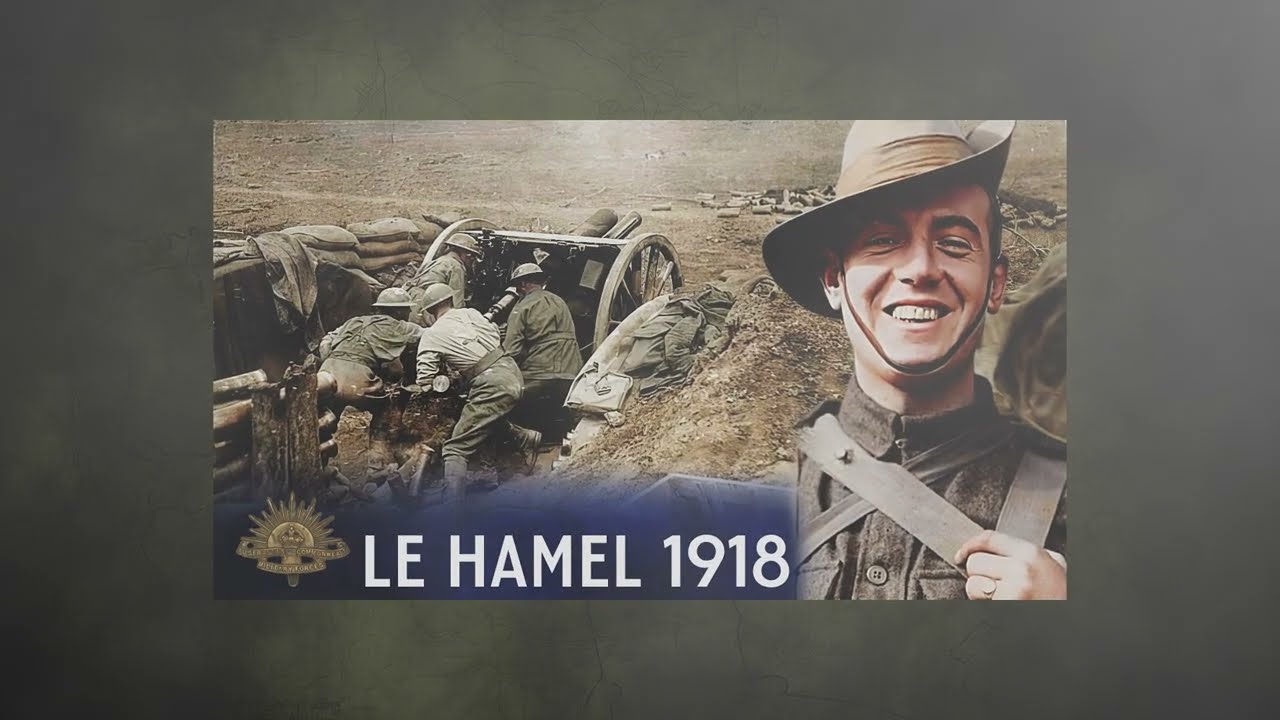
93 minutes is all it took. On the 4th of July 1918, outside the littleknown village of Le Aml on the Western Front, a groundbreaking attack was launched. For almost 4 years, the Western Front had been locked in stalemate with significant gains almost impossible to achieve. But on that day, Australian, American, and British troops would demonstrate a new way to fight.
In one morning, a blueprint would be laid. One which would demonstrate that trench warfare could be broken and that the war could be won on the battlefield. This is the story of Lit AL. To understand the importance of Liaml, we need to go back in time a little to 1917. Two major events had taken place in that year which would drastically change the outlook of the western front.
First, in Russia, a communist revolution had taken place, overthrowing the Zar, and eventually at great territorial cost, the Soviet government had come to peace terms with the Germans, bringing an end to fighting on the Eastern front. Secondly, in April, in part as a result of unrestricted submarine warfare, America had entered the war.
And whilst not immediately a threat, once her army and industrial might had been built up, she would spell the doom of Imperial Germany. But these two events did present an opportunity for the central powers. A short window of time existed during which the Americans were still raising their forces. But those German troops on the eastern front, close to a million of them, had no enemy in sight.
Now was the time to strike. Transferring the bulk of their manpower westwards and grouping their best troops into specialist assault formations known as stormtroopers. Germany planned to smash open the western front, driving the British and her allies northwards towards the Channel ports and the French southwards to defend Paris.
And so on the 21st of March 1918, the Germans had launched their famous spring offensive, an allout gamble to crush the British and French armies in the west before the unstoppable manpower of the US was brought to bear. That first assault had crashed through the British fifth army positions on the SO causing an unprecedented retreat which had only been stopped and with great loss of life outside the city of Amy.
In April, the Germans had tried again to destroy the hardpressed allies. So serious was the situation that the British commander Sir Douglas Hey, issued the following communicate to all troops. There is no other course open to us but to fight it out. Every position must be held to the last man. There can be no retirement.
With our backs to the wall and believing in the justice of our cause, each one of us must fight on to the end. The safety of our homes and freedom of mankind alike depend upon the conduct of each of us at this critical moment. Eventually that assault known as the battle of the lease was held but at huge cost.
Once more in May, the Germans attacked. Again, desperate fighting and again the enemy were held in part thanks to the sacrifice of Australian troops around the vital town of Via Bretonu. By the time the fighting finally petered out on the Som, the German army’s last chance to win the war on the Western Front had in all probability been lost.
But this didn’t mean that the war was over. Far from it. A bloody journey of many months fighting was still in store. And in some ways that journey could be said to start right here at Liaml. With the Germans still pressuring the French to the south around the river A, British commanderin-chief Sir Douglas Hey was asked to assist by launching local attacks against the enemy along his front.
Amongst those troops under his overall command and holding an approximately 17-mi long front on the southern flank of the British Expeditionary Force were the battleh hardardened and reliable Australians. Under the command of the charismatic and highly efficient Lieutenant General Sir John Mache, the Australians had already proved their metal on more than one occasion.
Since 1915, the Aussies have fought at Gallipoli, the Som, Bulacor, Msen, and Passandale. Now once more they were called on to take the fight to the enemy. Consulting with his divisional and brigade commanders on the 10th of June, Mish’s plan was to lead all his units on a broad front when the time for the big push came.
But in order to do that, he first needed to capture a prominent German salient around the small village of Liaml on the southern banks of the river Som. Let’s take a look. By overlaying this wartime trench map onto the satellite view, we can clearly identify the exact positions occupied by both Australian and German forces at this time.
The thick line marked in blue indicates the Allied front line in early July and those in red the enemy positions. Of note here, though, are the thinner lines running far into the German rear area, each of which was a further defensive position. We should make the point here that although for many the concept of thegreat war was that of continuous trench lines separated only by no man’s land by 1918 that idea had largely been abandoned by both sides with the concept of defense in depth being the order of the day. This in its simplest form saw
the battlefield broken down into three zones. First the forward zone. This was usually the old front line where groups of men formed outposts or strong points designed to slow the advancing enemy down and inflict losses, but not to hold indefinitely. Once this was bypassed, the attackers then reached the battle zone, an area which was much stronger defensively and where the main fight would take place and hopefully the enemy would be held.
Finally, if that was breached, the rear or reserve zone where counterattacking forces and artillery concentrations were held. In order to achieve success, both the forward and battle zones needed to be breached and held. Let’s see how this applies to Liam. As we see, this compact battlefield is bounded by the Som River Valley to the north and the Romanuilt Via Breton Rosier road to the south, a distance of some 5 km of frontage.
The German forward zone here is the front line with a particular strong point being this area known as pear trench and this area here known as kidney trench and then AML and Ve woods all of which had significant machine gun concentrations. Beyond the forward zone lay the village of Liam itself.
Let’s switch over to the drone. After making it through the rolling hills and woods of the German forward line, Lamel can be seen in the distance. approached today as it was in 1918 by flat open fields. The village can be seen in a slight hollow. Defenses here were strong and enemy fields of fire particularly potent. Unusually for the Great War, the ground here was not particularly churned up by shellfire, meaning that progress could be achieved, but the lack of shell holes meant little cover was available for attacking troops. As we approach closer, we see
beyond Liaml, the main German defensive line in the battle zone, dominating the entire area known as the Wolfsburg. This hilltop and the nearby Acroach Wood to its south would be the main Australian objectives in the fight to come. So, now we know what needs to be done. What about those men who would lead the advance? Mes had chosen Australian troops from across three different brigades in three different divisions to lead his assault.
To the north, the men of the 11th brigade of the third division under Brigadier General Cannon would lead the way. Whilst to their south, the highly regarded fourth brigade, consisting of three infantry battalions, including the legendary Australian Victoria Cross recipient Albert Jacker, would make the central advance.
And beyond them, the sixth brigade from the Australian state of Victoria would attack in the south. Let’s take a moment to understand a few commonly used terms in the Great War in reference to military units. what exactly they represent and how they interconnect in the military structure of the time. The most basic unit in the first world war was the section made up of usually 12 men and led by a corporal.
Four sections made up a platoon of around 50 men under the command of a left tenant or second left tenant with a sergeant assisting. Four platoon made up a company, officially 227 men, often commanded by a major or a captain. Those four companies, along with a machine gun section, battalion headquarters, and various specialist troops, made a battalion commanded by a lieutenant colonel.
It was on paper at least around 30 officers and a thousand men in all. For most of the war, four battalions formed a brigade commanded unsurprisingly by a brigadier general. Again, with various attached troops, it was about 4,000 men in total. Finally, three brigades usually made a division. commanded by a major general.
This consisted of a total of 12 infantry battalions, three field artillery brigades, two engineer field companies, one signal company, one divisional ammunition column, three field ambulances, and various additional specialist troops. All told, a complement of some 16 to 18,000 men. Added to this number were perhaps surprisingly a contingent of American troops brought into the area to gain experience from the battleh hardardened Aussies.
Mostly hailing from the state of Illinois. The men of the 131st and 132nd infantry regiments would be attached in platoon to a number of Australian units. They were unblooded but well-trained, physically fit, and ready for the fight. Completing MES’s attacking forces will be the new and highly effective Mark 5 tanks of the British Fifth Tank Brigade.
All told, some 7,000 men, 600 artillery pieces, 60 tanks, and numerous aircraft would be involved in the battle. Despite this impressive array of men, and firepower, we shouldn’t forget that in mid 1918, the Australians, still an all volunteer force, were exhausted and now suffering badly from a new menace on the WesternFront. the Spanish flu.
Those factors made the addition of the doughboys a truly welcome one. As Lieutenant Edgar Rule remembers, on the afternoon of the 2nd of July, a bunch of Yanks came up to be distributed among us for this fight. 12 were put in each platoon, and believe me, they were some men. This was the first time that they had been in the line, and they were dead eager.
And apart from that, it bucked up our lads. All the novelty of the war had long since vanished for our boys. They had seen too many shows like this, and as a rule, before such a fight, one now sees only set grim faces. But on this occasion, everyone was smiling or laughing. They were on their metals, and they were determined to let the Yanks see what the Aussies were capable of.
The Yanks were out for information, and our boys were very willing teachers. And it speaks well for the future to see one set so eager to learn and the other so willing to teach. On the other side of the wire, German forces were considerably less numerous, but still not to be overlooked. Intelligence are reported that some 2,780 men of the 13th and 43rd reserve divisions were manning the main forward and battle zones with a further 2,900 men held further back in reserve.
Further bolstering the defense were dozens of machine guns and artillery pieces, each wells sighted for maximum effect. That said, by this stage in the war, the Germans were exhausted too, squeezed ever tighter on the home front by British naval blockade. Russians had fallen significantly by this time, and many were suffering from malnutrition.
So, what about the plan? Having been part of the highly successful mass ridge attack under General Goff and being an innovator and meticulous planner, it’s no surprise that Me and his commanders looked to every conceivable detail. His intention was to split up his leading tank formation into three dedicated groups, each assigned a specific objective.
To the north, 15 tanks would lead the assault directly on Hamel Village, with the troops of 11th Brigade advancing in three waves. The first alongside the tanks, the second with a follow-up force to consolidate the captured ground and knock out any resistance points, and a third reserve wave to bring up supplies and strengthen positions once they had fallen.
The tanks themselves had even been given dedicated roles. Some would focus on crushing and clearing enemy wire. Some would act as a reserve to replace any knocked out tanks, and some would even go into action solely carrying supplies for infantry and other tanks. All designed to keep up the momentum of the attack. In the center, a further 12 tanks and infantry would attack the strongly defended pair trench position.
And to their south, a final group of 15 Mark 5s would head for Haml and Vewood with the sixth brigade in tow. All this would take place with even more innovative support. Firing ahead of the advancing troops, neutralizing enemy artillery batteries and strong points with a closely timed creeping barrage would be British and French heavy artillery, which crucially would not fire a preparatory bombardment, thus maintaining the element of surprise to the very last moment.
It had been decided to further aid the attack that one in every 10 artillery rounds fired would be a smoke shell, shielding the advancing troops from enemy vision. Even aircraft were to be employed, some spotting and correcting artillery fire, others strafing German positions, some solely dedicated to drown out the noise of the advancing tanks and others even employed to drop supplies to advancing tanks and infantry.
Keeping with the idea of innovation and to improve allarms cooperation on the ground, especially given the negative experience many Aussies had had with tanks in the fighting at Bulor, all troops were removed from the front lines before the assault, given opportunities to train together, learn to cooperate on the battlefield, and generally understand the role each other had to play.
To further aid this, a series of enormous scale models of the battlefield were created behind the lines in exquisite detail, which men had the chance to study, learn their specific roles and objectives, identify landmarks, and be fully prepared for the assault to come. Even camera crews were present to capture the scenes.
All of these features, which may seem like simple common sense today, were innovative for the time and would in reality lead to real success on the battlefield. In short, nothing was left a chance. Finally, training complete. The date and time of the attack was set for 3:10 a.m. on the 4th of July, 1918. The idea being that for the eastwards advancing troops, there would be sufficient light to see, but for the enemy facing west, the ground would still be bathed in darkness.
As men and tanks finally moved up to their start positions on the night of the 3rd of July, the tension grew with many of the old sweats reflecting on the battle to come. Edgar Rulerecalled the moment. What luck this time? Who would get it in the neck? Did the Hun know we were going to attack? Did he know the time? Was he waiting? What sort of barrage would he put down? Could we get beyond it before it fell? A few minutes later, and exactly on Q, a flash of light shot out across the battlefield as hundreds of guns roared into life. Captain Lionel Shaw was there
and remembered the moment years later. Everything was as still as death with the intermittent brilliance of the Huns flares. Every minute or so, Moss would say, “Shorty, what’s the time?” I would say, “Tend to 3 and so on.” The intense subdued excitement seemed to radiate through the air, and at 3:10 a.m.
, a leaping line of flame burst on the enemy trenches. The scene was enthralling and tremendous. The den was intolerable. You felt a great pity for the men underneath that fire yet knew it was your salvation. Beneath that same barrage, whistles blew and the Aussies of 12 battalions with their attached doughboys began to advance towards the mixture of shrapnel and smoke now inundating the enemy’s leading positions.
Impressed with the need of staying as close as possible to their friendly barrage, men advanced at speed, which inevitably resulted in some casualties, especially amongst the inexperienced Americans who advanced too far ahead of the methodically planned barrage. In the center of the line, the Aussie 15th battalion soon approached the enemy strong point at Pear Trench to come under heavy short-range fire from enemy machine guns protected behind uncut barbed wire.
With their allotted tanks, which had started four minutes behind the infantry, nowhere in sight, an A company taking the brunt of the fire, as so often happened in action, one man came to the four. Private Henry DL, a company transport driver who had volunteered to join the attack, armed only with a revolver, spotted an enemy machine gun through the smoke and single-handedly charged it, bolting the wire and capturing or killing the entire crew, despite losing his trigger finger to enemy gunfire.
His actions saved the lives of many of his mates who were pinned down nearby. Incredibly, despite twice being ordered to seek medical treatment, he would go on in the attack, repeatedly exposing himself to enemy fire by bringing up ammunition until he was hit in the head close to the final objective. Evacuated from the battlefield, he would survive his wounds and earned the Victoria Cross for his bravery.
This photo taken shortly after the award of his VC is fascinating as beneath his iconic slouch hat can be seen the bandage from the wounds he sustained that day at leamel with pear trench captured a key strong point was silenced but fire from another major position at nearby kidney trench was still taking its toll in a second episode of individual gallantry corporal Tom Axford in the 16th battalion stormed another machine gun throwing grenades as he ran Jumping into the position with a bayonet fixed, he too silenced his target, breaking the remaining defenders
who fled or surrendered. He would also earn the VC that day and live to see the end of the war. As the line pushed on, the leading Australians reached the front edge of Al and Vwood, where again the fighting became short range and bloody. With tanks unable to support in the thick undergrowth, it was down to infantry alone to force their way forwards with grenades and bayonets.
With incredibly heavy fighting, the Aussies pressed on, driving the enemy through the wood or down into their bunkers. At 4:49 a.m., a report reached Mach’s headquarters that Ve and Hamillwoods had been taken along with more than 400 German prisoners. For those attacking more open ground, the tanks were worth their waiting gold as they crushed barb wire, forced enemy from their trenches, and overran machine guns in an unstoppable advance towards Hamel village.
It was here on the 11th brigade front that troops first entered the now fiercely burning village. Working from house to house and cellar to cellar, the Aussies advanced, meeting bewildered enemy along the way. Many still wearing gas masks and unaware that the enemy were upon them. The men of the 43rd Battalion leading the attack through the village would later comment on the powerful effect of surprise and how it was vital to success with some German machine guns found still with the protective covers in place.
Within minutes of the attack commencing, Hamel had been entered and cleared of the enemy with a captain Moran climbing onto the roof of a ruined house to fire three green flares and raise the French trickle in triumph. Their job complete. The 43rd Battalion paused in Hel. The men of the 44th in the following wave pushed on through their ranks to climb the steep rise beyond the village to assault the formidable Wolfsburg.
With them were 12 tanks and importantly the artillery which mercilessly swept the ground ahead of them according to schedule. As the 44th crested the hillin a near perfectly orchestrated assault, the overwhelmed and demoralized enemy had little choice but to surrender or die. Edgar Rule was there and recalled the scene.
Out they came, two hands with a loaf of black bread in each, and presently a pair of terrified eyes took a glimpse at me. The Huns came out at once, and when I seized them up, all thoughts of revenge vanished. We could not kill children and these looked to be barely that. If any of us had been asked how old they were, most of us would have said between 14 and 15.
And that was giving them every day of their age. We knew that these babes hadn’t pulled the white flag on us. They were too terrified for that. And with the boot to help them along, they ran with their hands above their heads. Incredibly, by 5:13 a.m. when the barrage finally stopped, the Wolfsburg had been captured and was in the process of being consolidated.
Hamel and Vewood had fallen, and all along the front, the Aussies had captured their objectives. Even the notoriously unreliable tanks had performed flawlessly with only three of the 60 failing to reach their objectives. Their dedicated ammunition carriers had perhaps been the heroes of the day with more than 12,000 of supplies delivered directly to the heart of the fight.
A feat that months before would have taken more than 1,200 men to accomplish. These were particularly valued when several hours after the capture of the Wolfsburg, a determined German counterattack struck the Australian line. In bitter trench fighting at pointblank range, the Germans were eventually forced back by use of bayonets, grenades, and trench clubs, leaving behind many fallen in their attempt.
Even the relatively inexperienced Americans had performed well both in the assault and the subsequent counterattack in which Corporal Thomas Pope of Company E31st Infantry Regiment earned his nation’s first medal of honor in World War I for single-handedly rushing and silencing an enemy machine gun at the point of the Bayonet.
All told, the fighting at La Hamel, lasting a mere 93 minutes, only 3 minutes longer than Mish’s pre- battle prediction, was an astounding success, but not one without cost. In that morning’s attack, the Australians lost 1,200 men killed, wounded, or captured, and the Americans a further 176. The German army’s toll was some 2,000 men killed or wounded, and a further 1,600 taken prisoner.
an important loss they could ill afford. So, did the Battle of Hamel win the Great War? No, it didn’t. But with the exemplary use of new tactics, innovation, courage, and meticulous planning, it did perhaps show how it could be won. Of course, the story of the Australian Imperial Force on the Western Front would go on with many more bitter battles to come.
