Wednesday, January 10th, 1945. When the three Americans made a break for it, the MG42s lit up from the guard tower. Two were cut down almost instantly, but one paratrooper just kept running. Bullets snapped past his head. Dogs chased him to a cliff. And with no time to think, he jumped into a freezing river. When he crawled out the other side, he heard the most glorious sound on earth.
Sherman tanks. When he staggered onto the road, soaked, freezing, and half dead, there they were, an armored column of Shermans and T34s. But these weren’t American tanks. They were Soviet. The paratrooper pulled out a soggy pack of lucky strikes, lit one with numb fingers, and shouted the only Russian he knew, “Americansky Tvarish! American friend!” The lead tank screeched to a halt.
Its turret swung toward him. The hatch creaked open and outstepped a Soviet officer, a woman. Joe looked the stunning brunette in the eyes and said, “I want to kill Nazis.” This, my friends, is the unbelievable true story of jumping Joe Berley. [Music] glow of the morning. [Music] >> Joseph R. Berley was born on August 25th, 1923 in Muskegan, Michigan.
The second of seven kids in a tough bluecollar Catholic family. His dad worked the foundry. His mom ran the house. They spoke German at home, practiced the faith, and kept things tight. In high school, Joe was a four sport athlete, football, baseball, basketball, and track. Smart, fast, and hard as nails, he landed a baseball scholarship to Notre Dame.
But after Pearl Harbor, none of that mattered. He didn’t want to watch from the sidelines while others fought. So he turned down the scholarship, walked into a recruiting office, and said, “I want to jump out of planes. [Music] On September 17th, 1942, at just 19 years old, Joe Berley joined the United States Army.
After basic training, Joe was selected for one of America’s first airborne units, the 56th Parachute Infantry Regiment. Destination: Camp Takcoa, Georgia. Takcoa was hell by design. The men ran up and down Kurahhee, a steep three-mile hill, multiple times a week in full gear. They pushed through brutal marches, including a 162 mi trek completed in just 72 hours, a world record that still stands.
Berley kept pace every step. He joined eye company third battalion as a radio operator. Next stop, Fort Benning for jump school. That’s where Joe earned the nickname Jumping Joe. He was such an absolute badass that other soldiers paid him to make their jumps. And Joe took that money to buy cartons of Lucky Strikes, which he knew would be valuable currency in Europe.
After Benning, he went to demolition school, then headed to the UK to train with the Brits, where he earned British paratrooper wings and proved he could jump with the best of them on either side of the Atlantic. By early 1944, he’d volunteered for a secret mission, dropping into Nazi occupied France with a satchel of gold to fund the French resistance.
He did it twice, delivered the gold, and made it back. Before long, June arrived, and the invasion was coming. [Music] June 6th, 1944. D-Day. Joe Berley hooked into a C-47 and braced for hell. Before they reached the French coast, the flack started. Planes lit up, exploded midair, and spiraled into the dark.
His aircraft took hits, but stayed airborne, but began to stall. Joe jumped at just 400 ft. He crash landed on top of a church in Som Deong. Sliding off the roof and finding no friendlies in sight, he went solo and finished the mission himself. He located and blew up two vital electrical substations. In the morning, he spotted a German patrol.
He took them out with grenades and kept moving. But 20 hours in, crawling over a hedro, he came face to face with a German MG nest with 12 highly confused paratroopers. Outnumbered, he surrendered. The Germans hauled him to an HQ north of town. That’s where it got strange. A blonde woman joined the interrogation, naming guys from his unit, claimed she danced with them in Ramsbury.
Joe wasn’t falling for SCOPS and stuck to the basics: name, rank, serial number. Later, while marching toward Carantan with other PS, American artillery tore into the column, Berly caught some shrapnel, helped tourniquet two wounded GIs, flagged down a German patrol to save them, and slipped into the brush with two others.
They ran through the night, but within hours, Joe was alone again. By the next day, he was captured. Loaded onto a truck bound for St. Low, the convoy came under fire from American aircraft. Joe dove for cover and somehow came out unscathed. When they finally reached the city, it was already burning. He was thrown into a horse stable, his new prison.
That night, US bombers leveled Saint Low, flattened it. The stable and a nearby church were some of the only structures left standing. Joe survived, but his time as a prisoner had just begun. After St. Low, Berley was moved non-stop, first to a walled monastery outside Tessy Surmeare, nicknamed Starvation Hill. Food was scarce,sanitation worse.
He was soon pulled from the monastery and interrogated deep in France. The SS worked him 20 plus hours a day with the same questions. Why would a German American fight for Roosevelt? Was he Jewish, a traitor? When he called an officer a son of a he woke up days later in a hospital with his head caved in. After recovering, he was moved again.
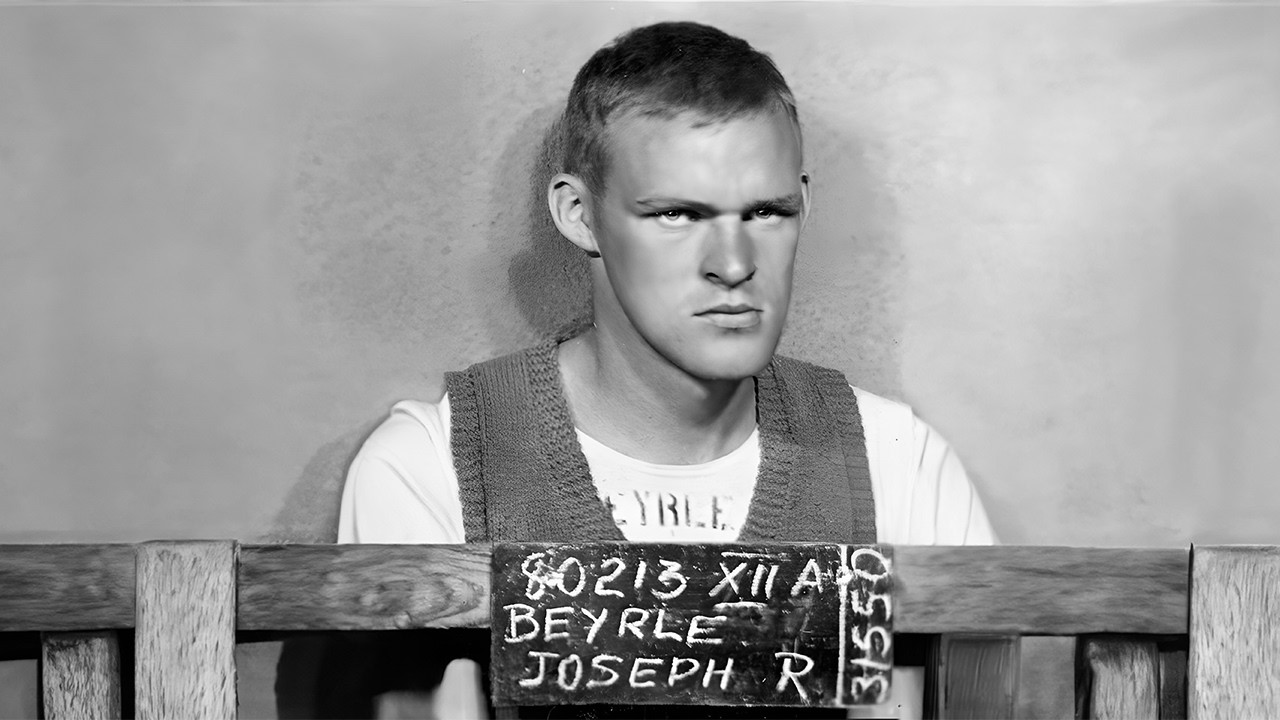
Alanson, then Chartre Paris, kept in a warehouse for 2 weeks with no food, water, or light. He was loaded into a box car, 80 men, jammed into a 40x 8 ft space for 7 days. On day two, Allied aircraft strafed the train. 10 men died and dozens were wounded. Finally, they arrived at Stalag 12A in Lindberg. After a 5mm march to the camp, Joe was processed, head shaved, given a cold shower, issued P tag 12A 80213.
A week later, Joe and other NCOs were moved again. Stalag 4B, then to Stalag 3C in Poland. 3C was rough. 10,000 Russian PS, including women, and now a few hundred Americans. The US NCOs’s organized fast escape teams, security units, supply networks. Joe worked both escape and security. When escape plans kept getting compromised, the Americans planted false intel and eventually caught the spy.
It was a German planted during the transfer. The PS held a court marshal. After 2 days of testimony, the verdict was guilty. They executed him, dismembered the body, and dumped it down the latrines. With the spy gone, security stabilized, and before long, Red Cross parcels occasionally got through. Canned meat and chocolate meant survival. Cigarettes were currency.
One night, Berley hit it big. He won 60 packs in a dice game. Enough to try something bold. [Music] Byerly had a plan and 60 cigarettes to make it happen. [Music] He and two other PS approached a German guard, offered 10 packs, five now, five later, just to look the other way. One cold, moonless night in November 1944, they cut through the wire and vanished into the dark.
About a mile out, they waited by a freight line. A train passed most nights around 10 p.m. When they heard steel on steel, they jumped aboard an open car, but the intel was bad. The train didn’t go east. It veered northwest, straight into Berlin. By dawn, they were stuck in the center of an active railard. Nowhere to run, nowhere to hide.
Bombers hit the city day and night. Then they spotted an older German man checking train wheels. Fireley approached carefully, told him they were escaped PS, offered cigarettes for food and help. The man agreed, brought bread, sausage, beer, and promised to return at dusk with a wagon. He did. They were taken to a house on the edge of the city, met by civilians.
Quiet, cold stairs. said they could help get them west, but something felt off. The next morning, boots, shouting, and gunfire. Gestapo, five plain clothes agents stormed the basement. Luggers drawn. The beatings were immediate. No questions, no interrogation, just pain. They were hung by the wrists, stomped, kicked, clubbed. Hitler.
>> When they passed out, the Gestapo started over. >> Then a miracle. German army officers stormed in, furious. The PS weren’t Gestapo property. They belonged to the Vermacht. After a screaming match, the Gestapo handed them over. Byerly and the others were sent to Stalog Luft 3, the camp made famous by the movie The Great Escape.
Joe was half dead, ribs cracked, face mangled, but alive. A week later, they dragged him back to Stalog 3C. 30 days in the box. A coffin-sized cell buried in snow with no heat, no insulation, just a ragged coat, a crust of black bread, and the kind of cold that makes your teeth crack. He survived by pacing. Staying awake and refusing to quit.
A week in, a Red Cross inspector from Geneva found him barely standing. He ordered Joe released, Berley limped out of the box, head high. And just like before, he started planning again. [Music] [Music] [Music] By January 1945, the Red Army was roaring through Poland, just 50 miles from Stalag 3C. Morale inside the camp surged. Hidden radios confirmed it.
Liberation was coming. But Joe Berley wasn’t waiting around to see if the Germans would flee or slaughter the prisoners. His second escape plan was Boulder. They staged a fake medical emergency. A prisoner faked a seizure. Joe and another P Brewer ran in with a stretcher, loaded him up, and convinced the guards they needed to reach the dispensary.
Schultz, the grumpy old ferret guard, waved them through. As they reached the second gate, chaos erupted behind them. Other PS staged a brawl. Diversion successful. They ditched the stretcher, sprinted into the woods, and jumped into a passing farm wagon loaded with three massive barrels used for hauling root vegetables. It made it past the final guard post until the wagon hit a rock and flipped.
The barrels shattered. They were exposed. Gunfire exploded from the tower. Two of the escapees were cut down instantly. Joe ran. He dove into a freezing river and hugged the muddy bank as German shepherds combed the area. The icy water masked his scent.For 3 days he moved only at night, hiding in hofts, barns, anything with four walls and a roof, and every day the artillery got closer.
The Red Army was nearly on top of him. On the third night, half starved and frozen, he passed out in a hoft. At dawn, he woke to the rumble of tanks and Russians shouting. He stumbled out to the road, lit a damp lucky strike with shaking hands, and yelled, “The only Russian he knew, Americans Tvaris, American friend.
” A hatch creaked open, outstepped a Soviet tank commander, Alexandra Grigory Samusenko, one of the few female officers in the Red Army. She was tough as nails, the only woman to command a tank battalion. And she wasn’t sure whether to shoot Joe or salute him. Joe didn’t flinch. I want to fight. I want to get to Berlin, and I want to kill Nazis.
Samosenko smirked. She huddled with her political officer, then handed Joe a PPSH41 and pointed west. Just like that, he was in. Joe Berley became the only American soldier known to fight for both the US Army and the Soviet Red Army in World War II. He spent the next several weeks riding in a Soviet Sherman tank four vehicles back from the front line, plowing through German roadblocks and ambushes as they advanced through Poland.
A few days in, they encountered a column of PS being marched out of Stalague 3C. A firefight broke out. Guards were killed. Tragically, so were some American prisoners caught in the crossfire. Samusenko, furious, ordered the column north to avoid further incidents with Allied PS. Eventually, they circled back to Joe’s old prison, Stalag 3C.
Some PS had refused to evacuate and were still hiding in the barracks. The Soviets took the camp with barely a fight. They brought Joe to the common office. Inside was a safe and a pile of US nitro starch explosives the Soviets didn’t know how to use. Joe did. He wired it up and blew the safe wide open.
The Russians grabbed watches, gold, and currency. Joe grabbed his P record, photo ID, and a satchel packed with invasion dollars, British pounds, and franks. He tied it to the back of the tank and kept moving west. Not long after the liberation of Stalic 3C, Ber Lee’s Soviet tank column continued pushing west, advancing day by day through pockets of German resistance.
One morning, as the tanks rolled out of a defensive position, a piercing sound tore through the sky. The high-pitched screech of Stooka dive bombers. Moments later, bombs began to fall. Berley dove for cover, but he wasn’t fast enough. He lost consciousness. When he woke up, a Soviet medic was crouched over him, working to remove shrapnel embedded in his upper thigh near the groin.
The pain was sharp and constant. There was no morphine. No one around him spoke English, but he was still alive. They moved him to a Soviet field hospital near the Polish border. He spent several days there, battling fever and infection. Weak and wounded, he tried to figure out what to do next. His plan was simple.
move west, find the front, and try to make contact with American forces somewhere in Poland or Czechoslovakia. Then one day, the mood in the hospital changed. The ward fell silent. Patients sat up. Officers snapped to attention. Marshall Guorgi Zhukov, commander of the entire Red Army, walked into the room. Zukov stopped at Berley’s bed.
Through a translator, he asked how Joe was feeling, where he had been wounded, and what unit he had served with. Joe answered every question. He told Jukov everything, how he parachuted into Normandy, how he had been captured, escaped twice, and ended up in a Soviet tank unit. Jukov listened carefully, gave a few quiet instructions to his aid, and left without another word.
2 days later, Joe was handed a letter written in Russian. It identified him as an American paratrooper and requested safe passage to the US embassy in Moscow. The Soviets placed him on a hospital train and sent him north. He passed through Wajj, then continued through the ruins of Warsaw. There, a Polish civilian helped him find a Catholic convent.
The nuns at the convent cleaned his wounds, gave him hot food, and helped him cross the Vistula River using a pontoon bridge. From there he made his way to Remberto, then boarded another train bound for Moscow. When he arrived at the edge of the city, a Soviet colonel met him at the station and personally escorted him into town by subway.
Together, they rode all the way to the US embassy located inside the National Hotel just off Red Square. Joe was finally back in American hands. They gave him clean clothes, a hot meal, and a cot to sleep on. But that night, a US Marine stood guard outside his room. When Joe asked why, the Marine replied bluntly, “Because you’re dead.” According to US Army records, Joseph R.
Byerly had been declared killed in action on June 10th, 1944, just 4 days after the D-Day landings. His parents had received the telegram. The War Department had filed the paperwork. A funeral mass had even been held in hishometown back in Michigan. to the US government. He no longer existed. Joe immediately requested to be fingerprinted and asked them to verify his identity with Fort Benning or Camp Takcoa.
Until that could be confirmed, he was confined to the hotel and treated with suspicion as if he might be a spy. Each night, the Marine Guard continued his post outside Joe’s room. Eventually, the embassy staff eased up. They believed he was telling the truth, but protocol still required official verification. Soon enough, the fingerprints came back.
The results confirmed it. Joe Berley was exactly who he claimed to be. On April 21st, 1945, Joe finally made it home to Michigan. 2 weeks later, he celebrated VE Day in Chicago. In 1946, he was married to Joanne Hollowell, coincidentally in the same church and by the same priest who had held his funeral mass two years earlier.
If you made it this far, thank you. Seriously, my goal here is simple. To preserve and share the stories of Americans like Joseph R. Irely, a man who jumped into Normandy, escaped two P camps, fought with the Soviets, and lived to tell the tale after being declared dead. These aren’t just war stories, they’re legacies.
And since the algorithm doesn’t always reward tales of American badasses, I’d be grateful if you shared this one, hit that like button, and dropped a comment below. Should Joe Berley be a household name? or maybe at least he certainly deserves more than just a footnote. Sources are linked in the description, including the full firstirhand interview that brought this story back to life.
Thanks for watching, and remember, not all ghosts are legends, but some legends come back from the dead.
